For years, the U.S. Navy’s electromagnetic railgun was treated as a symbol of futuristic warfare that never quite arrived.
The weapon promised to launch projectiles at hypersonic speeds using electricity instead of explosives, potentially hitting targets more than 100 miles away while dramatically lowering the cost per shot compared to modern missiles. Yet after more than a decade of research and roughly $500 million in investment, the program appeared to fade away in 2021 amid technical problems and shifting Pentagon priorities.
Now, the Navy’s controversial “supergun” is suddenly back in the spotlight.
A recently surfaced document outlining achievements by the Naval Surface Warfare Center (NSWC) indicates the U.S. Navy resumed live-fire railgun testing at New Mexico’s White Sands Missile Range (WSMR) during a classified evaluation campaign connected to hypersonic weapons research.
The War Zone has more on what could become one of the most remarkable military technology comebacks in decades:
The railgun had originally been installed at a land-based test site belonging to NSWC Dahlgren in Virginia. The Navy announced in 2019 that it had moved the weapon to the WSMR. Plans to conduct at-sea testing of the weapon were repeatedly delayed and never materialized.
TWZ has reached out to NAVSEA for more information about the three-day test campaign last year and its objectives, and to ask whether any other live-fire testing of the prototype railgun at WSMR has occurred since 2021. That year, the Navy had announced its intention to close out work on the railgun and effectively put what was left of the program into storage.
“Railgun hardware will be realigned to maximize its sustainability to facilitate potential future use,” the Navy had said at the time. However, there do not appear to have been any disclosures of further testing of the weapon before now.
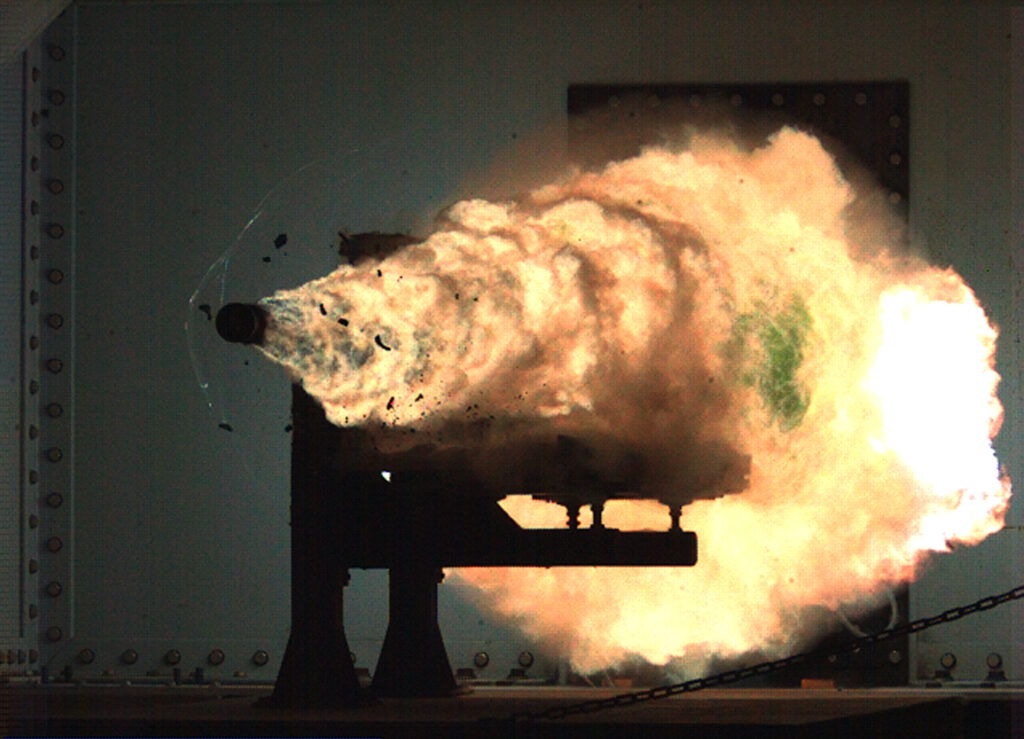
The video below shows the prototype railgun being fired at the test site in Virginia in 2016.
The renewed interest comes at a time when militaries around the world are searching for cheaper ways to counter drones, hypersonic threats, and mass missile attacks that can rapidly exhaust traditional interceptor inventories.
What Is the Navy’s Electromagnetic Railgun?
The Navy’s railgun is fundamentally different from conventional artillery.
Instead of using gunpowder or explosive propellants, the weapon uses powerful electromagnetic forces to accelerate a metal projectile along conductive rails at extreme velocities. The result is a projectile capable of traveling at speeds exceeding Mach 6 or 7.
Unlike traditional missiles, railgun projectiles contain no explosive warhead. They rely almost entirely on kinetic energy generated by their extraordinary speed.
Key Features of the Navy Railgun
| Capability | Estimated Performance |
|---|---|
| Projectile Speed | Mach 6-7 |
| Potential Range | Over 100 nautical miles |
| Launch Method | Electromagnetic acceleration |
| Ammunition Type | Solid metal projectile |
| Intended Targets | Ships, missiles, aircraft, land targets |
| Power Source | Massive electrical pulse systems |
The concept offered several major advantages in theory:
- Lower cost per shot compared to missiles
- Reduced need to store explosive ammunition aboard ships
- Faster projectile velocities
- Potentially deeper ammunition reserves during combat
- Long-range precision strike capability
At its peak, the Navy envisioned deploying railguns aboard advanced warships such as the futuristic Zumwalt-class destroyer.
Why the Navy Is Suddenly Testing Railguns Again
Electromagnetic railguns hold the potential to help the U.S. military manage missile losses and expenses by offering a high-velocity, low-cost alternative to traditional interceptor missiles, particularly in defending against large-scale, lower-cost drone and missile swarms.
Projectiles (like the Hypervelocity Projectile) are estimated to cost around $25,000 to $85,000 per round, compared to $1-$15 million for traditional interceptor missiles. This enables sustainable defense against “saturation attacks” without exhausting stockpiles.
However, the immense energy generated during launch creates extraordinary heat, pressure, and electromagnetic stress inside the barrel. As projectiles accelerated to hypersonic velocities approaching, the conductive rails and internal barrel surfaces degraded rapidly.
The damage is so severe that components often wear out after only a few dozen shots, making the system impractical for sustained combat operations.
Could Railguns Eventually Preserve America’s Missile Inventory?
Despite those setbacks, defense planners continue to see strategic potential in electromagnetic weapons.
If the engineering challenges surrounding barrel life and power consumption can eventually be solved, railguns could provide a more sustainable and cost-effective method of preserving the U.S. military’s limited inventory of traditional missiles.
That concern has become increasingly important in an era defined by:
- Mass drone warfare
- Expensive interceptor missiles
- Long-range precision strike competition
- Growing concerns about munitions stockpiles in prolonged conflicts
A New Mission?
In the meantime, renewed testing suggests the railgun’s future role may be evolving beyond its original purpose as a ship-mounted superweapon.
Rather than serving solely as a future shipboard cannon, the railgun may now function as:
- A hypersonic testing platform
- A materials research tool
- A high-speed projectile laboratory
- A sensor validation system
This distinction is important.
Even if operational railguns never appear aboard frontline destroyers, the technology could still provide significant value to the Pentagon’s broader hypersonic weapons and advanced defense research programs.
READ NEXT: Biden White House Ganged Up With Leftist Group To Wage Lawfare Against Major Gunmaker