

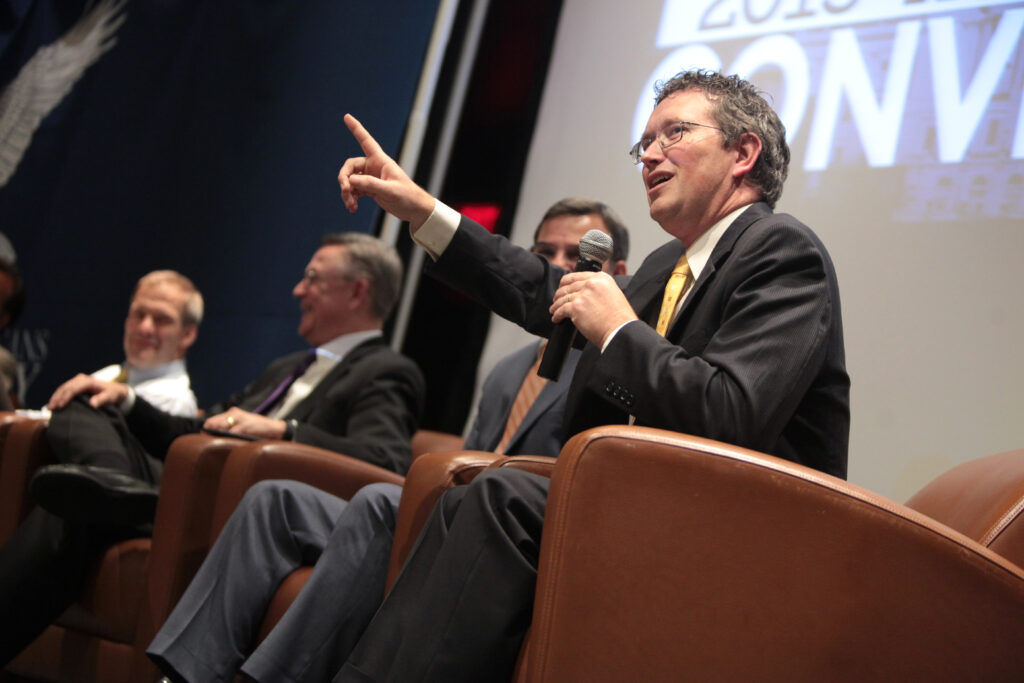
This endorsement is the next in my series of recommendations to Howard Lutnick, Donald J. Trump Jr., and the Trump transition team. Previously, I put forward Ken Paxton for Attorney General and Scott Jennings for Press Secretary—now, I turn my attention to Thomas Massie as the ideal choice for Department of Agriculture secretary.
As the dust of the 2024 election begins to settle, the groundwork is being laid for a Trump administration that aims to dismantle bureaucratic bloat, empower American farmers and promote true agricultural innovation. Amid this transition, Rep. Thomas Massie (R-Ky.) has been eyed to serve as secretary of agriculture. It is a move both prescient and bold, one that will not merely shake up the Department of Agriculture (USDA) but will invigorate the spirit of American self-reliance.
To truly understand why Massie is the right pick, we need to recognize his unique history and contributions. Massie, hailing from Kentucky, is not merely a beltway insider with a penchant for policy papers—he’s a farmer himself. His small farm in northeastern Kentucky is an embodiment of what agriculturalists call “hands-on innovation.” With a background in engineering, Massie turned his land into a practical experiment, raising cattle, producing honey and even establishing an off-the-grid residence that underscores his commitment to sustainable living. Unlike many of his predecessors, who viewed the agriculture secretary role through the lens of spreadsheets and Washington protocols, Massie lives the agricultural life every day. His firsthand understanding of the challenges faced by America’s rural heartland makes him uniquely qualified to bring substantive changes to the USDA, an institution plagued by inefficiency and favoritism.
Massie’s independent streak in Congress has often placed him at odds with both his own party and the Democrats. And yet, this “contrarian” approach is exactly what the Department of Agriculture needs to disrupt the longstanding marriage between bureaucratic inertia and crony corporatism. Massie has been vocal about his opposition to monopolistic agribusiness, arguing instead for policies that favor family farms and decentralized food production—a position that resonates deeply with Trump’s base and with American producers everywhere. Massie’s advocacy for raw milk legalization, support for local meat processors, and his staunch critique of over-regulation within agriculture have earned him a reputation as a champion of the independent farmer.
Notably, Massie authored the PRIME Act, which sought to give states greater control over meat inspection, allowing farmers to sell locally without the cumbersome federal rules that often stifle small businesses. This type of common-sense reform is sorely needed at the USDA, which for too long has catered to multinational conglomerates at the expense of smaller producers. If appointed, Massie could finally be the force that balances the scales, ensuring that policies benefit real farmers, not just the agribusiness lobbyists that roam K Street.
It’s important to remember that this is not Massie’s first brush with agricultural policy—he’s been actively involved in such issues since his election to Congress. His work with libertarian icons like Ron Paul, and more recently, his collaboration with Robert Kennedy Jr., has demonstrated his capacity to bring diverse coalitions together in support of agricultural freedom. Whether it’s the Amish, who wish to maintain their traditional farming practices without government interference, or urban parents seeking better access to nutritious food, Massie has positioned himself as an ally to those who want healthier, less regulated food options. His nuanced understanding of both the science and the cultural aspects of food production makes him an ideal fit to lead the USDA into a new era focused on liberty and sustainability.
Critics may argue that placing a congressman with such a strong ideological bent at the helm of the USDA is risky, especially given the tenuous balance of power in the House of Representatives. It’s true that Massie’s departure from the House could mean the difference between a slim Republican majority and a tied chamber. However, the benefits far outweigh the risks. The Fourth Congressional District of Kentucky, which Massie has represented since 2012, is a Republican stronghold—handily won by GOP candidates for two decades. While a special election would be required to fill his seat, there’s little doubt that the district would remain in Republican hands. The margin in the House is significant enough that the GOP can afford this move, especially when considering the long-term gains to be reaped by having someone with Massie’s expertise guiding agricultural policy.
Moreover, Massie’s unorthodox approach could fundamentally alter how the USDA interacts with both consumers and producers. His engineering background, coupled with his on-the-ground experience as a farmer, gives him a perspective few bureaucrats could even comprehend. Massie is a technologist at heart—he graduated from MIT with a degree in engineering and has an impressive record of inventing and patenting tech innovations. Bringing this kind of mindset to the Department of Agriculture could modernize practices, streamline regulatory compliance, and deploy technology that allows farmers to produce more with fewer resources. Imagine a USDA that actively collaborates with local farmers to create a blockchain-based system for food traceability, or one that incentivizes the use of renewable energy sources in farming operations—these are the kind of innovative leaps we can expect from Massie.
Some have called Joel Salatin, an icon in the sustainable farming movement, a “lunatic” for his unconventional views on agriculture. But Salatin’s support of Massie speaks volumes. Salatin’s methods—focused on holistic, regenerative agriculture—are precisely the direction that America’s farming sector should consider if it wants to remain sustainable and resilient. By placing Massie at the helm, we create an opportunity for the USDA to shift from an archaic, centralized command structure to one that respects the diversity of American farming practices and encourages innovation at every level.
President Trump has always thrived on big ideas—restructuring the USDA to better serve independent farmers is another such idea. Massie’s appointment would mark a decisive break from the past, where agricultural policy was written by and for agribusiness oligarchs. Instead, it would focus on the people who actually grow our food, the consumers who demand healthy choices, and the small entrepreneurs looking to make a living without drowning in federal red tape. This is a department in desperate need of a little healthy disruption, and Thomas Massie is just the person to do it.
Sponsored by the John Milton Freedom Foundation, a nonprofit dedicated to helping independent journalists overcome formidable challenges in today’s media landscape and bring crucial stories to you.
READ NEXT: The Trump Team Is Signaling A MAJOR Strategy Shake-Up















Stop poaching all the talent from the House!
I like all three of your recommends including press secretary, although there’s a number of people that could fill that role well. What I don’t agree with in any shape or form is depreciating the unique opportunity of bicameral control. Nothing is worth that much. No individual is worth that risk at this point. in time as time goes and Trump’s policies begin to work then the risk taking can again now is not the time. The fact that the only impediment to our progress as a party now would have been not having control of both the senate and the house. We cannot relinquish that at any cost right now. That’s my opinion.
Trump is going to eliminate the Republican majority if he keeps picking members of the House and Senate.