The Federal Reserve is facing criticism after appointing Xbox CEO Asha Sharma to a newly created advisory task force just days after Microsoft announced thousands of layoffs while continuing to hire foreign workers through the H-1B visa program.
Sharma, who leads Microsoft’s Xbox division, was named Thursday to the Federal Reserve’s new “Productivity and Jobs” task force alongside venture capitalist Marc Andreessen, co-founder of Andreessen Horowitz, and Stanford University economist Charles I. Jones.
The appointment comes amid growing scrutiny of Microsoft’s workforce decisions after the company confirmed it would eliminate approximately 4,800 jobs worldwide, including roughly 1,600 positions within its gaming division.
Layoffs Fuel Visa Debate
The timing of Sharma’s appointment immediately drew attention because Microsoft’s layoffs have coincided with the company’s continued participation in the H-1B visa program.
According to U.S. Citizenship and Immigration Services (USCIS) data cited by critics, Microsoft was approved earlier this year to hire 2,273 H-1B workers.
The juxtaposition has fueled renewed debate over whether American technology companies should be permitted to recruit large numbers of foreign workers while simultaneously reducing their domestic workforce.
Microsoft has rejected the suggestion that visa holders are replacing laid-off American employees, and added that H-1B employees were also affected by the workforce reductions.
Federal Reserve Announces New Task Forces
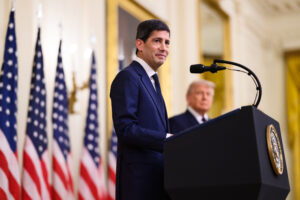
Sharma’s appointment is part of newly installed Federal Reserve Chairman Kevin Warsh’s broader initiative, who announced several advisory groups intended to examine how the central bank approaches key areas of economic policy.
“The Federal Reserve’s commitment to price stability and maximum employment is unwavering,” Warsh said in a statement announcing the appointments.
“As is our resolve to pursue our mandate with rigor.”
Warsh said each task force would evaluate whether the Fed’s analytical tools and policymaking methods could be improved.
“I am honored that the best minds from a range of disciplines have agreed to work with us to sharpen our performance as an institution,” he said.
Sharma’s panel will focus specifically on productivity and employment issues.
Online Critics Question Appointment
The announcement quickly generated backlash online, where many critics questioned why an executive overseeing large-scale layoffs would be selected to advise policymakers on jobs.
“It’s like asking El Chapo to lead the DEA,” one social media user wrote.
Another argued the appointment appeared to reward companies that reduce American employment while expanding foreign hiring.
Others questioned Sharma’s qualifications for advising the Federal Reserve, pointing out that her career has been in technology and business rather than economics or monetary policy.
Some criticism also took a more personal turn, with a handful of commenters juxtaposing Sharma’s Indian heritage with Microsoft’s use of H-1B visas.
Neither the Federal Reserve nor Xbox responded publicly to the criticism following the announcement.
H-1B Program Under Increased Scrutiny
The controversy comes as the Trump administration has intensified its focus on potential abuses within the H-1B visa system.
Earlier this week, Vice President JD Vance announced that the Department of Labor had launched dozens of investigations into alleged H-1B fraud.
“Today, I’m proud to announce that the federal Department of Labor has started dozens of subpoenas and investigations into foreign fraudsters who are trying to take advantage of the H-1B visa program,” Vance said during a press conference in Milwaukee.
“American jobs ought to go to American workers and not foreign fraudsters, and the Department of Labor is fighting back against it.”
The administration has repeatedly argued that the visa program should supplement—not replace—the domestic workforce.
The controversy surrounding Sharma’s appointment reflects a broader national debate over technology companies, immigration policy, and the future of the American workforce.
Supporters of the H-1B program argue it helps employers recruit specialized talent that may be difficult to find domestically, particularly in technical fields. Critics counter that some companies have used the program to reduce labor costs while displacing American workers.
READ NEXT: Trump Formally Announces Federal Reserve Chair Replacement