




Via National Defense Magazine by Scott R. Gourley
While the war in Ukraine has put a spotlight on so-called kamikaze drones and the need to protect smaller military vehicles from skyborne threats, the scourge of roadside bombs and mines has not gone away.
Both system and crew survivability have always been critical elements in the design and fielding of tactical wheeled vehicles, and those criteria were readjusted in the 2007-2008 timeframe as U.S. forces encountered battlefield threats of improvised explosive devices and rocket-propelled grenades capable of providing lethal vehicle side and underbody effects.
Those threats have continued to evolve over nearly two decades, presenting vehicle designers with new survivability challenges.
While roadside bombs and IEDs are no longer making headlines, protecting small tactical wheeled vehicles is still very much at the forefront of the manufacturers’ designs.
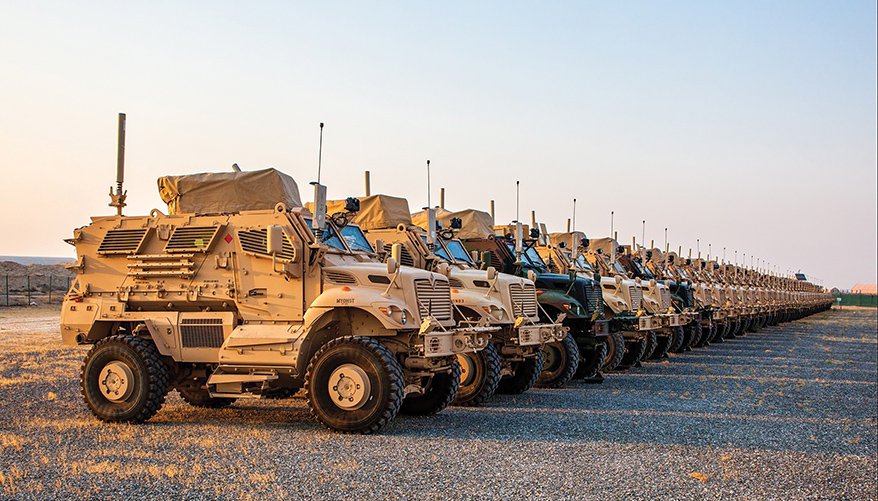
According to Pat Williams, chief programs officer for M-ATV manufacturer Oshkosh Defense, the underbody mine and IED threats encountered in Iraq and Afghanistan put an emphasis on vehicular survivability “in a way we weren’t used to thinking about.”
“If you think about how our design philosophy has gone on tactical wheeled vehicles from then until now, it’s very much rooted in the lessons we learned during those operations, both in Iraq and Afghanistan, in terms of the design maturity, the architecture of the vehicle and the understanding of the threats and the impacts on the vehicles,” Williams said.
Williams outlined a vehicular protection continuum stretching back to the early days of U.S. involvement in Iraq and Afghanistan, describing that period as “the days of the MRAPs, the great big, heavy, highly armored, very safe vehicles.”
“However, they had mobility issues just because they were so heavy,” he said.
Afghanistan required something with the level of protection of those large vehicles, but at half the size and with the offroad mobility for the rugged trails there. The solution was the M-ATV, he said.
Years on, the military turned to the Joint Light Tactical Vehicle, which offered a similar level of survivability but much higher mobility in a package that’s almost half the size of an M-ATV.
“Migrating first to the great big, heavy, very safe vehicles, then to a very much lighter, highly mobile vehicle with comparable protection is just one example of what we learned over time, just by looking at different architectures, looking at all those different pieces, synthetic materials, composite materials, different approaches to survivability, as opposed to just picking a ‘World War I philosophy’ great big, thick, heavy, slow tank that was very safe compared to what we have today, which are very mobile, very lightweight vehicles,” he said.
Phil Wiegand, vice president of engineering at military vehicle manufacturer ND Defense, said: “Survivability is always one of the most important requirements that occurs early with any new vehicle.”
Those survivability and crew safety requirements are at the forefront of new vehicle development activities.
“We see that there’s really no give and take on those crew and occupant protection requirements. They are what they are, and they are based on those lessons learned from Afghanistan and Iraq,” he said.
Referencing ND Defense’s MaxxPro MRAP, Wiegand said the company “is proud of how quickly the company was able to field what we consider, and I think what the Army considered, one of their most survivable MRAP vehicles. We’re proud of that heritage. And I think there’s still relevance with what’s going on in Ukraine, where you see videos of our MaxxPro vehicle still performing against the threats of today.”
Williams said that today’s vehicles reflect a maturation of processes that incorporate a significant amount of advanced modeling and simulation tools that allow design engineers to input different types of threats or chemistries.
Many of these advanced tools such as digital twins and advanced simulations that can advance protections for vehicles have only come to the forefront in recent years.
IEDs “all behave differently and have different impacts on the vehicle,” he said. “And with that modeling and simulation capability, we can adjust or tweak our designs.
Asked to elaborate on the different IED explosive effects, Williams said homemade explosive behaves differently than TNT, which behaves differently than plastic explosive due to different blast characteristics.
Advanced modeling and simulations allow engineers to look at all the variations, from where the explosion might take place — such as under or on the side of the target — to what kind of explosives are used and even the type of soil underneath the vehicle, he said.
“There are all these different variables that we can then model,” he added.
The Pentagon and the defense industry have done “a really good job of staying abreast of new types of munitions and their impacts,” Williams said. “If it’s a certain type of munition, it may have a slow, different performing blast than another type, which may be a higher speed, higher intensity blast. So, we’ve been able to model that and come up with an understanding of the impacts. And that allows us to determine the architecture of the vehicle. We can also look at different synthetic and composite materials instead of just relying on heavy steel.”
Another company that acknowledges work with new materials is GM Defense, which has spent internal research and development funding to test different materials, including steel, aluminum and steel or aluminum composite materials for the purpose of hardening vehicles “to complement the rigorous and extensive crash and other hazard testing we already perform in both virtual and physical environments,” said Michael Reynolds, survivability integration lead for the company.
“We continue to look at different, novel materials for use in our defense vehicles and will conduct testing should there be external funding to do so in the future,” he said.
Williams highlighted the importance of digital engineering in enhancing vehicle survivability.
“We talk a lot about digital engineering now, and the way that you want to design something in a digital space,” he said. “You don’t have to go through all the process of build, test, build, blow it up and build it again. You can model and simulate a lot of that just based on the dynamics of the different threats. That also cuts design lead time and saves money as well, because you don’t have to build it, blow it up, redesign it, build it and blow it up again.”
He added: “From a survivability perspective, we look at it as a system of systems approach. So, you have to consider a lot of different design features. You look at standoff distance from the blast, the hull or underbody geometry, the different armor recipes, the steel or aluminum or ceramics or composites … along with blast attenuating elements such as seats and mats.”
Both Williams and Wiegand pointed to examples of successful programs that enhanced vehicle survivability through the application of add-on armor and other vehicular modifications.
Williams said: “When you think back to Iraq and Afghanistan, what we originally started doing was applying applique armor or up-armoring some of the heavy and medium vehicles that had been designed without armor in the calculus. And certainly with the Humvees as well — they were not our vehicle, but the same concept applied.”
Shifting to the M-ATV, he continued, “We designed a certain level of protection, but the bad guys had a vote, and they started coming with different munitions. So, we developed — through some of the approaches I just mentioned — an upgraded Underbody Protection Kit, an applique kit to be applied for a greater threat level.”
Wiegand offered the example of the MaxxPro Survivability Upgrade, which includes features like a stiffer hull, ripple floors and redesigned bracketry to better capture components in the event of a blast and prevent them from becoming projectiles in the cab.
“The enhanced V-hull design and the upgraded suspension kit also gave us a little bit more distance from the threat,” he said. “So, raising the whole crew capsule up away from the threat plays a large part, and stiffness of that whole crew capsule was pretty paramount in improving the performance and blast protection.”
Vehicle designers, he said, learned many lessons through testing and developing the survivability upgrade and fielding the kits.
“And that really honed our engineering expertise to be able to use modeling and simulation as an upfront tool, to be able to predict the response of new vehicles and how they respond to the threats that are still relevant, so we can do a better job predicting and optimizing our future design for new cabs,” he said.
Another aspect of the future vision balances increased survivability against service calls for greater fuel efficiency.
Wiegand said: “We’re looking at ways to maybe not burden your vehicle with the full armor complement, because right now it seems like both the Army and the Marine Corps are focused on what they call demand reduction, or fuel economy.”
Adding weight to a vehicle has a negative effect for fuel economy performance.
“How do you provide a truck that can be armored to meet the threats when it’s fielded but maintain that optimal fuel economy when you’re not in a threat environment?” he said. “So yeah, I would say we’re playing around with ways to do that now.” ND
Read in its entirety at nationaldefensemagazine.org.
READ NEXT: Dems Scramble To Block Key GOP Election – Corrupt Tactics Revealed!
















Had IED issue in Iraq & Afganistan