





President Donald Trump’s latest social media post has sent shockwaves through the political world, igniting a fierce debate over executive power.
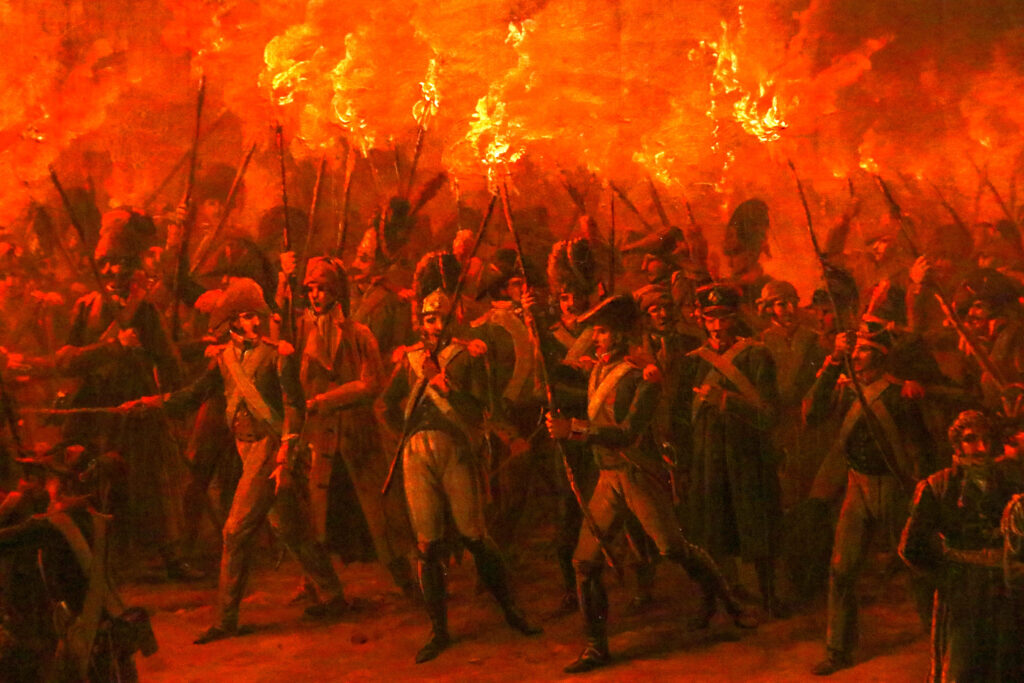
On Saturday, Trump shared a quote attributed to Napoleon Bonaparte: “He who saves his Country does not violate any Law.” The post immediately triggered a furor of speculation, with many interpreting it as a signal that Trump sees expansive executive action as justified—especially as legal challenges mount against some of his policies.
The quote also has an unexpected link. It’s not just attributed to Napoleon—it was also featured in the 1970 film Waterloo, a Russian-funded epic about the famous battle. The movie starred Rod Steiger as Napoleon, Christopher Plummer as the Duke of Wellington and featured a staggering 16,000 Red Army extras to recreate the battlefield scenes.
Critics—including from the libertarian right—wasted no time in sounding the alarm, claiming the statement promotes executive overreach and undermines the rule of law. They argue that such a mindset could set a dangerous precedent, allowing a president to bypass legal limits in the name of perceived national interests.
This is some un-American monarchical nonsense. The president is above *some* laws, because there are things legally only he may do. But his entire office remains a creature of law. https://t.co/R5DYOk6xPn
— Dan McLaughlin (@baseballcrank) February 15, 2025
This is actually a profoundly disturbing sentiment: https://t.co/82WNY79x5v
— Brad Polumbo 🇺🇸⚽️ (@brad_polumbo) February 15, 2025
Trump’s most ardent supporters, however, see it differently. To them, the message is clear: decisive leadership is sometimes necessary to protect the nation, even when the political establishment pushes back. With America facing unprecedented challenges, many conservatives believe Trump is simply reinforcing his commitment to putting the country first, no matter the obstacles.
I’m confused why you think that is a defense of such a disturbing sentiment? And could you ask yourself honestly, how would you have felt if President Kamala Harris said the same thing?
— Brad Polumbo 🇺🇸⚽️ (@brad_polumbo) February 15, 2025
The official White House account on X actively shared the message, amplifying its significance.
— The White House (@WhiteHouse) February 15, 2025
Mediaite’s Phillip Nieto provides further context:
The phrase reportedly originates from the the 1970 Napoleon film starring Rod Steiger called Waterloo where Napoleon Bonaparte is seen justifying his dictatorship
🚨🚨🚨Trump just quoted the 1970 Napoleon film starring Rod Steiger. The context is Napoleon justifying dictatorship. 🚨🚨
— Matthew Sheffield (@mattsheffield) February 15, 2025
Here's the movie context
'To my dear Prince Alexis… I did not "usurp" the crown. I found it, in the gutter, and I, I picked it up with my sword, and it… https://t.co/u3UM1eEpr3
The movie line is based on an actual quote from Napoleon:
— Matthew Sheffield (@mattsheffield) February 15, 2025
"Celui qui sauve sa patrie ne viole aucune loi."
From the book "Virilités, maximes et pensées" compiled by Jules Bertaut, in 1912
What do you think? Is the quote much ado about nothing or is it a rhetorical bridge too far? Tell us your thoughts in the comments below!
READ NEXT: Trump’s Constitutional Power Play Is Desperately Needed – Here’s Why




















He is not saving our country he is out. to destroy it.
The president is above *some* laws, because there are things legally only he may do. But his entire office remains a creature of law.
Actually, the office of the President is a creation of the Constitution, just as the Congress is a creation of the Constitution.
As such, it is subject to the Constitution alone, not to legislation.
Actually, the function of the Executive Branch, as the name says, is to execute the laws passed by Congress, and must be done within whatever constraints are written into those laws, as long as those constraints are not themselves unconstitutional. If Congress passes a law that is unconstitutional, it is the president’s obligation to veto it. If the veto is overridden, or if the unconstitutional legislation was signed into law by a previous president, it is the president’s duty to refuse to enforce it. So the president IS subject to legislation to a limited extent under our system of checks and balances. Thanks for your comment, though, which is basically correct. This reply is not to dispute it, but to clarify it.
He sure scares the hell out of the lefties, it seems…good!. By the way, the Democrat left follows the Socialist playbook, which worked perfectly for the Soviet Communist system. Perfectly for a dictatorship and a one-party system with no input from the people, and government control over everything…plus a completely dominant central government. Kamala is about as close to a Marxist as anyone who was a heartbeat away from the White House. Oh, yeah…and no white reporters welcome…trans people excepted.
That a dictator used a phrase to bolster his dictatorship does not mean that another who uses the same words uses them for the same purpose with the same goal. Brad Pulombo, above, puts the matter into perspective.
First thing is that it is a historical quote of Napoleon NOT a quote from the movie. What is being referred to is a mystery to many today, a concept called honor. Honor is a subject and concept that many in todays world are confused and clueless about. I am a Military Combat Veteran and I took and lived my oath the the Constitution, that oath is still active today as my enlistment had a termination point but the oath as taken has none. Even at 71 years my honor and my oath to the Constitution controls and governs my decisions and actions, it is supposed to be the same way for every one who takes a similar oath to the US Constitution. In pre 1840 America willful and conscious violation of ones oath to the Constitution was a capital crime (so was violation of the public trust) and if convicted of that crime execution was a possibility, that result vanished out of our statutes about same time dueling was made a crime, I think it still should be the result for an oath breaker. I have early American, Constitutional, and Military History as an avocation (BA 1979), my vocation is Engineering, I am a retired Skunkworks polymath Aero Engineer (Dual MEs in Electrical and Mechanical/Structural Engineering 1998). I examine and research History as I do for engineering issues IE fact vs the opinion of someone else, opinions cannot help but be biased. I state this because understanding what our framers meant and intended something to mean is primary in keeping and cleaving to ones oath to the Constitution, following the lead and declarations of anyone else is moronic.
I look at people based on actions not words. Honor is proven by actions not words.
I hate this quote. First of all, Napoleon made himself and all his family members emperors and tried to take over all of Europe so that is a horrible role model. Secondly, we are fighting against Biden’s lawfare and the unlawful acts. Why would trump want to make it seem like he can do the same thing?
As an avid Trump supporter who busted his butt to get him elected last year, I cheer the decisive actions that President Trump has taken so far. They are all within the law, though the complete abolition of the Dept. of Education will require an act of Congress, which should be forthcoming. That said, Napoleon Bonaparte was a dictator, whose methods should never be adopted by any constitutionally elected U.S. president. That quote, however, could have been used (but to my knowledge wasn’t) by President Abraham Lincoln to justify his suspension of habeas corpus and other unconstitutional measure he took to save the American republic. My point is, the decisive actions taken by any American president, including Trump, must be (and can be) within the framework of our Constitution and laws. The restoration of our Constitution and the rule of law is the right thing to do, but it must be done in the right way.