

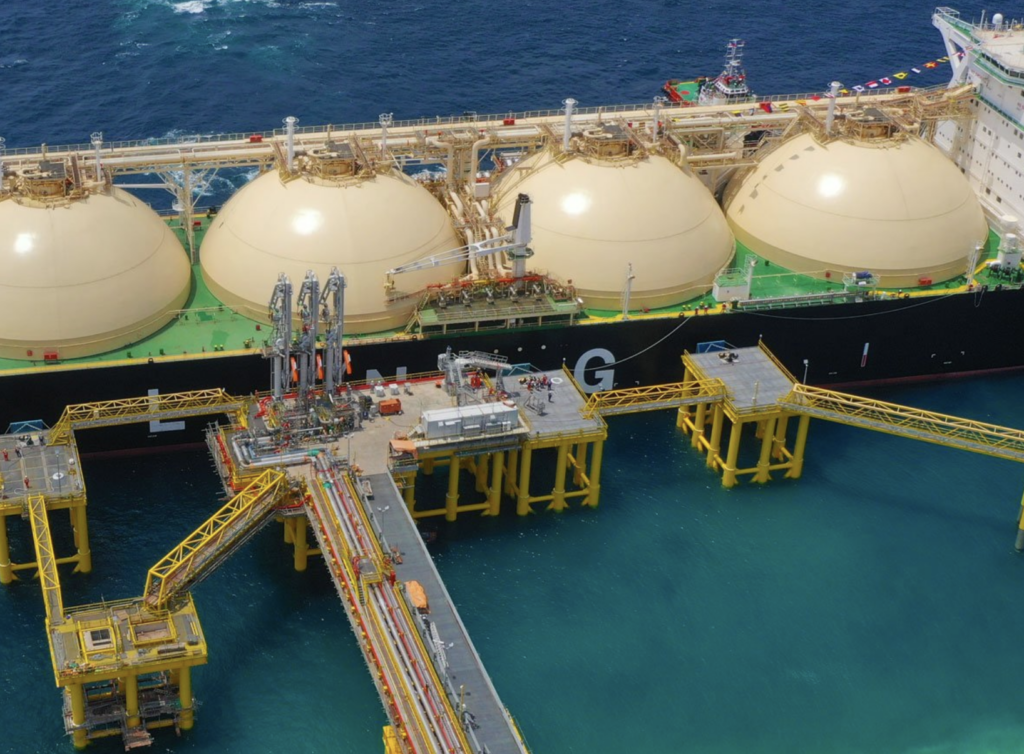
President Donald Trump has returned to the White House with a clear mandate: restore American energy dominance. Yet, barely two months into his second term, his administration faces a critical decision that will test that commitment. The U.S. Export-Import (ExIm) Bank is set to vote on whether to approve a nearly $5 billion loan to a French energy conglomerate, TotalEnergies, to exploit liquefied natural gas (LNG) reserves in Mozambique. This is not Trump’s deal—it is a leftover from the Biden administration’s disastrous energy policies. But now, it is up to Trump’s team to decide whether to let Biden’s misguided initiative proceed or to shut it down in the name of American economic and energy security.
The very existence of this deal is a testament to the contradictions and failures of Biden’s energy policy. Before leaving office, Biden and his bureaucrats worked to throttle U.S. LNG production in the name of climate activism while simultaneously backing foreign competitors with American taxpayer money. The ExIm Bank’s proposed loan would empower a foreign company to flood the global market with LNG, directly competing with U.S. energy exports and undermining domestic production projects like the Alaska LNG initiative. If approved, this deal will put American workers at a disadvantage, limit future U.S. LNG contracts and hand billions to foreign interests—all while Biden himself is no longer in power to answer for it.
Fortunately, Trump has the opportunity to stop this madness. His first term was defined by a relentless push to make the U.S. energy independent, slashing regulations, expanding oil and gas production and turning America into the world’s leading LNG exporter. The question now is whether his administration will act decisively to halt this last remnant of Biden’s America-last energy strategy or whether it will allow bureaucratic inertia to push the deal forward.
Biden’s LNG pause, enacted in early 2024, was a political gift to radical environmental activists. Under the guise of conducting an environmental review, his administration put U.S. projects on ice while continuing to greenlight foreign LNG developments. Though a federal judge eventually overturned the pause in July 2024, the damage had already been done: America’s LNG industry lost critical time securing long-term supply contracts, while competitors like TotalEnergies positioned themselves to dominate the market.
The Mozambique project exemplifies everything wrong with Biden’s approach. The proposed site is located in a region plagued by insurgent violence, where TotalEnergies had previously suspended operations due to security threats. It would be one thing if this investment were supporting an American-led effort, but it is not—this is a French project, operated by a European corporation, with American taxpayers being forced to foot the bill. Worse, the LNG produced in Mozambique will be directly competing for the same Asian markets that the U.S. has been working to supply through the Alaska LNG initiative and Gulf Coast terminals.
Trump’s administration must now weigh its options carefully. The ExIm Bank’s role is to promote American exports and support American jobs—not to subsidize foreign businesses at the expense of domestic industry. By rejecting Biden’s $5 billion giveaway, Trump’s team would send a strong message that America is no longer in the business of funding its own competition. This would be a natural extension of the “America First” doctrine that Trump championed in his first term, a doctrine that helped transform the U.S. into an energy superpower.
Key voices in the industry, including former Energy Secretary Rick Perry, have already condemned the proposed ExIm Bank deal. Perry compared it to Texas A&M handing a check to the University of Texas to improve their football program—a move so counterproductive that it borders on absurdity. He’s right. Why should America subsidize a foreign competitor when we have the resources, expertise, and infrastructure to be the dominant player in global LNG markets?
The economic consequences of allowing this deal to proceed are dire. LNG projects are massive job creators, supporting workers in Texas, Louisiana, Pennsylvania, Ohio and beyond. The supply chains that fuel these projects span the entire country, from steel manufacturers to port operators to high-tech engineering firms. Every dollar diverted to a foreign competitor is a dollar taken out of the pockets of American workers and businesses. If Trump is serious about prioritizing U.S. economic growth, blocking this deal should be an easy decision.
There is still time to act. The ExIm Bank vote has not yet been cast, and Trump’s administration can intervene to prevent it. His energy team—led by a new wave of appointees determined to undo Biden’s mistakes—should move swiftly to ensure that American taxpayers are not forced to underwrite foreign energy dominance. If Biden wanted this deal so badly, he should have funded it himself. Now that he’s gone, there is no reason for Trump’s administration to honor a policy that actively harms the country.
Republicans in Congress should also apply pressure to ensure this deal does not move forward. Hearings, legislative maneuvers and public advocacy can help shine a spotlight on this absurd giveaway. Trump, who campaigned on revitalizing the American energy sector, should make it crystal clear that this loan has no place in his administration’s agenda.
The ExIm Bank’s upcoming vote is not just about one loan—it is about whether Trump’s second term will fully repudiate Biden’s economic and energy policies. Allowing this deal to proceed would be a slap in the face to American energy producers and a gift to our foreign competitors. The choice is clear: Trump must kill Biden’s $5 billion LNG giveaway, protect American jobs and reassert U.S. dominance in global energy markets. Anything less would be a failure to uphold the very principles that put him back in the White House.
Sponsored by the John Milton Freedom Foundation, a nonprofit dedicated to helping independent journalists overcome formidable challenges in today’s media landscape and bring crucial stories to you.
READ NEXT: Supreme Court To Decide On Trump’s Push To Redefine KEY Legal Principle



















On reading this I immediately wondered why the Export-Import Bank is financing a French company with an African project?
Ex-Im Bank, as the article tells, is to facilitate American export and import ventures to the benefit of Americans. so why is the USA doing this? Aside from Trump’s obvious pending denial, why was it proposed in the first place?
I speculate that an incentive might have been provided to individuals in the chain of approval. Was the “Big Guy” being rewarded?