






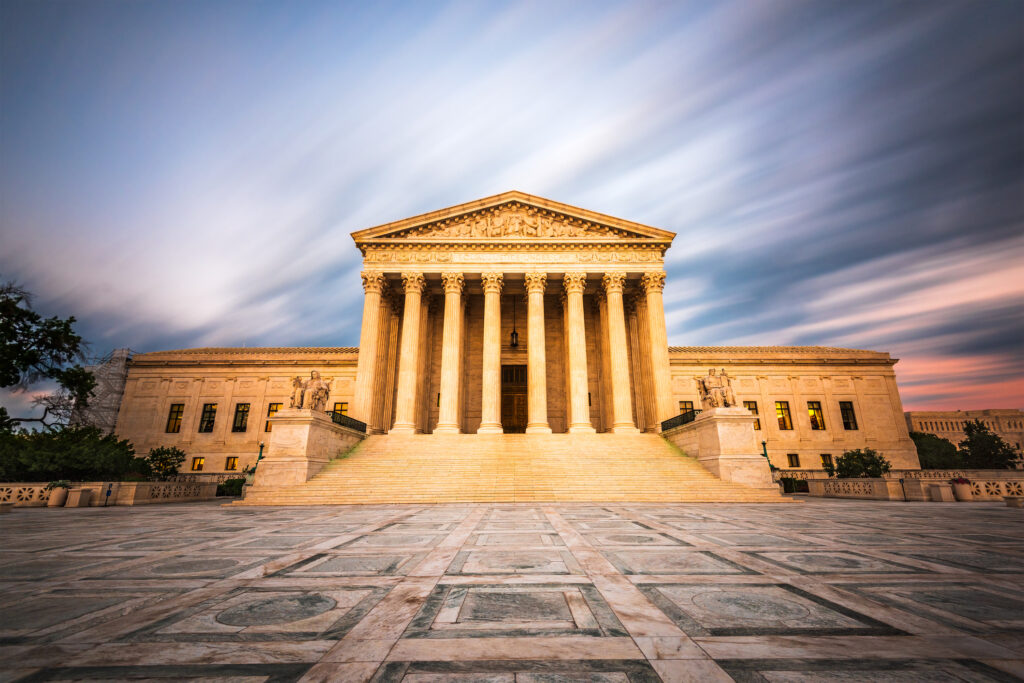
The Acting Solicitor General has formally advised Congress of the administration’s intent to petition the Supreme Court for a review of Humphrey’s Executor v. United States (1935), with the goal of its complete repudiation. That decision, long regarded as an architectural pillar of the modern administrative state, rests on premises that are not only doctrinally indefensible, but textually and structurally at odds with the Constitution. It is a ruling born of exigency, not principle, and one that continues to corrode the very idea of democratic accountability. President Trump, having been elected with an unmistakable mandate to dismantle the bureaucratic inertia that stifles self-government, cannot fulfill that mandate while hamstrung by a phalanx of unaccountable, statutorily insulated actors. To restore the integrity of the executive branch, Humphrey’s Executor must be overturned.
The Constitution’s Article II is not an invitation to creative interpretation. “The executive Power shall be vested in a President of the United States of America.” This phrase is not a polite suggestion or a vague grant of managerial oversight. It is a definitive allocation of power, singular, indivisible, and plenary within its domain. Humphrey’s Executor, however, introduced a gerrymandered view of executive power, imagining a distinction between “quasi-legislative” and “quasi-judicial” functions, and in so doing, placed certain executive officials beyond the reach of the President’s removal authority. This legal fiction fractured the accountability chain that the Framers saw as essential.
The consequences were immediate and enduring. By immunizing independent regulatory commissioners from at-will removal, the decision created a bifurcated executive, one in which certain agencies, though wielding the coercive power of the state, operate without direct presidential control. That is not executive power in any intelligible sense, but rather its negation. As Justice Scalia once remarked, there is no such thing as “quasi-legislative” or “quasi-judicial” power, just legislative, judicial, and executive power, each vested in a separate branch. The idea that executive enforcement can occur without executive accountability is a conceptual error that would have bewildered the Framers.
This is not a merely academic defect. The modern administrative state, emboldened by Humphrey’s Executor, has grown into a Leviathan, a term not used lightly. It writes rules, enforces them, and adjudicates their breach. It fines and bans and censors. It does so often with little regard for electoral input and in a fashion that has proven disproportionately aligned with the ideological leanings of the permanent bureaucracy. The Federal Trade Commission, the very agency at the center of Humphrey’s Executor, is a case in point. It imposes fines, demands compliance, and initiates enforcement actions with major economic and political consequences, all while being shielded from presidential oversight. In what world can such conduct be described as anything but executive? And if it is executive, it must answer to the President.
The Court has already signaled discomfort with this untenable arrangement. In Seila Law LLC v. Consumer Financial Protection Bureau (2020), the Court invalidated statutory tenure protections for the Director of the CFPB, holding that such insulation violates the unitary executive principle. Chief Justice Roberts, writing for the majority, reaffirmed that the President must be able to control those who wield executive power. Likewise, in Free Enterprise Fund v. PCAOB (2010), the Court rejected multi-layered protections that effectively created entire bureaucratic strata immune to presidential oversight. Each case has been a slow but steady dismantling of the scaffolding that Humphrey’s Executor erected. The final blow is overdue.
Objections persist. Some defenders of independent agencies argue that political neutrality and institutional continuity justify restrictions on presidential removal. This view is superficially appealing but ultimately misguided. Accountability, not continuity, is the lifeblood of republican government. If neutrality and stability were paramount, we would dispense with elections altogether. The notion that a technocratic elite can govern more effectively than elected officials is a recurring temptation in democratic societies, and one that must be rigorously resisted. Expertise is no substitute for consent.
The question then becomes not whether Humphrey’s Executor should be overruled, but when. There is now a momentous alignment of legal doctrine, political will, and historical necessity. President Trump, having appointed a substantial portion of the federal judiciary and having staffed his administration with reformers dedicated to executive accountability, has both the means and the motive. The Solicitor General’s action is more than procedural. It is the reassertion of a constitutional truth long denied.
To overrule Humphrey’s Executor is not to aggrandize presidential power. It is to return it to its constitutional moorings. The President cannot faithfully execute the laws if he cannot control those who execute them. This is not an abstract separation-of-powers concern. It has immediate and practical consequences. Consider the administration’s deregulatory agenda. Agencies like the SEC, NLRB, and FTC have in recent years pursued ideologically charged campaigns against industries and organizations that do not align with progressive priorities. That pattern is not coincidental. It is the result of bureaucratic autonomy unconstrained by electoral legitimacy. Allowing the President to remove commissioners at will would check these excesses, restore balance, and ensure the policies enacted reflect the preferences of the people, not the whims of career functionaries.
Moreover, overruling Humphrey’s Executor would simplify governance. Presently, presidents must contend with a fragmented apparatus, a byzantine maze of power centers operating in semi-independence. This fragmentation invites legal ambiguity, institutional turf wars, and inconsistent policy implementation. A unitary executive would clarify lines of authority, enabling swifter and more coherent action. It would also invigorate political responsibility. When power is diffuse, no one is accountable. When power is consolidated in the President, voters know whom to reward or punish. That is how democracy works.
None of this implies that executive power is unlimited. The President remains subject to law, to Congress’s appropriations power, and to judicial review. But those checks do not require internal fragmentation. They exist outside the executive, as external restraints. The danger of Humphrey’s Executor is that it grafts constraint into the heart of the executive itself, subverting its functionality and distorting constitutional design.
The Trump administration’s legal challenge, then, is not a power grab. It is a course correction. It seeks to undo a judicial error that has endured far too long and caused untold mischief. It recognizes that the unitary executive is not a conservative theory or a novel innovation. It is the Constitution.
The Court has an opportunity to restore that understanding. It should take it.
Sponsored by the John Milton Freedom Foundation, a nonprofit dedicated to helping independent journalists overcome formidable challenges in today’s media landscape and bring crucial stories to you.
READ NEXT: Almost Mythical Aircraft Touted As US Response To China’s Breakthroughs























4:30 AM on April 12, 1861!
These leftist judges are a disgrace to what is supposedly a unbiased judicial system they all should be removed from ever presiding over any legal matter.
Amuse, your grasp of both the law and its historical raison d’etre, its (de)evolution, and its Constitutional foundations is refreshing! I am always enlightened and encouraged that there are still opportunities to course-correct. Thank you! Please keep up the wonderful, insightful work!
“That is how democracy works.” No! That is how our Republic is supposed to work.