






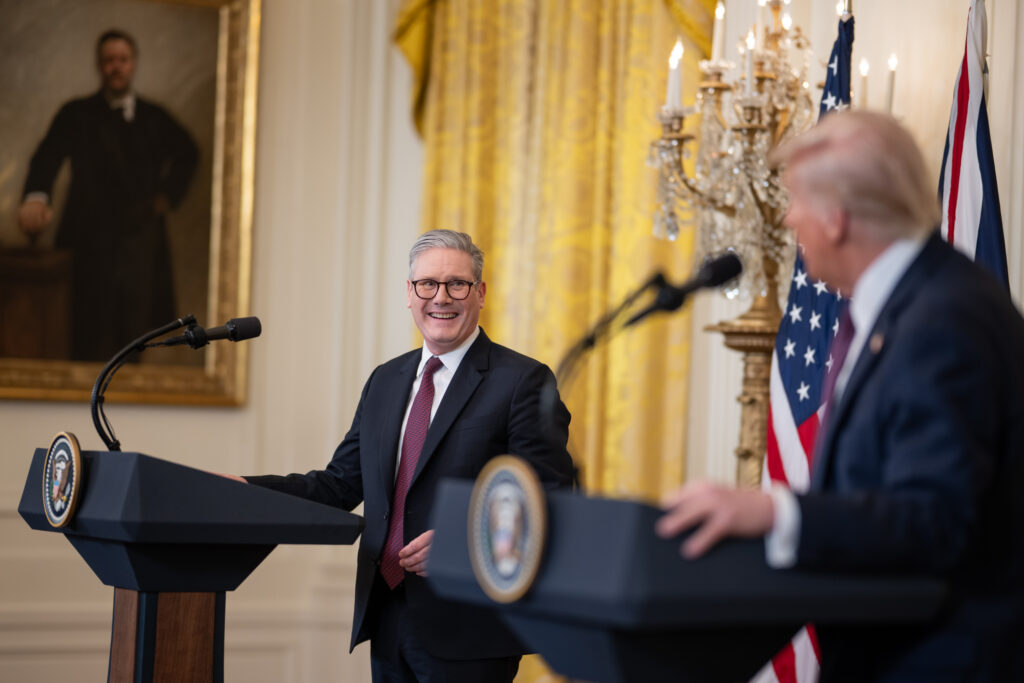
The Special Relationship, much like the Atlantic Ocean that separates yet connects us, has always depended on tides: political, cultural, economic. In times of war, we were allies. In times of peace, we were trading partners. And in times of confusion, we were reminders to one another of the virtues of liberal democracy, limited government, and the rule of law. With the announcement of the U.S.-U.K. Economic Prosperity Deal (EPD), President Donald J. Trump and Prime Minister Sir Keir Starmer have jointly undertaken to anchor that relationship in a deeper economic foundation, one aimed at fairer trade, reciprocal benefit and, above all, national sovereignty.
What makes this agreement novel is not merely its scale, but its premise: that trade must serve the citizen, not the technocrat; that regulations must respect national interest, not dissolve it and that economic partnership must be rooted in parity, not dependency. This is neither the sterile globalism of a bureaucratic Brussels nor the neo-mercantilist tit-for-tat of Beijing. Rather, it is a recognition, long overdue, that our nations do best when our people do well.
Consider tariffs. They are the skeletal frame of modern trade, shaping what can move and at what cost. Under the EPD, both nations commit to significant mutual reductions. The United Kingdom will eliminate its 20 percent tariff on U.S. beef and expand the quota from a meager 1,000 metric tons to a generous 13,000. In exchange, the United States will reallocate 13,000 metric tons from its own beef quota and extend a preferential duty-free quota of 1.4 billion liters for U.S. ethanol. The logic is simple: if British consumers want American goods, and American producers are ready to provide them, governments ought to stand aside, not stand in the way.
But what about cars, steel and pharmaceuticals? These are not mere goods. They are strategic sectors. The EPD acknowledges this by embedding economic security provisions into trade architecture. U.K. vehicle exports, for example, will be granted a quota of 100,000 units at a 10 percent tariff. In turn, the United Kingdom has agreed to meet U.S. standards on steel and aluminum supply chain security. If these conditions are met, the United States will grant quotas at most-favored-nation rates. Even pharmaceuticals are not exempt. While the U.S. has launched a Section 232 investigation on the national security implications of pharmaceutical sourcing, the EPD creates a framework for preferential treatment contingent upon U.K. compliance with security criteria.
One might object: Is this not simply managed trade dressed up as free trade? That objection would be well taken, were it not for the philosophical core animating the agreement: sovereignty through cooperation, not surrender. The aim is not to entangle but to empower. The EPD seeks to disarm the bureaucratic thicket of “non-tariff barriers,” the hidden tariffs of the modern age, and replace them with clear, fair standards.
Sanitary and phytosanitary (SPS) standards, long a thorn in transatlantic trade, will now be harmonized where possible, with an eye toward science-based criteria. Mutual Recognition Agreements will be expanded, enabling conformity assessment bodies in each country to be treated equally. Standards will be reviewed together, and where international standards exist, each side will deliberate whether the other’s standards development organizations meet them. This is not deregulation, but rationalization.
Digital trade, the lifeblood of modern commerce, is likewise addressed with sophistication. The EPD commits both nations to paperless trade protocols, digital customs clearance and harmonized rules for services, including financial services. These provisions are neither ornamental nor trivial. They strike at the heart of what trade has become: not merely an exchange of goods, but of data, algorithms and digital processes. In this sense, the EPD may be as much a treaty on information sovereignty as on goods.
Economic security is not a footnote but a focal point. Both countries will coordinate investment security policies, export controls and procurement standards. The EPD explicitly reaffirms commitments under the World Trade Organization’s Government Procurement Agreement, while allowing the U.K. to wield its new National Security Unit for Procurement, an institutional mechanism unthinkable under EU law but essential in an age of strategic decoupling.
This is not to say the agreement is a panacea. It does not abolish tariffs entirely, nor does it guarantee frictionless trade. It is aspirational in some areas, conditional in others and cautious throughout. But it reflects a coherent philosophical stance: that trade, to be legitimate, must be fair; that cooperation, to be enduring, must be reciprocal and that prosperity, to be shared, must be built on the integrity of national decision-making.
Here, then, is a conservative blueprint for trade policy: one that rejects both the flattening effect of transnational technocracy and the stifling paranoia of economic isolationism. It is Burkean, not utopian. It aims not to perfect but to preserve, to reform without destroying, to balance tradition with adaptation.
In sum, the U.S.-U.K. Economic Prosperity Deal may well be the most philosophically coherent trade initiative in recent memory. It is conservative in method, classical in its conception of sovereignty and modern in its scope. Whether it succeeds will depend not on paper commitments but on political will, administrative competence and the fortitude to enforce its principles. But if it does succeed, it will have done something rare: it will have made free trade compatible again with free nations.
The Atlantic, always broad, has just become a little narrower.
Sponsored by the John Milton Freedom Foundation, a nonprofit dedicated to helping independent journalists overcome formidable challenges in today’s media landscape and bring crucial stories to you.
READ NEXT: Former Supreme Court Justice Appointed By GOP Dies




















…… ethics becomes Governance.