





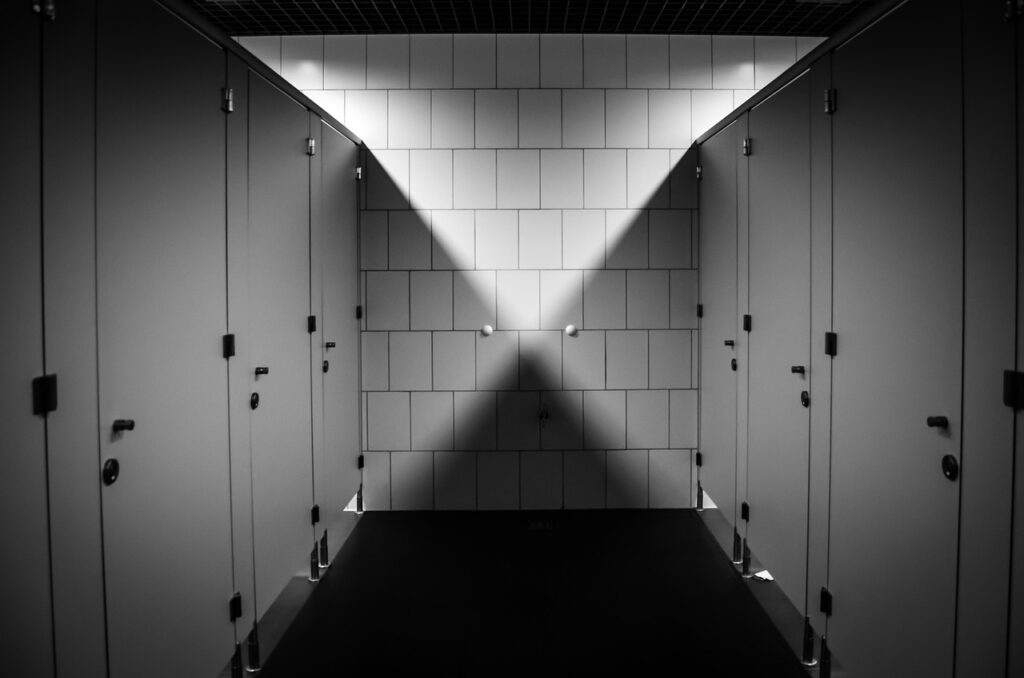
In a just society, it is tempting to assume that all public resources should be freely accessible. Indeed, the logic of equity, equal access regardless of means, holds a powerful intuitive appeal. But as the history of public toilets in the United States demonstrates, good intentions do not always lead to good outcomes. In the case of pay toilets, the pursuit of fairness inadvertently produced a worse result: not just fewer choices, but fewer toilets altogether. This story is not merely about sanitation. It is about a fundamental misunderstanding of incentives, public goods, and the role of markets in civil life.
Let us begin with a simple observation. Public restrooms have become increasingly rare in American cities. Travelers wander for blocks in search of one, only to be rebuffed by locked doors, purchase requirements, or handwritten signs that say “restroom for customers only.” The scarcity is especially striking in cities such as New York, where dense populations would seem to demand accessible public sanitation. The irony, as Planet Money’s Erika Beras recounts, is that America once had thousands of pay toilets and free public bathrooms alike. But both have largely disappeared. What happened?
The answer lies in a crusade against inequality that achieved its formal goals but undermined its practical ones. In the 1970s, two teenage brothers, Michael and Ira Gessel, launched the Committee to End Pay Toilets in America (CEPTIA). Their argument was moral: access to a toilet, a basic human need, should not be contingent upon the ability to pay a dime. The cause struck a chord during an era already attuned to civil rights and gender equity. Men often had access to free urinals, while women faced locked stalls requiring coins. Politicians, seizing the populist optics, took up the banner. California Assemblywoman March Fong Eu became a national figure when she shattered a chained toilet with a sledgehammer on the steps of the state capitol. The symbolism was irresistible. Equity had a face, a toilet had fallen, and legislation soon followed.
Within a decade, most states had banned pay toilets outright. The policy was clear: public restrooms could exist, but they must be free. What was not clear, however, was who would pay to maintain them. Here lies the crux of the matter. In the zeal to remove the fee, reformers also removed the incentive. The market mechanism that had supported both access and upkeep vanished. And as economist John Cochrane points out, this was a textbook case of a price control. When the price is set to zero, demand rises but supply falls. The result is scarcity. Equity, when defined as the removal of payment, led not to universal access but to universal deficiency.
Nik-O-Lok, the leading manufacturer of toilet locks, predicted this very outcome when they opposed the ban. Without the ability to charge, they argued, public and private entities would find little reason to install or maintain facilities. Their prediction came true. In the absence of fees, cities could not offset the costs of cleaning, maintenance, and policing. Toilets became overrun, not just by those in need, but by those abusing the spaces for drugs, sex, or vandalism. Businesses, now unable to recoup costs through access control, simply locked their restrooms or tore them out entirely. The toilets were gone. So, too, were the expectations of decency that once came with them.
The unintended consequence of toilet equity was thus the elimination of a tiered but functional system in favor of a flat and dysfunctional one. Previously, there were options. A dime granted access to a clean, managed space. Free public options existed alongside them, albeit with fewer amenities. After the ban, only two options remained: the locked private toilet or the neglected and often unusable public one. Eventually, even the latter vanished in many places. The binary of “pay or hold it” became “there is no toilet at all.”
At this juncture, we must address an objection. Does the moral indignation against pay toilets not still carry weight? Should not access to basic human needs be a right, not a commodity? These are reasonable sentiments, but they overlook the essential difference between rights and resources. A right is a moral claim, often secured by law. A resource is a physical good that must be provided, maintained, and funded. Conflating the two leads to policy that sounds virtuous but performs poorly.
Consider the analogy of housing. Declaring housing a right does not conjure homes into existence. Builders, landlords, and tenants operate within an ecosystem of incentives. Price controls, such as rent caps, often lead to housing shortages, disrepair, or black markets. The story of public toilets is no different. When the price of sanitation was set to zero by fiat, the providers of that sanitation vanished. The result was not dignity, but degradation.
This is not to say that all market solutions are appropriate. A wholly privatized approach to public restrooms can easily become exclusionary or predatory. But the history recounted by Planet Money suggests that a blend of public provisioning and modest fees could have preserved both access and accountability. Indeed, in some countries, pay toilets coexist with public subsidies to ensure both cleanliness and availability. In the United States, however, the absolutism of equity politics won out. And in doing so, it eliminated the very infrastructure it hoped to democratize.
Moreover, the failure was not just economic but civic. The disappearance of public toilets contributed to the erosion of shared spaces in American cities. Public infrastructure depends on shared responsibility. When no one owns the problem, the problem persists. The locked door becomes not just a barrier to relief, but a symbol of societal neglect. In refusing to treat sanitation as either a market good or a public obligation, the United States chose a path of institutional ambiguity. Predictably, the result was institutional failure.
There is, however, a path forward. New York City, which banned pay toilets in the 1970s, carved out an exception in 2006. A handful of high-tech, self-cleaning toilets were installed with a fee of 25 cents. But even here, inertia and bureaucratic delay have limited their spread. As of today, most remain in storage. The private sector, too, has tiptoed around the problem, offering restrooms in retail locations but only to paying customers. This is not generosity, it is circumstantial commerce. You buy coffee, you pee. If not, move along.
What the American experience reveals is not that toilets should be free or paid, but that they must be maintained, and maintenance requires funding and incentives. If cities want public toilets, they must either fund them directly with tax revenue, subsidize access through partnerships, or permit modest fees to ensure self-sustaining upkeep. What they cannot do is continue pretending that moral outrage will replace pipes, paper, and plumbing.
We are left, then, with a lesson that extends far beyond sanitation. Equity without economics is a fantasy. The desire to make all things free, if not coupled with a plan to fund and manage them, leads to the disappearance of those things altogether. Justice must not only be proclaimed, it must be provisioned. And provisioning, in a world of limited resources, requires the cold math of incentives, not just the warm glow of idealism.
Sponsored by the John Milton Freedom Foundation, a nonprofit dedicated to helping independent journalists overcome formidable challenges in today’s media landscape and bring crucial stories to you.
READ NEXT: Policy Change Follows Legal Pressure From Constitutional Watchdogs




















If this is equity then the word has been bastardized
I’m a Boomer. When was a kid all the major department stores had very fancy bathrooms and you paid 10 cents to go to the bathroom and usually people would double up like my sister and I would go into one stall at one time for a dime
Every gas station in the world had free public restrooms and most of them were open all the time and you didn’t need a key. And they were clean
And I agree it’s ridiculous that public sanitation was left to private business and private business said no thanks we don’t want transience we don’t want non customers coming in and using our facilities for free so if you want to use them you’ve got to buy something
and guess what? A $5 cup of coffee is a lot more than a dime
And in the end, no pun intended, the public is left without any options for good public sanitation just to go to the bathroom