






Beginning his first day in office, President Trump unleashed a flurry of executive orders when he returned to the White House.
These have ranged from withdrawing the U.S. from the Paris climate accords, ending DEI programs in the federal government, gutting foreign aid and the Education Department, banning transgender individuals in the military, to a massive illegal immigration crackdown, and pardons for Jan. 6 rioters.
And almost as quickly the lawsuits by leftist activists against his orders began, usually starting with judge-shopping for a liberal jurisdiction. Some have temporarily succeeded in blocking Trump’s agenda, others haven’t.
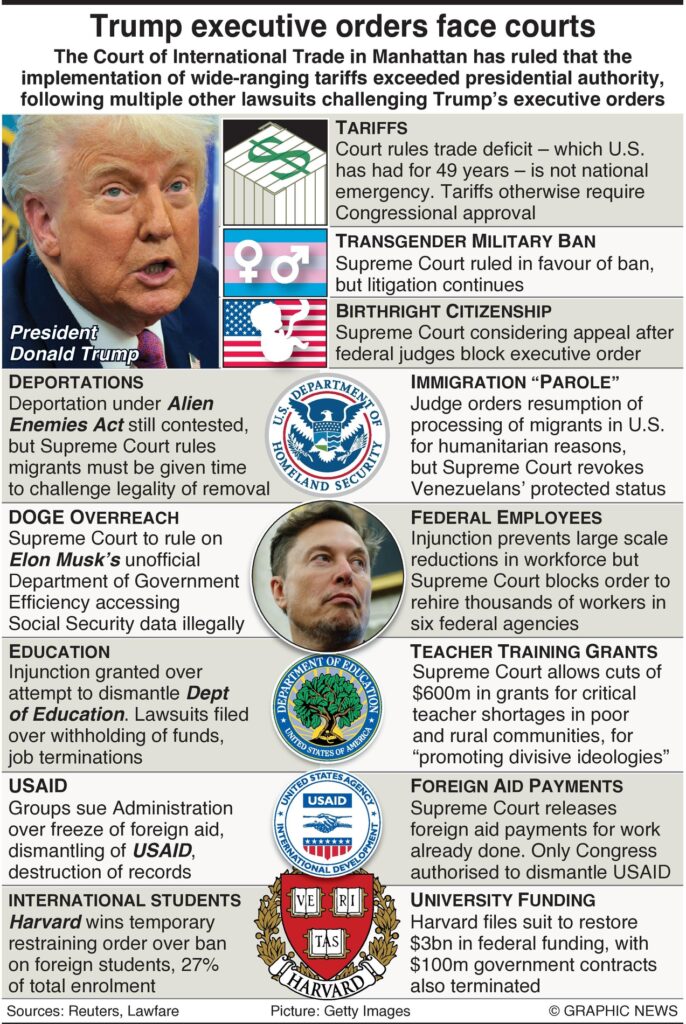
Most recently, the Court of International Trade in Manhattan has ruled that the implementation of wide-ranging tariffs exceeded presidential authority, following multiple other lawsuits challenging Trump’s executive orders.
Despite claims by the administration that the tariffs were in response to a national emergency the court rejected that, noting that the U.S. has had a trade deficit for 49 years. Tariffs typically require congressional approval, without which U.S. trade policy could be set on the president’s whims, causing economic chaos around the world.
The court ruling immediately blocked all tariff orders issued through the International Emergency Economic Powers Act (IEEPA), a law meant to address “unusual and extraordinary” threats during a national emergency.
But as The Guardian reported:
The judges were keen to state that they were not passing judgment on the “wisdom or likely effectiveness of the president’s use of tariffs as leverage”. Instead, their ruling centred on whether the trade levies had been legally applied in the first place. Their use was “impermissible not because it is unwise or ineffective, but because [federal law] does not allow it”, the decision explained.
Still, Trump officials struck back at the court’s authority. “It is not for unelected judges to decide how to properly address a national emergency,” a White House spokesperson said.
After the onslaught of executive orders in the first few months of the Trump administration, legal challenges and government appeals are taking them all the way to the Supreme Court.
In this most recent case, Trump’s team intends to ask the justices to immediately pause what it correctly calls a bid by “activist judges” to block President Trump’s lawful agenda.
However, any legal challenge to the IEEPA ruling will have to be heard at the U.S. court of appeals for the federal circuit in Washington, DC, first, before going to the highest court.
On Thursday, the Trump administration filed for “emergency relief” from the ruling “to avoid the irreparable national-security and economic harms at stake” The administration will appeal only if a federal court declines to temporarily pause the tariff ruling.
Meanwhile, the ever-resilient Trump could still find a workaround to the ruling.
As CNBC reported:
Goldman Sachs economists said the White House has a few tools at its disposal that could ensure the court ruling is only a temporary problem.
“This ruling represents a setback for the administration’s tariff plans and increases uncertainty but might not change the final outcome for most major US trading partners,” Goldman Sachs economists said in a research note.
“For now, we expect the Trump administration will find other ways to impose tariffs,” they added.
The opinions expressed in this article are those of the author and do not necessarily reflect the positions of American Liberty News.
READ NEXT: AI Scandal Hits Trump World — FBI Steps In: Report























Unless you don’t agree, please always state in your headers the the judicial system is operating illegally and expressing OVER-REACH of their circles of influence.
Thanks.
Supreme Court Justice Clarence Thomas warned about the dangers of “judge shopping,” a practice where litigants strategically file cases in specific courts or districts to secure a favorable judge. In a 2018 dissent in Patchak v. Zinke, Thomas expressed skepticism about the authority of district courts to issue universal or nationwide injunctions, arguing that this practice enables litigants to seek out judges likely to align with their views, undermining the rule of law. He highlighted how such injunctions allow a single district judge to halt federal policies nationwide, bypassing the broader judicial process and potentially encouraging forum shopping. Thomas reiterated concerns about this trend in later writings, emphasizing that it disrupts the judiciary’s role and invites manipulation by litigants seeking specific outcomes.
Where in the constitution does it say that ANY court can supersede the activities of any of the three branches of government. It is like a lion waiting in the bushes to pounce upon anything a local judge doesn’t like. That
decision is not in their realm of operation. Let’s bring these judges back to reality and to their own area that they were appointed (not elected) to serve. And it looks like time to institute term limits.