

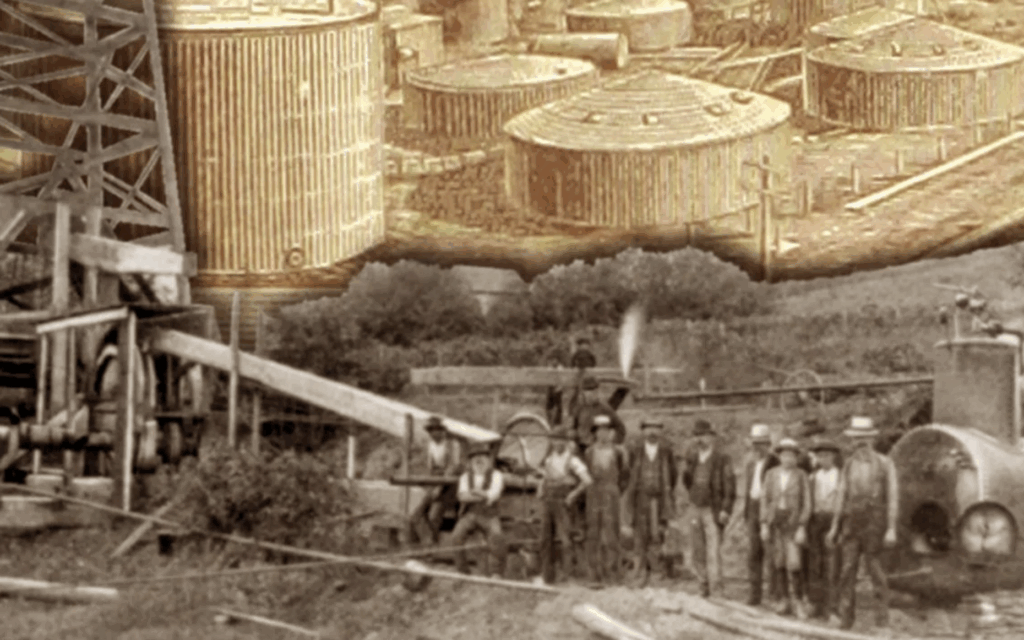
When Americans speak of exceptionalism, it is often misunderstood, diminished by those who mistake confidence for arrogance and invention for imperialism. But real American exceptionalism is not a boast. It is an empirical fact, proved not by slogans, but by what Americans have built, solved, and overcome. Sometimes, it emerges not in the spotlight of war or politics, but in the dim backrooms of laboratories and the cracked fields of flyover towns. Consider, for instance, the curious case of sour crude oil in 1880s Ohio.
Here is the story of how America won the industrial revolution not by seizing what was obvious, but by claiming what was worthless. No European consortium could match it. No imperial merchant fleet could replicate it. The reason is simple: only Americans were audacious enough to buy barrels of foul-smelling, sulfur-choked oil that nobody else wanted, and clever enough to turn it into clean-burning kerosene that lit the world.
In 1885, oilmen in Lima, Ohio, struck black gold, or so they thought. Instead, they found crude oil laced with high levels of sulfur. It reeked, burned poorly, and clogged engines with soot. The industry dismissed it. This was not oil, they concluded. It was waste in liquid form. As prices plummeted to 40 cents per barrel, the oil was effectively stranded. Only Standard Oil, the empire built by John D. Rockefeller, saw potential where others saw poison.
2- (Lima Oil) in Ohio was one of the main sources of Rockefeller’s wealth. The oil was so sour & stinky that all producers lost money. Rockefeller bought everything dirt cheap. He hired a chemist who separated the Sulfur, the he made a fortune selling Kerosene. #Oil_History pic.twitter.com/bYxfyQkVDL
— Anas Alhajji (@anasalhajji) October 7, 2018
Standard Oil began buying these “worthless” wells in 1886, acquiring territory at rock-bottom prices, especially around the Lima fields. Critics called the move reckless, a speculative land grab for garbage. But Rockefeller, in his habitual focus on waste reduction and operational efficiency, suspected that technology might transmute trash into treasure. So he did something the competition had not even considered: he hired a chemist.
Herman Frasch was no ordinary tinkerer. German-born and scientifically rigorous, Frasch had already experimented with sulfur removal in Canadian crude. Standard Oil brought him on board in 1886 and tasked him with a deceptively simple mission: fix the sulfur problem. For two years, Frasch worked inside the Solar Refining Company in Lima, a Standard subsidiary, pursuing a solution the industry deemed impossible.
By 1888, he had done it. Frasch perfected a chemical desulfurization method that removed the sourness from Ohio’s crude, leaving behind a product that was not only usable but superior. Clean, efficient, and odor-free, this new kerosene could now compete with Pennsylvania oil. Rockefeller immediately patented the method, locking it behind legal walls until 1905. What had been valueless was now priceless, and only Standard could sell it.
This was not merely a technical achievement. It was a revolution in industrial strategy. The secret lay not just in the chemistry but in the philosophy. Where European oil firms waited for pristine resources and ideal conditions, American entrepreneurs imposed will upon nature. It was not enough to find resources. One had to unlock them. In this sense, Frasch’s method became the alchemy of American capitalism.
The benefits were immediate and immense. Standard Oil scaled up the process at its new Whiting refinery, built in 1889 and operational by 1890. Whiting became the largest refinery in the world, and Ohio’s sour crude became a major export. The sour oil that once sold for 40 cents per barrel now rivaled Pennsylvania’s “light sweet crude” in value and utility. By 1904, Standard controlled 91 percent of all US refining. The Lima-Indiana field alone accounted for 95 percent of kerosene exports by 1906.
To critics, this was monopoly power. To honest observers, it was monopoly earned, by invention, not regulation. Standard did not win because it crushed competitors. It won because it solved problems they could not. Competitors had access to the same crude oil, the same territory, and the same pipelines. What they lacked was the curiosity, daring, and discipline to convert sulfurous oil into American light. In this regard, Rockefeller’s triumph foreshadowed the achievements of Elon Musk, who has done much the same in our time. With Tesla, he made electric vehicles desirable and scalable where others failed. With SpaceX, he built a private rocket company that now launches more payloads than all nations combined. With Starlink, he turned a dream of global internet access into a constellation of reality. And with Robotaxi and Optimus, he soon will redefine transportation and labor. Like Rockefeller, Musk identified overlooked or derided problems and dared to solve them with discipline and vision. This is not mere innovation, it is a demonstration of what American exceptionalism looks like when unshackled.
Moreover, the ripple effects extended far beyond Ohio. This was a moment when energy transitioned from luck to logistics, from exploration to engineering. It showed that America did not need to find new continents or colonize others. It only needed to outthink them. From the Midwest emerged a doctrine: resources are not what you find, but what you make of them.
This is why we must resist the revisionist impulse to sneer at names like Rockefeller. Too often, critics reduce him to a caricature of greed, a robber baron in a silk hat. But this view ignores the essential point: Rockefeller built his empire not by theft or privilege, but by solving a technical problem no one else could solve. His wealth came not from rigged markets, but from right answers.
Frasch, too, is a forgotten hero of the American mind. His work deserves mention alongside the Wright brothers, Edison, and Bell. He did not simply invent a better process. He invented value itself. Before Frasch, Ohio oil was sludge. After him, it lit the lamps of Europe. And unlike many modern innovators, Frasch did not hoard his insights behind corporate opacity. The moment the patents expired in 1905, the entire industry adopted his methods. America rose with him.
It is worth noting what this episode tells us about innovation today. We live in an age where many problems appear insoluble, energy, infrastructure, inflation, geopolitical entropy. Too often, we are told that decline is natural, that growth is exploitative, and that prosperity is a colonial artifact. The story of sour oil demolishes this view. Progress is not theft. It is imagination applied to failure.
What would happen today if an American firm tried to do what Standard Oil did in 1886? Regulators would block the acquisitions. Activists would sue over “environmental impact.” Academics would declare that sulfur removal is a form of “ecological violence.” The genius of Herman Frasch would be outsourced, denounced, or lost in a compliance audit. In this respect, we are not suffering from a lack of resources, but a lack of courage.
But there is hope. The resurgence of interest in nuclear power, the growing backlash against DEI-driven mediocrity, and the renewed celebration of entrepreneurial grit under President Trump’s second administration all suggest that the spirit of 1886 is not extinct, merely dormant. And as Elon Musk retools the Department of Government Efficiency to cut through bureaucracy, we are reminded that American genius needs only one thing: permission to act.
Standard Oil’s triumph is not a relic. It is a roadmap. It teaches us that leadership lies not in managing scarcity, but in unleashing abundance. That is what Rockefeller did. He bought what no one wanted, hired who no one thought to hire, and refined what no one believed could be refined. He turned foul oil into national prosperity. He did not exploit the system. He improved it.
American exceptionalism is not just an idea. It is a proven model. It is Frasch in his lab, Rockefeller at the ledger, and the people of Lima, Ohio betting on what the experts said was worthless. In this, America is not just a nation. It is a method—a way of thinking that begins with a challenge and ends with a civilization.
If you enjoy my work, please consider subscribing: https://x.com/amuse.
Sponsored by the John Milton Freedom Foundation, a nonprofit dedicated to helping independent journalists overcome formidable challenges in today’s media landscape and bring crucial stories to you.
READ NEXT: Trump Insider Recruited By Foreign Government To Solve Crisis


















IMHO this article captured what made America exceptional – the ability and willingness to look for solutions rather than just accepting the status quo. Unfortunately we are now so bound up by entrenched bureaucrats, red tape they create and a host of regulations they create that our national creativity and problem solving are stymied. Hmm ‘maybe’ that is why the ‘professional’ bureaucracy hates folks like DJT and Elon, they don’t play by the ‘rules’ – they try to solve problems.
Nice story!