






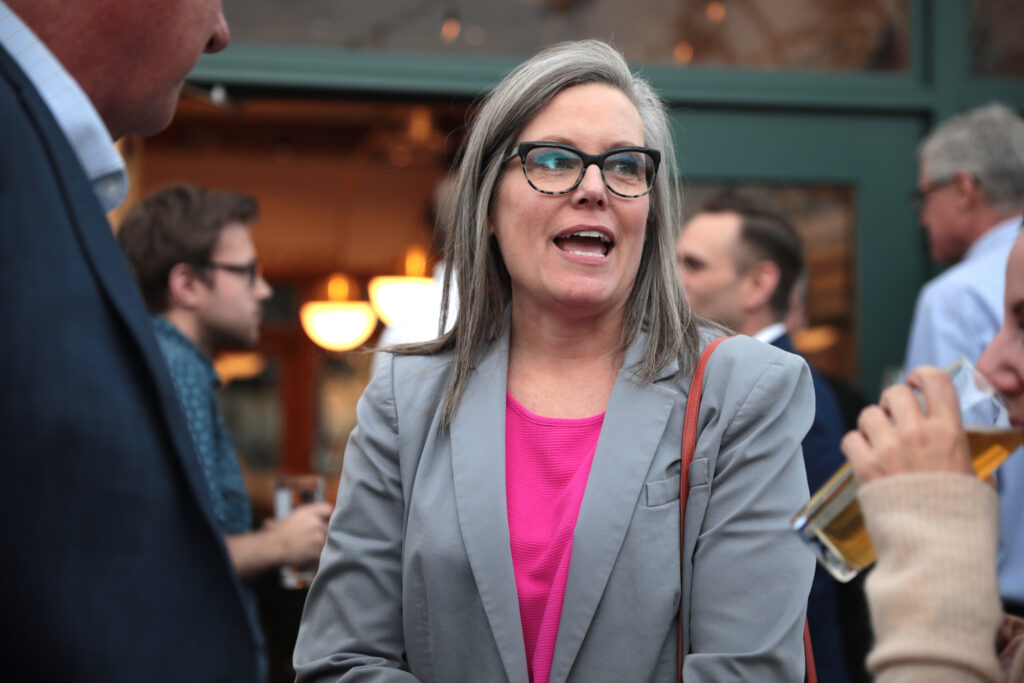
Arizona Governor Katie Hobbs is facing fierce criticism after vetoing legislation that would have blocked the Chinese government and its affiliates from purchasing land near critical infrastructure and military installations in the state. The move has ignited concerns over national security and accusations that Hobbs is prioritizing political optics over protecting state and national interests.
The bill in question, S.B. 1109, sought to prevent entities tied to the People’s Republic of China from owning more than a 30% stake in Arizona properties located near strategic sites, such as Luke Air Force Base, the Palo Verde nuclear power plant, and Taiwan Semiconductor Manufacturing Company’s rapidly expanding chip fabrication facility in Phoenix.
Calling the legislation “ineffective at counter-espionage,” Hobbs argued the bill lacked clear implementation criteria and could result in arbitrary enforcement. “This legislation does not directly protect military assets or provide the tools needed to address the espionage threats it purports to solve,” she said in a statement.
But state lawmakers and national security advocates say the governor’s explanation falls flat.
“This politically motivated veto is utterly insane,” said Arizona Senate Majority Leader Janae Shamp. “Instead of joining a bipartisan effort to protect our most sensitive assets, Hobbs chose to be an obstructionist against safeguarding our citizens from threats.”
Michael Lucci, CEO of State Armor Action, a national security think tank, was even more direct: “Governor Hobbs’s veto of S.B. 1109 hangs an ‘Open for the CCP’ sign on Arizona’s front door.” He pointed to Chinese efforts to lease property near Luke Air Force Base as a glaring example of how proximity to strategic sites can be exploited in modern asymmetric warfare. “Proximity produces peril,” Lucci warned, referencing Ukraine’s recent use of drones to target Russian aircraft based on location intelligence.
The veto comes at a time when foreign land ownership—especially by adversarial regimes—is under intense scrutiny. As of March, 22 states had passed laws restricting foreign entities from owning land, with 17 of those laws passed just in 2024. Congress is currently weighing seven federal bills to address the issue, underscoring growing bipartisan concern about foreign encroachment on U.S. soil.
Hobbs defended her decision by emphasizing potential enforcement issues and the risk of legal overreach. But the bill had already undergone bipartisan amendment efforts to narrow its scope, specifically targeting Chinese government-linked entities rather than individuals or private investors. Despite these refinements, Hobbs stood by her claim that the measure was poorly designed.
“There is a real and present danger here, and it’s not imaginary or rooted in bias,” said one defense official who spoke on background. “The Chinese government has proven time and again that it will exploit every available pathway—legal or not—to position itself near our infrastructure and intelligence assets.”
With Arizona’s rapidly growing role in America’s defense and semiconductor industries, critics argue that the state cannot afford ambiguity or political hesitance when it comes to countering foreign influence.
Still, supporters of S.B. 1109 say the fight to block adversarial land purchases is far from over.
“This isn’t about politics,” said Shamp. “It’s about whether we are going to stand up for our state’s security or allow foreign powers to quietly set up shop in our own backyard.”
READ NEXT: Kari Lake Rips Democrat Katie Hobbs Over Baseless Campaign Office Break-in Accusation





















Does not Arizona’s legislature have veto overide capabilities? So the Gov veto’s a bill, our Nevada legislature can overide the veto and implement the bill.