







PAUL’S DEFENSE BRIEF (PDB) – Drug cartel members fought in Ukraine to learn first-person view (FPV) attack drone tactics. Hands-on combat experience with FPV drones in Ukraine could radically speed up the learning curve for Mexican cartels already in the early stages of using these weapons.
Mexico’s increasingly well-armed drug cartels began to use quadcopters equipped with small explosive devices about five years ago. They later graduated to using drones that dropped munitions on enemies and law enforcement.
FPV drones are now being used in a war between the Cártel de Jalisco Nueva Generación (CJNG) and Sinaloa cartels in coastal west central Mexico.
Ukrainian counterintelligence services are investigating the infiltration of Latin American drug cartel members into the country’s International Legion, with operatives seeking advanced drone training to later deploy against rivals and security forces.
Investigators are looking into whether members of the Revolutionary Armed Forces of Colombia (FARC) have joined the International Legion for similar purposes.
FOR YOUR EYES ONLY – Here’s a roundup of today’s other top defense stories ending the week from conservative national security expert PAUL CRESPO.
Not the President’s Daily Brief, but almost as good – PAUL’S DEFENSE BRIEFING – the PDB:
NATIONAL SECURITY
NSA’s top lawyer was removed from her post after being criticized by MAGA activist Laura Loomer.
HOMELAND SECURITY
Incorrect altitude readings on the Army helicopter that collided with a passenger plane over Washington, D.C., contributed to the aircraft getting too close, but air traffic controllers warned about the hazards of helicopter traffic years before the crash.
DEFENSE POLITICS
SECDEF Hegseth team lashes out at DOD’s internal ‘Signalgate’ review. The attack on DOD’s inspector general appears designed to undermine the inquiry’s legitimacy — even before its findings are made public.
Army puts political operative in charge of public affairs. While it’s not unusual for political hands to manage messaging at the highest levels of DOD, the changes to military public affairs marks a broader institutional pivot.
Army Secretary directed West Point to review its hiring practices, bar outside groups from choosing employees and remove a newly announced hire who led the nation’s cybersecurity agency under Joe Biden.
US POWER OVERSEAS
Europe has ‘understanding and assumption’ of U.S. military drawdown there, Estonian official says. More details about an anticipated U.S. troop reduction in Europe are expected in the fall.
Army’s counter drone mega-exercise in Europe shows that senior officers need more data training.
Navy’s newest carrier strike group led by USS Ford is putting hard-earned lessons from combat in the Red Sea into practice in drills with allies, helping to shape its current eastern Mediterranean deployment.
IRAN THREAT/MIDDLE EAST
RUSSIA THREAT – UKRAINE WAR
Russia is building a drone empire. It has developed a far-reaching, multi-level approach to turbocharge the country’s development and production of drones with an eye to becoming a world leader in the field.
Questions about Russian nuclear submarine base after historic earthquake. The earthquake was only around 75 miles away from a cluster of key Russian naval bases, including ones that host nuclear ballistic missile subs.
Before the war Ukraine’s military-industrial complex was almost entirely directed by the government and large defense contractors. However, Ukraine has quickly become a massive innovator in defense tech, especially with air, sea and ground drones, and small startups pushing the technological envelope alongside larger firms. Sadly, these critical weapons development lessons are not being learned by the West.
Germany’s armed forces reported a 28% surge in soldier recruits from January to late July, compared with the same period last year, bolstering plans to boost NATO defenses in response to an increased Russia threat.
CHINA THREAT
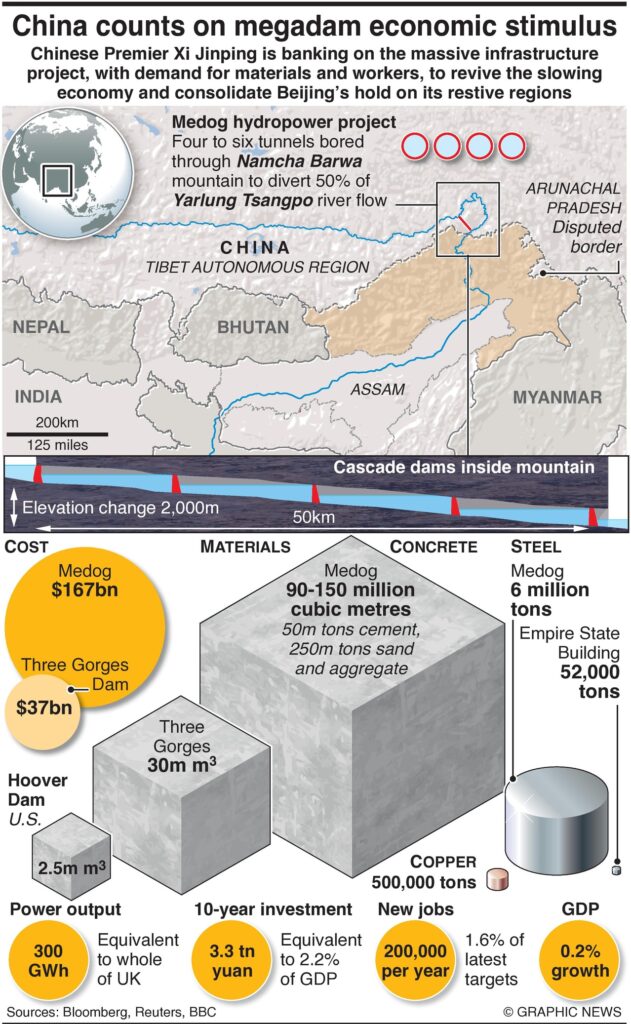
China Builds World’s Largest Hydroelectric Dam in Tibet: Threat or Innovation? Expected to cost around $167 billion, it will be the most expensive infrastructure project in the world.
NORTH KOREA THREAT
SPACE THREAT
U.S. should act now to mitigate conflict on the moon. Countries and companies seek to gain access to prime real estate for future space operations that may enable future scientific discovery and allow for significant commercial gain.
INTERNATIONAL SECURITY
While the annual 2025 Shangri-La Dialogue security forum retained its usual stagecraft between the U.S. and China, this year’s exchanges revealed that the zero-sum logic driving great-power rivalry contrasts sharply with the pragmatic, interests-based approach favored by many middle powers and small states.
US MILITARY
DOD plans to prototype a hydrogen-powered system for naval vessels. If successful, the Expeditionary Hydrogen On Ship & Shore project, or EHOSS, could help fulfill a long-standing DOD goal of eliminating petroleum-based propulsion from military operations.
END of PDB
The opinions expressed in this article are those of the author and do not necessarily reflect the positions of American Liberty News.
READ NEXT: Dems Threaten To Flee Capitol To Block GOP Bill — Police Response Requested






















To apply drone skills worldwide scary
If the story is accurate, the USA should immediately pull every piece of equipment and dollar for additional material out of Ukraine!