







A central pillar of democratic governance is the public’s ability to trust its government’s statistics. When federal agencies that provide economic data begin to drift, not just from accuracy but from neutrality, the damage is twofold: public confidence erodes, and policy decisions float on clouds of fiction. President Trump’s decision to fire Bureau of Labor Statistics (BLS) Commissioner Erika McEntarfer was not merely justified, it was overdue. Beneath the tranquil surface of payroll data and employment curves lies a troubling pattern of partisan manipulation masquerading as bureaucratic error. The Trump administration has done what previous administrations have lacked the courage to do: hold politicized technocrats accountable for distorting economic reality in favor of partisan narrative.
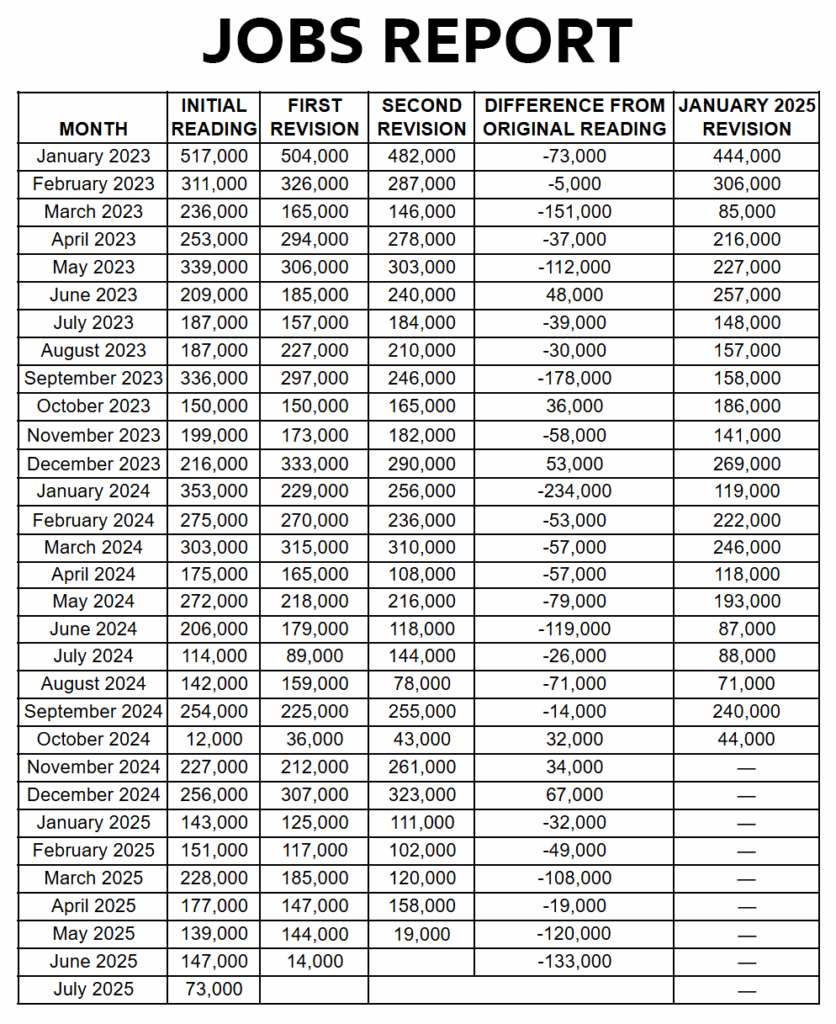
To understand the gravity of the case, one must begin not with the dismissal itself, but with the curious trajectory of BLS reporting during the Biden administration. In nearly every month of 2023, the BLS initially reported strong job gains that were later revised downward, almost always significantly. By October of that year, one US senator pointed out that sixteen of the past seventeen reports had been revised down. These are not random errors. They are directional, cumulative, and, perhaps most damningly, they provided the Biden administration with a steady stream of positive headlines at precisely the moment it needed them.
For perspective: in 2023 alone, BLS job growth was overstated by approximately 800,000 jobs. That number is not incidental, nor is it within a tolerable margin of statistical error. According to the Heritage Foundation, roughly one in every four jobs reported as “added” in 2023 simply did not exist. They were statistical phantoms, fabricated not by malice perhaps, but by a methodological negligence that curiously always bent in favor of the administration in power.
The standard defense offered by McEntarfer and her allies is familiar: early estimates are volatile; revisions are normal; no sinister intent. But such a defense collapses under the weight of repetition. If the BLS were merely underestimating or overestimating based on new data, we would expect to see revisions in both directions. We did not. The revisions were overwhelmingly downward, concentrated in a specific timeframe that aligned with Biden’s economic messaging crisis.
This brings us to Erika McEntarfer herself, installed as BLS Commissioner in 2023. A former labor economist with stints in the Obama administration and at the Census Bureau’s experimental data teams, McEntarfer was no stranger to the mechanics of labor statistics. Her academic pedigree and technocratic veneer camouflaged what was, in substance, a partisan appointment. And while not every political appointee is a partisan actor, the fruits of McEntarfer’s tenure suggest that at minimum she tolerated, if not actively abetted, a process that manufactured the illusion of economic health while millions of Americans struggled under inflation, stagnant wages, and rising costs.
To put this in context, imagine a CFO who repeatedly overstates company earnings, quarter after quarter, only to revise them down quietly after the stock price has rallied. That CFO would be removed, investigated, and likely prosecuted for securities fraud. Yet McEntarfer presided over the statistical equivalent of this deception, and until now, faced no consequences.
Let us also dispense with the notion that Trump’s action is unprecedented or dangerous. Federal agencies, even those staffed predominantly by career officials, do not exist outside the political sphere. They report to the executive. And when their outputs become corrupted by bias, even implicit, unspoken, or subconscious bias, the president is not only entitled but obligated to correct course. Accountability is not authoritarianism; it is governance.
Moreover, the effects of this statistical sabotage are not abstract. False job numbers influence markets, shift public opinion, and shape legislation. When the BLS reported 263,000 jobs added, only to revise that number down by 100,000 a month later, the initial headline shaped the news cycle. By the time the correction arrived, the narrative had been set, and the media had moved on. If the New York Times buried the revision on page B12, the White House had long since claimed victory on social media.
Some might argue that Trump risks politicizing the BLS by firing McEntarfer. But again, this assumes that the BLS under Biden was apolitical. It was not. What Trump has done is restore balance. And the July 2025 jobs report makes the case clearer than ever. The headline number was deeply disappointing—a stark reflection of McEntarfer’s legacy and her final report before being fired. But buried within the bleak top-line data was a significant achievement: native-born American workers experienced their strongest July on record, with employment rising by over two million year-over-year. Their employment now stands 1.8 million above pre-pandemic levels, outpacing foreign-born workers by over 2.2 million on an annualized basis. That shift underscores the tangible impact of Trump’s immigration enforcement and a redirection of opportunity toward American citizens.
This is not a minor footnote. It is a monumental shift. For decades, immigration-driven job growth has masked the stagnation of native-born employment. But as Trump tightened border enforcement and focused economic policy on American citizens, the numbers finally began to reflect reality. For once, it is the native-born American worker who is seeing real gains. The American dream is becoming attainable again, not through statistical illusion, but through actual, measurable results.
One might ask, what of the institutional safeguards? Why did the revisions not trigger internal alarms? The answer is that in Washington, process often replaces principle. So long as the proper forms were filed, and the right footnotes included, no one dares raise a hand. Bureaucratic inertia becomes a shield for mediocrity, or worse. Under McEntarfer, the BLS mistook routine for rigor, and process for impartiality.
Let us be precise. We are not alleging fraud in the criminal sense. Rather, we are accusing the BLS under McEntarfer of a subtler kind of fraud, the fraud of allowing partisan momentum to infect empirical integrity. The fraud of issuing good news you know is likely false, and letting the correction fade quietly into bureaucratic obscurity. The fraud of abandoning the public trust in favor of political expediency.
And let us anticipate the objection that this is all hindsight bias. That only with the benefit of later revisions can we now say the numbers were wrong. But that is precisely the point. The BLS should have known better. Or, if it truly could not know, it should have hedged its headlines, tempered its tone, and emphasized the provisional nature of its findings. Instead, it chose to amplify the best-case scenario, month after month, while quietly rewriting history in the footnotes.
President Trump’s decision to fire Erika McEntarfer should be seen as a declaration that the American people deserve better. Not just better numbers, but better honesty. Better accountability. Better government. If we cannot trust the data that drives our policy, then we are building our economy on sand.
The irony, of course, is that in firing McEntarfer, Trump has restored more credibility to the BLS than she ever did while in office. The message is clear: truth matters, even in statistics. Especially in statistics.
If you enjoy my work, please consider subscribing: https://x.com/amuse.
Sponsored by the John Milton Freedom Foundation, a nonprofit dedicated to helping independent journalists overcome formidable challenges in today’s media landscape and bring crucial stories to you.
READ NEXT: Mexican Cartel Members Spotted Learning Dangerous Skills In Ukraine























Delete Useless positions Govt wide A-Z & save $$$$$
More Biden administration corruption uncovered.
About fricking time. Root all of these liberal ideologues out of government. Their allegiance is to the Democrat party and George Soros not to the American people.
First, shout out to Amuse! Thank you for your steadfast reporting. Dave from X22 often quotes you.
Second, we can judge a book by its cover—it’s very unlikely that someone who looks like that woman would be good at a serious job, like the one from which Trump just fired her. We can see how intelligent (or not) someone is just by looking into his/her eyes.