




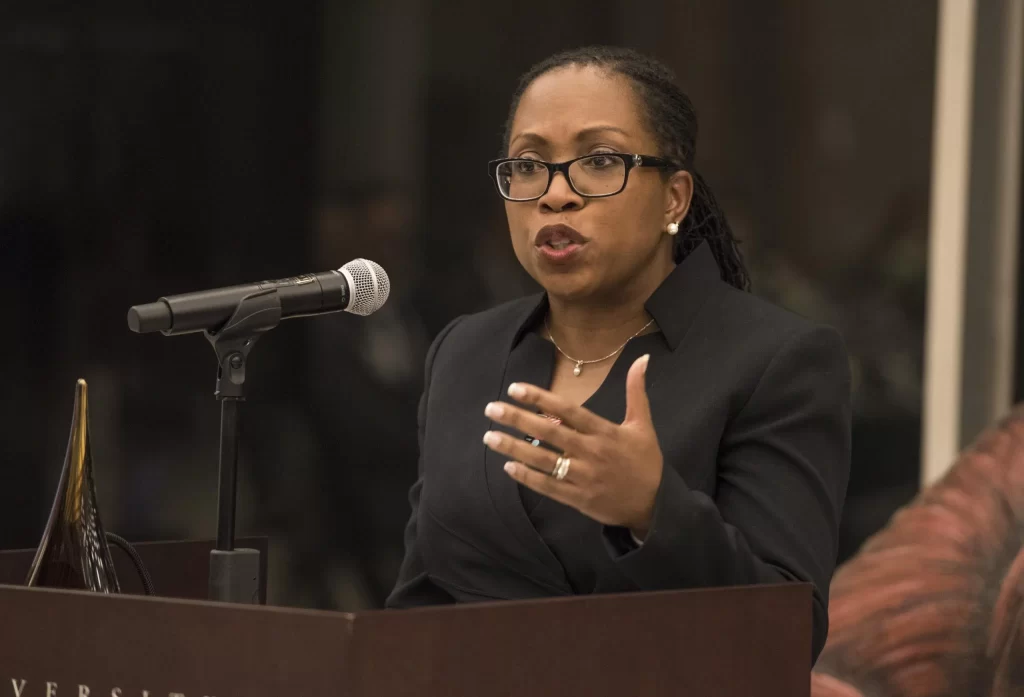
During oral arguments in a pivotal Supreme Court case on the constitutionality of Section 2 of the Voting Rights Act, Justice Ketanji Brown Jackson made comments that drew immediate attention — and criticism — after she appeared to liken black Americans to Americans with disabilities.
The case, Louisiana v. Callais, is about whether Louisiana’s congressional redistricting plan — which includes two majority-black districts — violates the 14th Amendment’s Equal Protection Clause and the 15th Amendment, which prohibits racial discrimination in voting. Plaintiffs claim the map is racially gerrymandered, while defenders argue it complies with current constitutional standards.
During the hearing, Justice Jackson drew a parallel between remedies in the Americans with Disabilities Act (ADA) and those in Section 2 of the Voting Rights Act (VRA), arguing that Congress has the authority to mandate equitable access to democratic institutions even in the absence of proven discriminatory intent.
“Congress passed the Americans with Disabilities Act against the backdrop of a world that was generally not accessible to people with disabilities,” Jackson said. “It didn’t matter whether the person who built the building intended for them to be exclusionary… Congress said, the facilities have to be made equally open to people with disabilities if readily possible.”
She continued, “I guess I don’t understand why that’s not what’s happening here… We are responding to current-day manifestations of past and present decisions that disadvantage minorities and make it so that they don’t have equal access to the voting system. They’re disabled. In fact, we use the word ‘disabled’ in [Milliken v. Bradley].”
Her reference to voters being “disabled” immediate pushback and stirred debate.
Attorney Edward Greim, representing one of the challengers to the congressional map, responded by distinguishing racial remedies from those applied under disability law.
“The difference is that the remedy under the ADA and other anti-discrimination laws is not stereotype. It’s not race-based,” Greim said.
Justice Jackson argued, “You’re saying then that if the problem of no access is about race, it’s just too bad because you can’t have a remedy that relates to race?” she asked.
Greim clarified his position: “It’s not whether it relates to race. It’s whether the remedy that relates to race involves stereotyping voters and making assumptions about their politics and their views… and that’s the problem. It doesn’t exist in those other civil rights statutes.”
Conservative commentators and legal scholars quickly reacted to Justice Jackson’s analogy, accusing her of reducing the experience of Black Americans and reinforcing racial stereotypes under the guise of legal remedy.
The Supreme Court’s ruling could have sweeping consequences for how states draw electoral maps, especially in regions with significant racial minority populations. Section 2 of the Voting Rights Act, a key provision used for decades to challenge racial gerrymandering and vote dilution, faces unprecedented scrutiny in this case.
If the Court finds Section 2 unconstitutional or narrows its application significantly, future legal challenges to racially biased maps may be severely limited.
A ruling in Louisiana v. Callais is expected by June 2026, and it could determine the future scope of federal protections for minority voting power in the United States.
READ NEXT: Supreme Court Clears Way For Trump To Resume Education Dept. Layoffs























Gerrymandering is wrong today , it was wrong yesterday and regardless of party needs to be eliminated. It had allowed the party in power to permanently skew the outcome of elections by shaping the boundaries of districts to ensure election results. It’s wrong and it’s how we end up with one party states. Over representation of any group is just as bad as the opposite.
She is pushing their worn-out wailing that they cannot conduct themselves as well as the other peoples. In her defense, she must assume that most of her people believe what their leadershits tell them. Seems to me that more and more are “fleeing the plantation” and assuming their rightful place in our society.
So if I ‘understand’ her rationale a person of color who happens to be physically disabled is double handicapped and somehow ‘deserves’ even MORE assistance/privilege because of it, correct?
As Dennis observed, gerrymandering is wrong no matter what the ‘reason’.