

This is part 1 of a 2-part piece. As the threat of major war between nuclear-armed powers like the U.S., Russia, and China, not to mention North Korea, Pakistan, and India, keeps rising, Netflix has produced a scary and somewhat realistic film about a likely nuclear attack on the United States.
Its underlying message is that nuclear weapons are bad.
I’ve been a student of nuclear war, strategy, doctrine, and weapons for decades, though serving in a nuclear-capable Marine Corps artillery battery in the 1980s is the closest I got to working with nukes in the wild.
This is an extremely complex topic. But I will give it a shot.
If you want a scene-by-scene rundown and explanation of the movie, you can read one here. Note, it will have an anti-nuclear bias as it is from the Bulletin of the Atomic Scientists.
Spoiler Alert: If you don’t want spoilers, don’t read this until after you watch the movie.
Apparently, the Pentagon wasn’t too happy about the film, either. Especially since in the movie, our defenses fail. And I argue this is one of the biggest lessons the movie wants to relay.
The film has been hailed by some as extremely realistic, while others point out various flaws. The director, Kathryn Bigelow, recruited a former Army officer, Dan Karbler, who previously served as chief of staff at Strategic Command (STRATCOM) — which commands our nuke forces — to be the movie’s technical advisor (even playing a role).
It is fairly realistic in the details. Still, it is a drama, not a documentary. And it gets some big things wrong.
So, what lessons should we learn from this film?
As one former senior military officer noted about “A House of Dynamite,” the first thing our senior leaders should ask is — can this ever happen and how do we fix it?
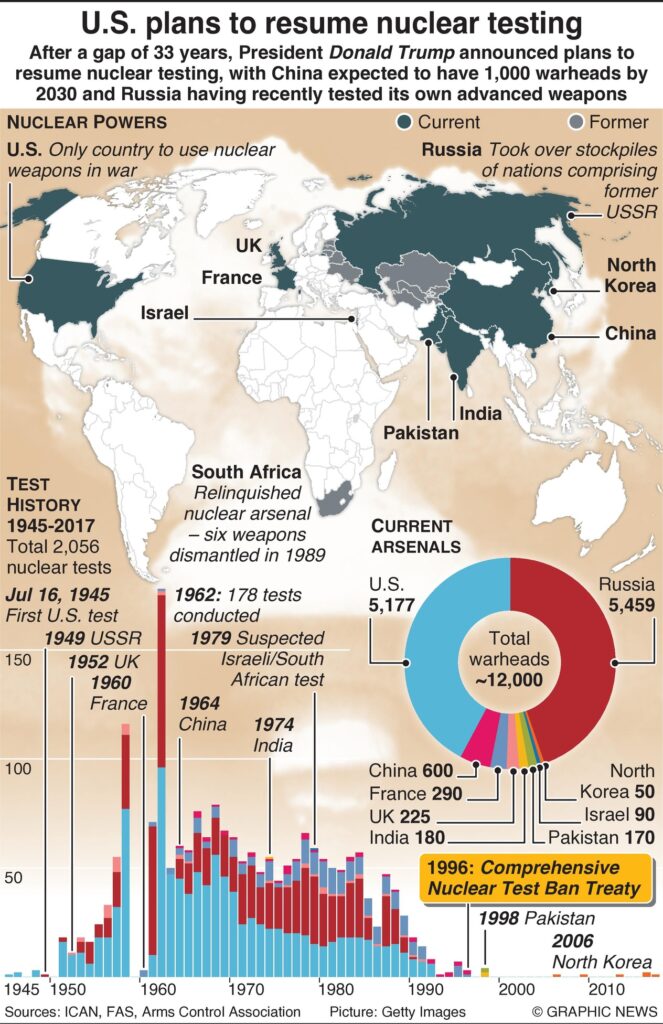
But let’s start with the premise — an unidentified nuclear missile is detected on a soon-to-be suborbital trajectory heading towards the U.S. mainland, and officials have less than 20 minutes to respond before 10 million Americans are vaporized.
SEE THE MOVIE’S WRITER TRYING TO EXPLAIN HIS IDEAS AND LESSONS HE HOPES TO RELAY.
This is the worst-case scenario for U.S. defense planners: a “bolt out of the blue” attack. But it is also less likely than a nuclear attack after an escalation of a major conventional conflict that would involve quite a bit of signaling and warning, as has been done by Vladimir Putin over the war in Ukraine.
A “bolt from the blue” would also more likely involve a massive attack intended to decapitate our leadership and devastate our military command and control — think multiple large hits on the Pentagon, D.C., and many other strategic sites, not just a single missile.
And certainly not against Chicago, a tertiary “counter value” target, at most. Counter value refers to striking large population centers versus nuclear forces, which is called “counter force,” and is expected to be the first thing an enemy will hit.
Chicago is a really poor target for a strike.
Also, most believe that any first strike by an opponent would include an Electromagnetic Pulse (EMP) attack, likely from a high-altitude airburst of a nuke, which would fry most, if not all our electronics nationwide.
If the missile in the film was intended to be an airburst over Chicago to produce an EMP, then it would be a great target due to its proximity to NYC and D.C. An EMP in this scenario might change everything. But we don’t know.
In the film, radars at Alaska’s Fort Greely missile defense and warning base pick up an Intercontinental Ballistic Missile (ICBM) heading towards the U.S. from the Pacific. For some reason, maybe a cyberattack on our satellites, the launch location is undetermined.
Some speculated that the North Koreans may have secretly developed a sub-launched nuke capability, which the film accurately notes is possible.
Initially, in the movie, military officials, numbed by previous unannounced, unarmed practice launches by North Korea, are unconcerned. But when this missile fails to land harmlessly in the Sea of Japan, as others have, they realize this one is real.
According to author Annie Jacobsen, who recently released a book, “Nuclear War: A Scenario,” about a nuclear attack on our country (a great book I highly recommend), in real life, within 30 seconds, warning systems would have been triggered within the secretive and secure underground Cheyenne Mountain Complex in Colorado.
Referring to the film’s single missile bolt from the blue, she adds in the Daily Mail, “Surprise attacks change history. But a surprise attack is designed to decapitate. To cut off the head of the snake,” meaning one nuke against Chicago wouldn’t cut it.
But as noted earlier, there is also a question in the movie about whether there was some sort of cyberattack on our sensors. And that should be expected. This can also greatly complicate decision-making.
But as Time reported:
In speaking with various experts, [the writer, Noah] Oppenheim found that the most plausible way for someone to carry out a surprise attack would be to interfere with the satellite systems (as is surmised in the movie), which he says are “strong but vulnerable” and “arguably the least secure element of our cyber infrastructure.”
However, according to Karbler, unattributable missile launches are “almost unheard of,” because of the confidence in the U.S. SBIRs (space-based infrared satellites). Still, Karbler acknowledges that Secretary of Defense Ash Carter ran these kinds of scenarios to prepare for a lack of information.
“I don’t think it’s likely, because we have a lot of redundancy in our capabilities,” Karbler says. “But is it something we have to consider and practice? Yeah.”
Despite what Karbler says, many believe that a mass cyberattack that spreads and has a cascading effect on our systems is also an extremely likely and serious threat. And definitely has to be defended against. It could be the real opening salvo of a greater attack.
A VIDEO OVERVIEW OF HOW WE WOULD FIGHT A NUCLEAR WAR.
Then we go to the decision-making by what was formerly called our National Command Authority (NCA), primarily the president and/or the secretary of defense. The term also refers to communications with the commanding officers of the unified combatant commands to launch nuclear and conventional strikes.
In recent years, we simply refer to the president as the launch authority since, as the movie depicts, only the president can direct the use of nuclear weapons, through the pre-set options for a U.S. nuclear strike in his decision handbook and OPLAN 8010–12 (shown in the film).
As far as launching nukes is concerned, the president, unless he is incapacitated, has unilateral launch authority as commander in chief, though the Chairman of the Joint Chiefs of Staff or duty officer at the National Military Command Center (NMCC) will need to authenticate if the president’s order is valid.
As shown in the film, the president carries a laminated card, called the “biscuit” with authentication codes to prove who he is.
The movie accurately portrays the president’s military aide carrying the ‘nuclear football,’ a briefcase that holds the Presidential Decision Handbook, or Black Book, which is the menu of nuclear strike options available to the president. It is as accurate as can be from public information.
In the film the aide jokingly refers to the three major categories or nuke response (limited, tailored/flexible and massive), as “rare, medium and well done.”
As depicted, the “football” is not full of sophisticated equipment, nor “codes” to launch nuclear weapons. The aide also carries a secure phone to connect with the Pentagon to start the nuclear launch process.
The VP and the designated survivor, during an inauguration or State of the Union, also have a “nuclear football.”
CONTINUED IN PART TWO
The opinions expressed in this article are those of the author and do not necessarily reflect the positions of American Liberty News.
READ NEXT: Ben Shapiro Unloads On Fox News Icon In Hourlong Rant [WATCH]





















It was a waste of time; Netflix at its worst.