

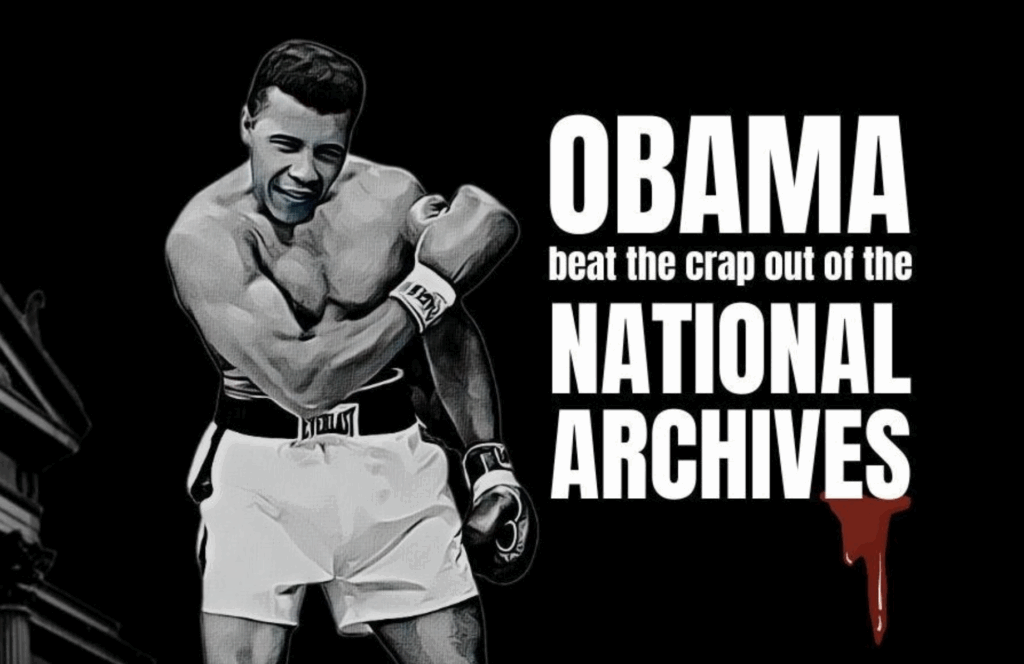
In the early days of President Trump’s first term, he watched a quiet but consequential battle between former President Obama and the National Archives unfold. That dispute, which concerned control of Obama’s presidential papers, shaped Trump’s understanding of his own later conflict with NARA. The pattern was clear. A president who fears that his successor might reinterpret or diminish his legacy can take steps to preserve control of his records. Obama’s team did exactly this when they moved roughly 30M pages of presidential documents to a shuttered furniture showroom in Illinois. Trump understood the stakes because Obama had already drawn a blueprint for a president determined to maintain custody of historical material that might otherwise be shaped by political adversaries.
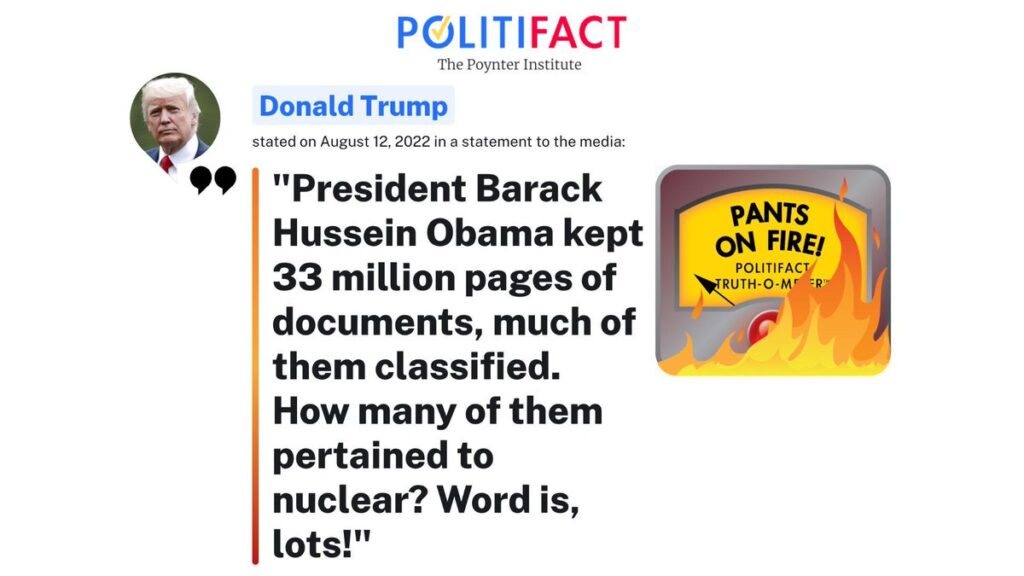
Trump, confronted with questions about boxes stored at Mar-a-Lago, reminded reporters about Obama’s massive records transfer. He noted that some of Obama’s documents included nuclear-related material, a fact NARA itself confirmed long before Trump entered office. Mainstream outlets insisted these claims were false, but their refusal to engage the underlying facts obscured the historical record. The press forgot that Obama and NARA had clashed publicly in 2016, that NARA complained about classified records being moved to an unsecured suburban facility, and that Obama, in the final days of his term, declared the documents declassified as they headed to Chicago. The parallel with Trump’s situation was evident, but the media declined to admit it.
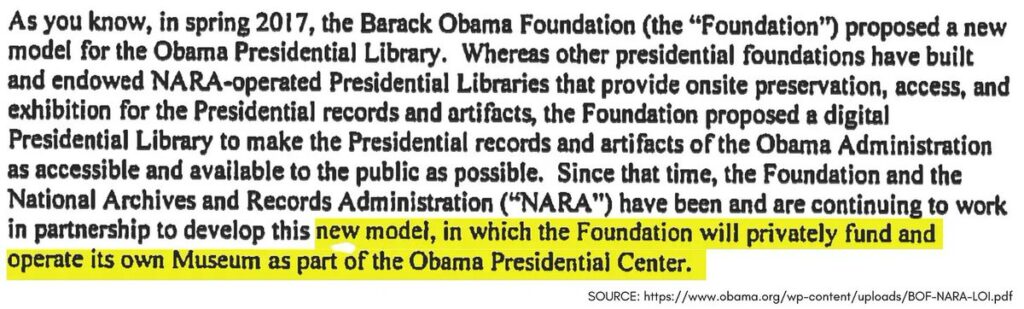
To see what happened, we should return to the beginning of Obama’s maneuver. In 2014, the president asked Marty Nesbitt, Julianna Smoot, and J. Kevin Poorman to create the Barack Obama Foundation. Their mission was simple. They would ensure Obama kept full control of his legacy, including control over the records on which historical interpretations would turn. NARA has traditionally managed all presidential libraries. Former presidents raise funds to construct the buildings, then hand them to NARA for permanent stewardship. Obama rejected this practice. His foundation aimed to build a facility entirely outside NARA’s control. That decision triggered alarm among archivists who believed the president was breaking a careful system of bipartisan custodianship.
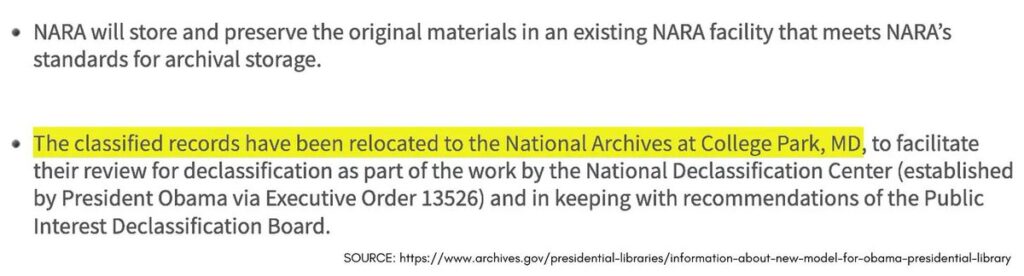
NARA officials privately warned Obama that the transfer likely violated federal records rules. They were also concerned that thousands of the documents were highly classified and had been removed from secure locations like the Capitol’s SCIF. They complained that the Plunket facility lacked the humidity controls required to preserve paper records for long term storage. They also noted that nearly every door could be opened with a thumb turn lock. Obama’s team responded by invoking the president’s Article II authority. They insisted that he had declassified all 30M records before shipment. That announcement stunned staff but effectively mooted their objections. A president’s classification authority is constitutional, not statutory. NARA had little recourse.
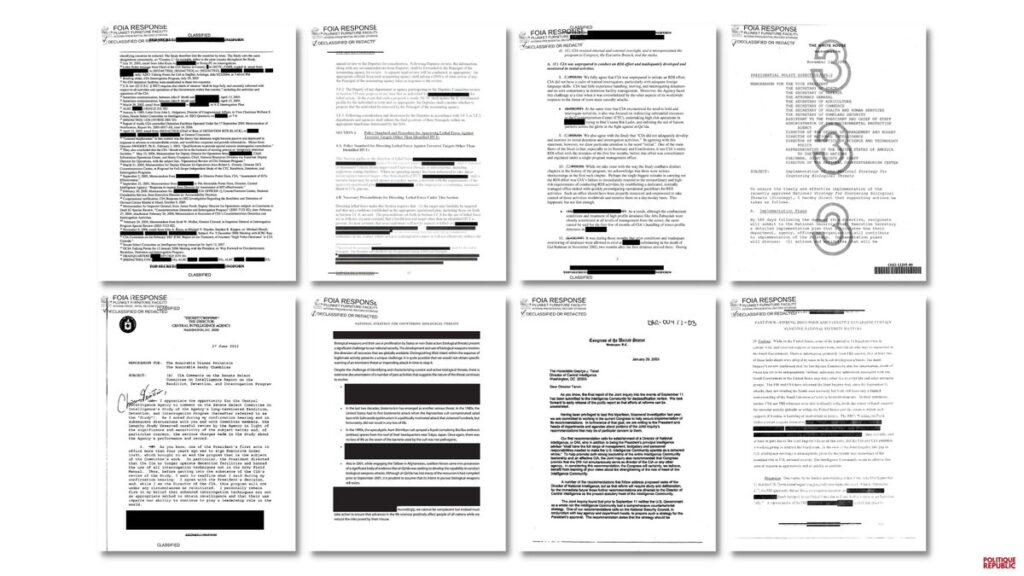
When Trump took office in 2017, NARA continued to raise concerns but Trump expressed no interest in inserting himself into their feud with Obama. Ironically, Trump left Obama’s Archivist, David Ferriero, in place. Ferriero faced a dilemma. Obama’s records were sitting in a suburban warehouse, NARA lacked resources to staff or secure it, and the new president would not enforce NARA’s demands. Obama’s foundation knew it was operating from a position of strength. The records were already in Illinois, Obama was widely admired in the bureaucracy, and the outgoing administration had neutralized classification concerns by asserting declassification. The result was predictable. NARA had to negotiate.
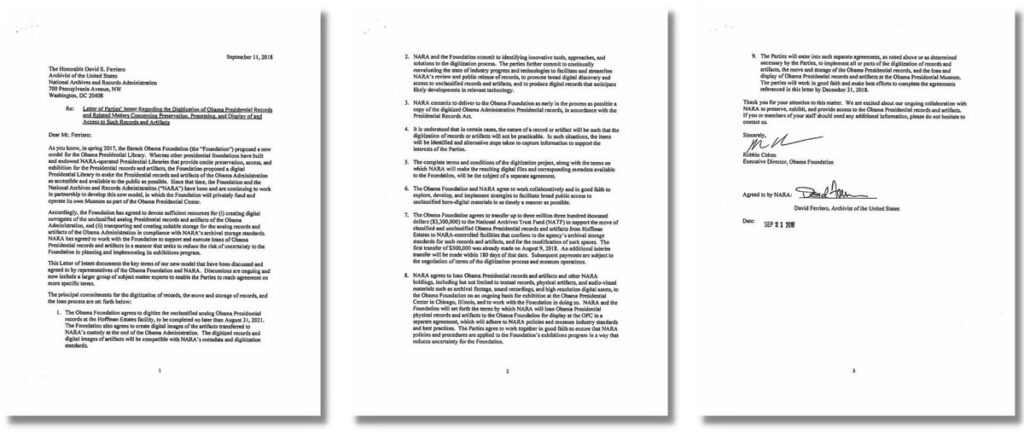
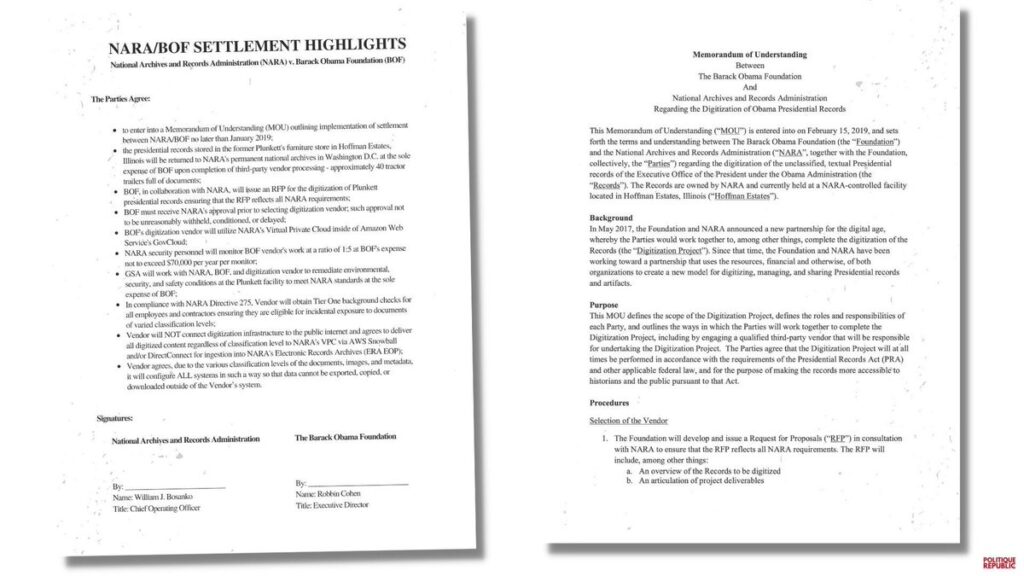
The two sides eventually drafted a ten page memorandum of understanding. It allowed the Obama Foundation to hire its own vendor to digitize the 30M documents. It required the vendor to meet basic background check requirements and promised that documents would be returned to NARA in archival quality folders. The most important concession, however, concerned control. The memorandum ensured that Obama’s presidential center would not become a NARA run library. NARA would hold the records eventually, but the center itself would be fully private. There would be no NARA staff on site, no NARA programming, and no NARA oversight. Obama and his foundation would retain control over the story told about his presidency.
This decision has no modern precedent. Since Herbert Hoover, presidential libraries have been public institutions managed by career archivists. Obama replaced that tradition with a privately controlled museum built in a historic park in Chicago. Archivists and scholars raised concerns. Former library director Timothy Naftali said he found the move astounding and feared that the center would become a partisan monument rather than a research institution. Environmentalists opposed the destruction of over 1,000 hardwood trees in Jackson Park. Neighborhood groups were outraged when they learned that a major road would be closed without community input. Local critics believed the foundation had executed a bait-and-switch, promising a public library but delivering a private political campus.
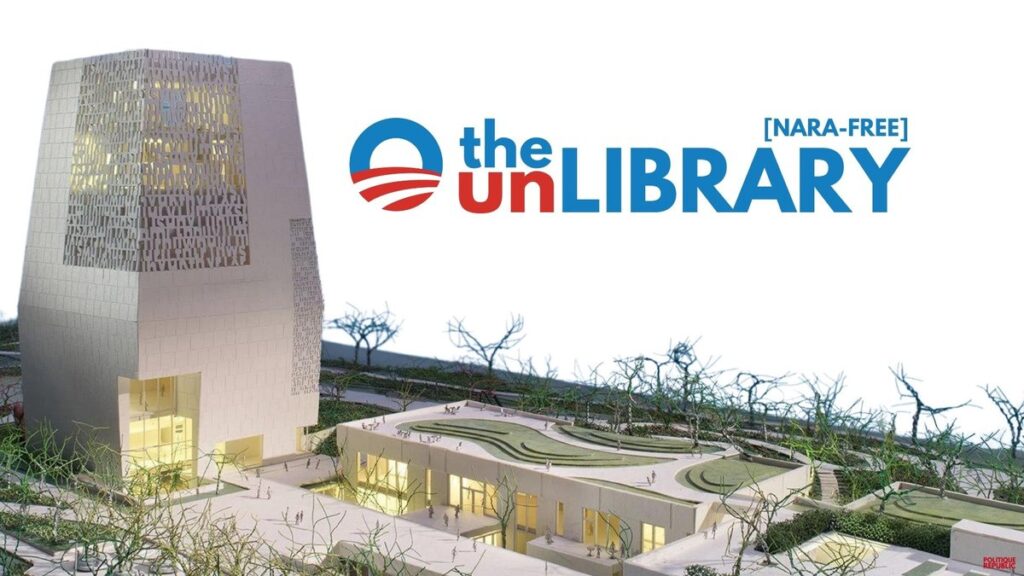
These controversies revealed more than aesthetic or environmental disagreements. They illustrated a deeper anxiety. Many historians believe that public custodianship prevents political manipulation of presidential narratives. A privately controlled center gives a former president the power to shape public memory through selective presentation of documents. Obama’s critics feared that removing NARA from the institution would enable curation that resembled political advocacy more than historical transparency. Their concerns were amplified by the foundation’s heavy payroll. Top officials earned salaries far above those of the Archivist of the United States, a fact that deepened resentment inside NARA.
The archival conflict between Obama and NARA is essential for understanding the intensity surrounding Trump’s records dispute. By the time Trump left office in 2021, it was accepted that presidents could assert declassification authority over vast pools of documents and could negotiate terms with NARA. Obama had invoked Article II to declare 30M records declassified in a single act. He had moved those records to an unsecured facility and had maintained effective control of his legacy through private intermediaries. These actions created a precedent. A president who believes he has the right to declassify and control records will expect NARA to negotiate rather than criminalize disagreements.
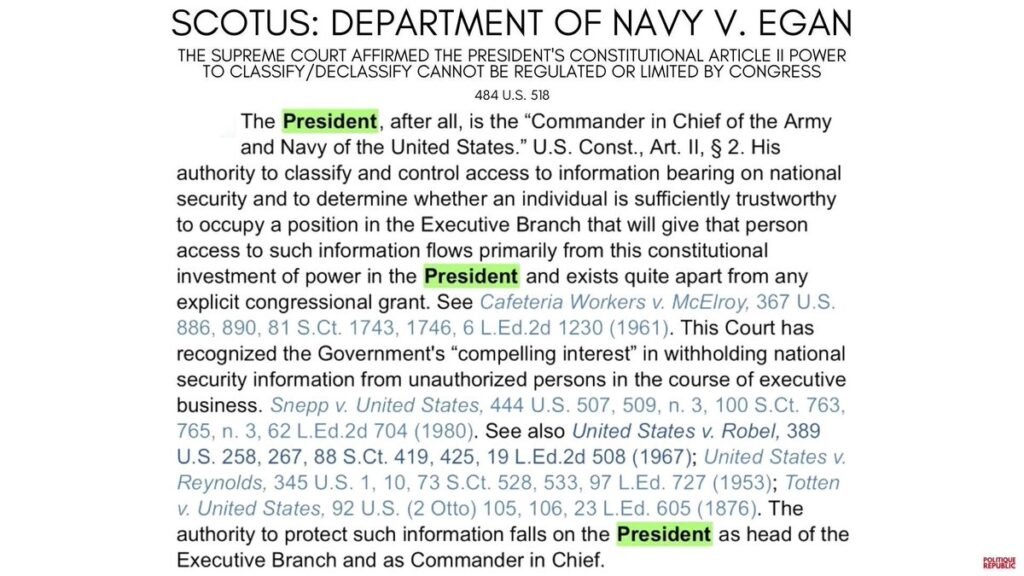
This precedent makes the treatment of President Trump striking. Like Obama, Trump asserted Article II authority. Like Obama, he argued that his team was in negotiation with NARA. Unlike Obama, he was subjected to a criminal investigation, public accusations of espionage, and an armed FBI raid. The discrepancy requires explanation. It cannot be justified by classification concerns because classification authority resides in the presidency, not in the administrative state. It also cannot be justified by procedural differences because Obama’s transfer involved tens of millions more documents, including files that had been stored in SCIFs. The reason for the asymmetry lies elsewhere.
Several officials familiar with the Mar a Lago search have stated that the FBI’s true objective was the Crossfire Hurricane binder. This binder contained material declassified by Trump in the closing hours of his first term. It included internal FBI and CIA assessments exposing misconduct in the Russian collusion investigation. If released, it would have documented abuses that embarrassed senior intelligence officials who remained influential inside the Biden administration. The binder had been declassified but not yet made public. Attorney General Garland supposedly feared Trump would disseminate its contents. Critics argue that this fear motivated the unprecedented decision to use force rather than negotiation.
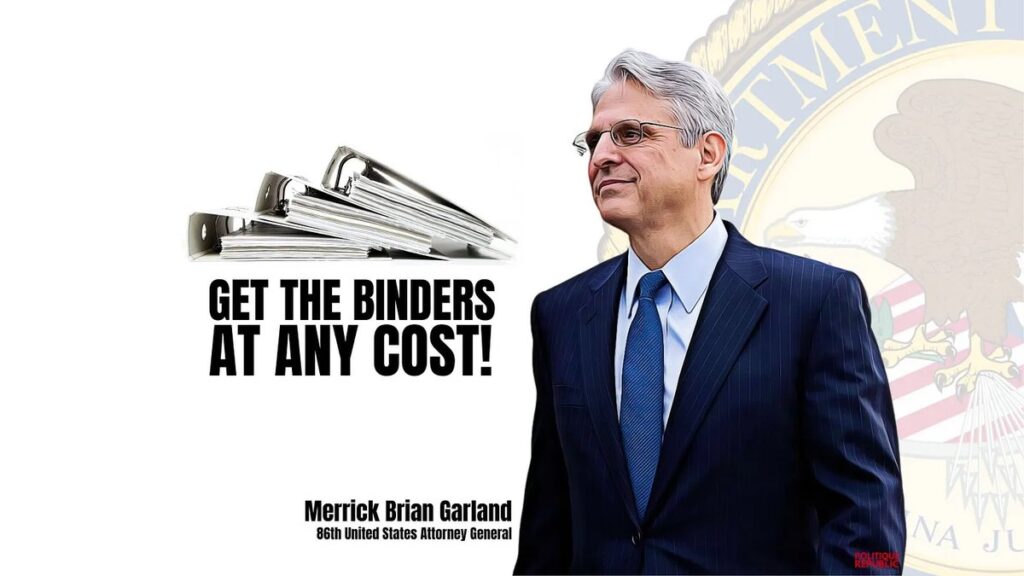
If that account is correct, the raid was not about archival disputes. It was about suppressing politically explosive records before they reached the public domain. Observers often forget that the Crossfire Hurricane investigation formed the backbone of years of political warfare waged against President Trump. Documents revealing internal doubts about its legitimacy would be damaging to the agencies that advanced it. A search framed as a classification dispute provided a convenient legal cover.
The contrast with Obama’s experience is sharp. Obama declared millions of classified records declassified and moved them to a suburban warehouse. NARA complained but did not call the FBI. Scholars protested, but no prosecutors sought warrants. Obama’s assertion of control was treated as legitimate. Trump, however, was told that similar assertions constituted espionage. The double standard is obvious.
We should be clear about the constitutional question. A president’s authority to classify and declassify information flows from Article II. Congress cannot limit a president’s access to national security material and cannot create statutory limits that override the president’s constitutional authority. Regulations issued by agencies apply to employees, not to the president. This principle has been recognized by courts and by scholars for decades. A president may mishandle records in a practical sense, but he cannot violate classification law in the way an officer or contractor can. If we want to change this regime, we must amend the Constitution.
When viewed through this lens, the Obama precedent helps illuminate the political nature of the Trump records saga. Obama moved millions of documents to a private site, asserted declassification, and negotiated a private arrangement with NARA. Trump did something far less sweeping but was treated as a criminal. The difference lies not in the acts themselves but in the political environment that surrounded them.
We should resist the temptation to treat executive branch disputes as criminal matters. The presidential records system depends on negotiation, trust, and respect for constitutional limits. When those norms are replaced by police actions aimed at political rivals, the system becomes unstable. To preserve the legitimacy of presidential transitions, we need clear and consistent principles. If Obama was entitled to declassify and relocate records, then Trump was entitled to rely on the same authority. If NARA could negotiate with a former president in one case, it should negotiate in the other.
What is at stake is not merely a procedural question about record keeping. It is the balance of power between elected presidents and the permanent bureaucracy. When agencies can weaponize classification disputes against a former president, they gain leverage over the office itself. Presidents from both parties should reject that dynamic. The executive must remain independent and constitutionally grounded.
The Obama archive battle revealed a president determined to maintain control over his legacy. The Trump dispute revealed an administrative state determined to prevent a former president from exposing its past misconduct. Understanding both episodes is the only way to see the larger truth. The real fight is over who controls the story of American government, the people elected by voters or the institutions that increasingly act without accountability.
If you enjoy my work, please subscribe: https://x.com/amuse.
Sponsored by the John Milton Freedom Foundation, a nonprofit dedicated to helping independent journalists overcome formidable challenges in today’s media landscape and bring crucial stories to you.
READ NEXT: Senator Exposes Emails From These Two Deep Staters Who Blocked Hillary Probe














And yet the National Archives protects Obama and the democrats. Crazy!
It seems that Obama got away with classified documents. But Trump was treated as a common felony criminal for doing exactly the same as Obama. There should be justice for both presidents. The first should have been treated the same as the second one.
I’m sorry but when did we start letting suspected criminals to have all the evidence and control of it all?
still no justice and poorer
Can we prosecute those abusing NARA & have subopena etc on record to hurt Obama alone
OBAMA WAS NOTHING MORE THEN A TOOL FOR SOROS,,,SOROS CALLED ALL THE SHOTS, THATS WHY OVOMIT HAS TWO VERY EXPENSIVE HOMES ONE IN MARTHAS VINYARD AND ONE ON THE BEACH IN HAWAII, ITS PAY OFFS IDIOTS.