





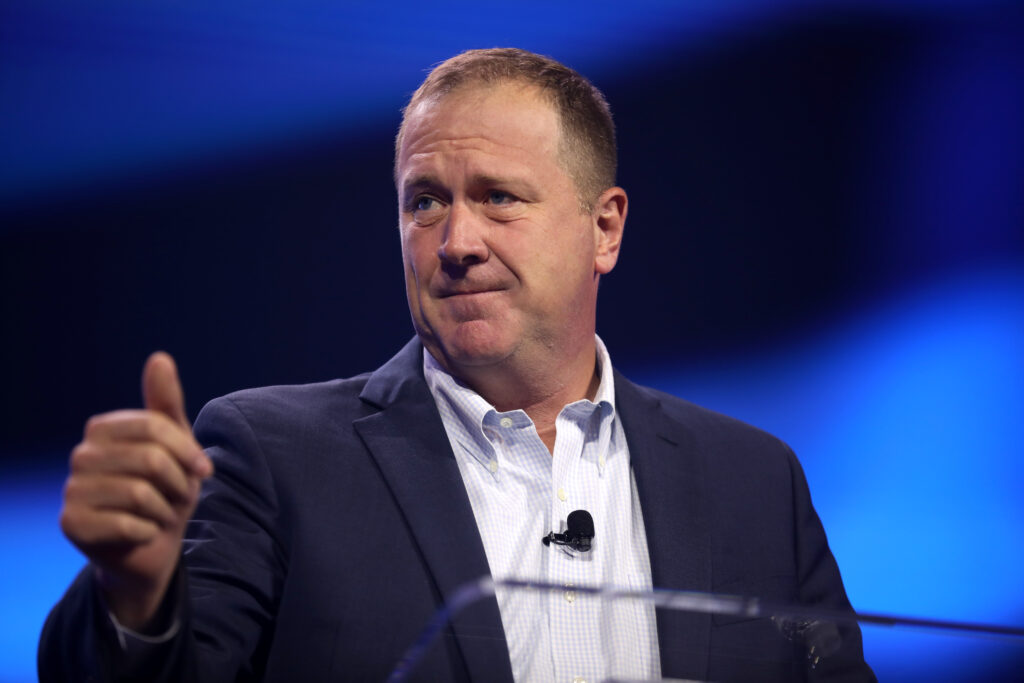
Sen. Eric Schmitt (R-Mo.) said Tuesday that he has no plans to apologize to Chinese institutions that filed a $50 billion lawsuit against him, calling the action retaliation for litigation he pursued against China while serving as Missouri’s attorney general.
In an appearance on The Ingraham Angle, Schmitt dismissed the lawsuit as unfounded.
“It’s totally ridiculous. They’re just mad that we exposed their lies and their deceit,” he said. “Missouri got a $24 billion judgment against them, and they don’t like that. They unleashed COVID on the world. We sued them, and we won.”
The suit—brought by the People’s Government of Wuhan Municipality, the Chinese Academy of Sciences, and the Wuhan Institute of Virology—was first reported by Fox News Digital. It alleges that Schmitt, current Missouri Attorney General Andrew Bailey, and the State of Missouri damaged the reputation of Chinese governmental bodies and research institutions through “malicious vexatious litigation, fabricating enormous disinformation, and spreading stigmatizing and discriminating slanders.”

Schmitt characterized the allegations as politically motivated.
“It’s sour grapes,” he said, noting that his legal team is reviewing and translating the documents. “I won’t be apologizing any time soon, as you’d imagine.”
Background on Schmitt’s 2020 Lawsuit
Schmitt filed suit in April 2020 against the People’s Republic of China, several Chinese ministries, the Communist Party of China, the Wuhan Institute of Virology, and the Chinese Academy of Sciences. The complaint accused Chinese authorities of suppressing critical information during the early spread of COVID-19 and failing to contain the outbreak, which Missouri argued had caused widespread economic and public health harm.
Missouri’s lawsuit was part of a broader wave of legal action and political scrutiny directed at China during the early months of the pandemic. While several states and private plaintiffs attempted similar suits, most faced significant legal hurdles due to the Foreign Sovereign Immunities Act (FSIA), which generally shields foreign governments from being sued in U.S. courts. Schmitt’s claim that Missouri won a $24 billion judgment refers to a decision issued by a Missouri circuit court after China declined to participate in the case—a ruling widely viewed as symbolic, since U.S. courts have limited ability to enforce financial penalties against foreign sovereigns without their cooperation.
The New Lawsuit
The lawsuit filed by Wuhan and its affiliated research institutions is unusual, as foreign governments typically do not pursue retaliatory litigation in U.S. courts. Legal experts note that the case may face jurisdictional issues similar to those encountered in Missouri’s 2020 suit, but it nevertheless illustrates ongoing tensions between U.S. state officials and Chinese entities over responsibility for the pandemic.
The filing comes amid broader geopolitical strains between Washington and Beijing, including disputes over trade, cybersecurity incidents, and the origins of COVID-19—an issue that has remained politically charged more than four years after the virus first emerged.
Schmitt, who was elected to the U.S. Senate in 2022, has continued to highlight his role in pandemic-related litigation as part of his record. Bailey, who succeeded Schmitt as attorney general, has also criticized China in public statements but has not yet commented on the new lawsuit.
READ NEXT: Trump Cabinet Official Calls On Tim Walz To Resign