Can you legally carry a gun at a protest? The short answer is that there’s no single federal law, but lots of nuanced state and local laws you need to consider.
By USCCA Staff for US Concealed Carry
While there’s no outright federal ban on carrying firearms at protests, state and local firearms laws vary widely. In some states, lawful carry may be allowed at protests, but many states restrict firearms at permitted demonstrations or once a gathering is declared unlawful.
Whether carrying openly or concealed, a firearm at a public demonstration is governed by a patchwork of laws and court decisions that depend on where the protest is taking place and how state laws define public carry.
Carrying a Firearm at a Protest
The Second Amendment protects legal gun owners’ rights to carry a firearm in public spaces so long as they comply with other relevant laws. Protests typically take place in public spaces such as streets, parks or sidewalks, where firearm carry may already be regulated.
Understanding how those baseline rules apply is essential before considering whether the nature of a gathering changes anything. However, the context of a protest or demonstration does not automatically change the legal status of carrying a firearm. From a legal standpoint, what matters is:
- Whether your state allows open carry or concealed carry
- Whether a permit is required
- Whether the location in question has specific restrictions
-
- Sensitive places, such as courthouses and government buildings where firearms are prohibited, restrict carry during protests
-
While there is no federal law dictating open or concealed carry of firearms at protests or similar demonstrations, some states have adopted laws explicitly restricting carrying weapons during public rallies.
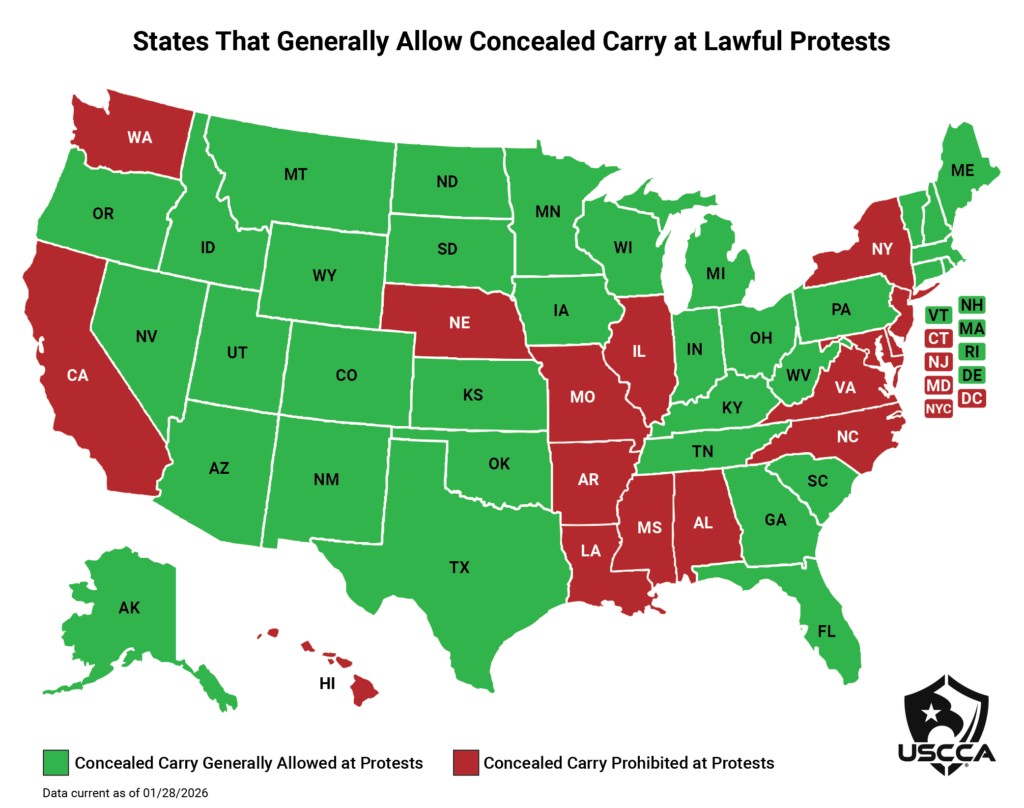
States That May Allow Concealed Carry at Protests
Many states do not have specific laws targeting protests. The following states generally default to “lawful carry is lawful,” even at a protest, but other elements can make otherwise lawful carry unlawful quickly. Sensitive-place laws, riot declarations and other restrictions still apply.
- Alaska
- Arizona
- Colorado
- Delaware
- Florida
- Georgia
- Idaho
- Indiana
- Iowa
- Kansas
- Kentucky
- Maine
- Massachusetts
- Michigan
- Minnesota
- Missouri
- Montana
- Nevada
- New Hampshire
- New Mexico
- North Dakota
- Ohio
- Oklahoma
- Oregon
- Pennsylvania
- Rhode Island
- South Carolina
- South Dakota
- Tennessee
- Texas
- Utah
- Vermont
- West Virginia
- Wisconsin
- Wyoming
Other Legal Restrictions That May Apply at Protests
Lawful carry can quickly become illegal if you are violating another law at the same time, such as brandishing or threatening behavior, carrying while intoxicated, or violating other laws related to what you must also have in your possession while carrying, masks, disorderly conduct or riot-related restrictions.
Even in states that allow public carry, there may be location-specific restrictions that apply whether or not a protest is occurring.
- Sensitive places such as schools, courthouses, polling places and government buildings are commonly restricted under state law.
- Local governments generally cannot impose gun regulations that exceed state law due to preemption in many states, but special event permits or injunctions may temporarily alter what is allowed at specific times or locations.
States/Jurisdictions That Restrict Carry at Protests
These states (and Washington D.C.) have explicit protest/permitted-gathering restrictions (or very closely targeted “public gathering” language that covers protests when a permit is required):
- Alabama generally restricts carrying a pistol at a public demonstration, with defined exceptions.
- Arkansas includes restrictions related to public demonstrations/related conduct.
- California treats public gatherings or special events that require permits as “sensitive places,” prohibiting concealed carry at the event and on adjacent streets or sidewalks within up to 1,000 feet.
Penal Code § 26230(a)(10) - Connecticut carry law includes restrictions related to the display or open carry of firearms, which can become relevant in the context of protests or demonstrations.
Conn. Gen. Stat. § 29-35 (current version) - The District of Columbia prohibits carrying firearms within a designated perimeter (up to 1,000 feet) of a demonstration after notice by signs or law enforcement order.
D.C. Code § 7–2509.07 - Hawaii defines permitted public gatherings, including demonstrations and protests, as sensitive places.
HRS § 134-9.1(15) - Illinois prohibits firearms at “any public gathering or special event […] that requires the issuance of a permit,” with a limited walk-through exception, allowing brief passage through the area without stopping.
430 ILCS 66/65(a)(10) - Louisiana law restricts firearms at parades, a legal classification that includes many protests or demonstrations.
La. Rev. Stat. 14:95.2.1 - Maryland prohibits firearm possession at a public demonstration and within 1,000 feet of the event after law enforcement provides notice or issues an order.
Md. Crim. Law § 4-208 (and recently upheld by the 4th Circuit on that point) - Mississippi specifies that a concealed carry license does not authorize participants in a permitted parade or demonstration to carry.
Miss. Code § 45-9-101(13) - Nebraska prohibits concealed handguns at listed locations, including “political rally or fundraiser,” which may include protest-style events.
Neb. Rev. Stat. § 28-1202.01(3) - New Jersey prohibits firearm carry within 100 feet of a permitted “public gathering, demonstration or event” while the event is taking place.
N.J.S.A. 2C:58-4.6(7)(a)(6) (as enacted in P.L.2022 c.131) - New York designates certain permitted gatherings and protest-related locations as sensitive places where firearm carry is restricted.
Penal Law § 265.01-e for the categories - North Carolina prohibits weapons at parades, funeral processions, picket lines and demonstrations.
N.C.G.S. 14-277.2 - Washington prohibits open carry at permitted demonstrations and within 250 feet of the event after notice or law enforcement order.
RCW 9.41.300
Firearms laws are complex and vary significantly between states and municipalities. It’s important to research the specific laws applicable where you live or plan to attend a demonstration.
Carrying During a Riot
While protests are often lawful assemblies, the legal analysis changes dramatically once an event becomes a riot or unlawful assembly. Carrying a firearm at a riot is either explicitly illegal or becomes illegal the moment the event is legally classified as a riot.
Once authorities declare a riot or unlawful assembly, orders to disperse become lawful commands. Remaining armed after that point often constitutes a separate criminal offense, even if carrying was lawful moments earlier.
What Is a Riot?
The federal definition of a riot as outlined in 18 U.S.C. § 2102, part of the Anti-Riot Act, defines a riot as a public disturbance involving acts or threats of violence by an assemblage of three or more persons that creates a clear and present danger of damage, injury, or harm.
That is a very loose definition and officials can declare an otherwise legal gathering a riot if they feel those or other conditions apply.
Common elements found in most state statutes include:
- Three or more persons
- Use or threat of force or violence
- Disturbance of the public peace
- Risk of injury or actual injury
- Damage to property
A riot or unlawful assembly can be declared by:
- On-scene law enforcement commanders
- Police chiefs or sheriffs
- Governors acting under emergency powers
- Mayors or local executives under local emergency authority
A formal script is not required.
Once a lawful order to disperse is issued by authorized officials, the legal status of the gathering changes immediately. Remaining on the scene can result in arrest and enhanced charges. Being armed increases the danger and the possible penalties.
Firearm Possession During a Declared Riot
Many states explicitly prohibit firearms at riots. In these states, it is illegal to possess or carry a firearm while participating in a riot, while remaining at the scene after a riot is declared, or remaining within a defined area once a riot or unlawful assembly has been declared.
Even in states without an explicit statute banning firearms at riots, possession is still criminalized indirectly.
In gun-friendly states, charges such as disorderly conduct, failure to disperse, brandishing or menacing, reckless endangerment, participating in a riot, and obstruction of law enforcement commonly apply once violence begins. The presence of a firearm frequently elevates the severity of those charges.
In many states, participating in a riot is a felony. Possession of a firearm during the commission of a felony often results in an additional felony charge.
Self-Defense at a Riot
Self-defense does not justify remaining armed in a riot.
Courts consistently hold that a person cannot lawfully remain at a riot and claim self-defense. Once a riot is declared and you are ordered to disperse, you must leave or face arrest. Self-defense does not excuse staying in a known violent public disturbance. Even in stand-your-ground states, the legal duty to retreat can reattach once an event becomes unlawful.
If you are armed, the law expects you to leave, not to stay. Do not try to provide security. Do not be prepared to respond or assist. Just leave.
Responsible Considerations for Armed Citizens
Carrying a firearm to a public assembly raises practical and legal considerations beyond whether it is technically permitted. Peacefully assembling and expressing your views is as much a constitutional right as the right to bear arms. However, attending a protest combined with the exercise of gun rights can create risk due to large crowds, heightened emotions, unpredictable behavior from participants, and rapidly changing conditions.
If you choose to attend a protest as a legally armed citizen, you should proceed with extra caution. Understanding the law ahead of time and making informed decisions about personal safety and de-escalation can help reduce your legal and personal risk in any public gathering. Practice good situational awareness and leave the protest if things begin to escalate to avoid danger.
The information contained on this website is provided as a service to USCCA, Inc. members and the concealed carry community and does not constitute legal advice. Although we attempt to address all areas of concealed carry laws in all states, we make no claims, representations, warranties, promises or guarantees as to the accuracy, completeness or adequacy of the information disclosed. Legal advice must always be tailored to the individual facts and circumstances of each individual case. Laws are constantly changing, and, as such, nothing contained on this website should be used as a substitute for the advice of a lawyer.
❓FAQs
Can you carry concealed at a protest?
There is no single federal law that governs carrying a firearm at a protest. Legality depends on state and local law, including whether open or concealed carry is allowed, whether a permit is required, and whether the location has restrictions. Some states restrict firearms at protests or permitted public gatherings.
Which states allow guns at protests?
Many states do not have protest-specific laws and generally default to “lawful carry is lawful.” Other states and jurisdictions, including Washington, D.C., have statutes restricting firearms at protests, demonstrations, parades, or permitted public gatherings. See the USCCA’s “Can You Carry a Gun at a Protest?” state-by-state breakdown for the specific lists.
Will a concealed carry permit allow you to carry at a protest?
A concealed carry permit does not override state laws that prohibit firearms at certain locations or during specific events, including permitted demonstrations, riots, or unlawful assemblies. In states with protest-specific restrictions or sensitive-place laws, permit holders are subject to the same prohibitions as everyone else.
What happens if a protest turns into a riot?
Carrying at a protest may be lawful depending on state and local law. Carrying during a riot is either explicitly illegal or becomes illegal once the event is legally classified as a riot or unlawful assembly. Lawful orders to disperse become enforceable commands, and remaining at the scene can result in arrest. In many states, carrying a firearm during a riot is explicitly illegal.
Can police stop or disarm you if you’re carrying a gun at a protest?
Law enforcement officers may lawfully stop or temporarily disarm individuals at a protest under certain circumstances, especially when public safety concerns are present. This is more likely if officers are issuing lawful orders to disperse or if the situation is escalating. Even when carry is otherwise lawful, police authority and discretion increase significantly at large public gatherings.
Is it safe to carry a gun at a protest?
Carrying to a public assembly can create risk due to large crowds, heightened emotions, unpredictable behavior, and rapidly changing conditions. If a protest escalates or is declared a riot or unlawful assembly, the legal status can change immediately. Know the applicable laws ahead of time, proceed with extra caution, practice good situational awareness, and leave if things begin to escalate.
Find the original article in its entirety at US Concealed Carry.
READ NEXT: Congress Must Not Allow Foreign Governments To Censor American Speech