Coalition plans to reopen critical shipping lane after months of disruption…
The United Kingdom and France are finalizing plans for a multinational mine-clearing operation in the Strait of Hormuz that could begin shortly after any ceasefire agreement between the United States and Iran, according to Bloomberg.
The proposed mission would involve 15 nations and would include direct communication with Tehran to prevent misunderstandings as coalition vessels work to reopen one of the world’s most important maritime chokepoints.
According to Bloomberg, the UK and France have almost finished formulating a plan to implement a mine/clearing operation in the Strait of Hormuz, following a potential deal between the U.S. and Iran on a lasting ceasefire. The plan would be a multinational effort and comes… pic.twitter.com/pWZ8MUlJ1y
— OSINTdefender (@sentdefender) June 4, 2026
The effort comes after months of disruption in the Gulf following the 2026 escalation that began when U.S. and Israeli forces struck Iranian nuclear facilities. In response, Iran laid naval mines in the Strait of Hormuz, effectively closing a waterway responsible for roughly one-fifth of global oil shipments.
The closure has triggered one of the largest oil supply disruptions in modern history, removing an estimated 10 million to 14 million barrels per day or more from global seaborne oil trade.
New technology changes the mine-clearing mission
A key part of the operation will be the use of autonomous mine-hunting systems, a technology that is rapidly transforming naval mine warfare.
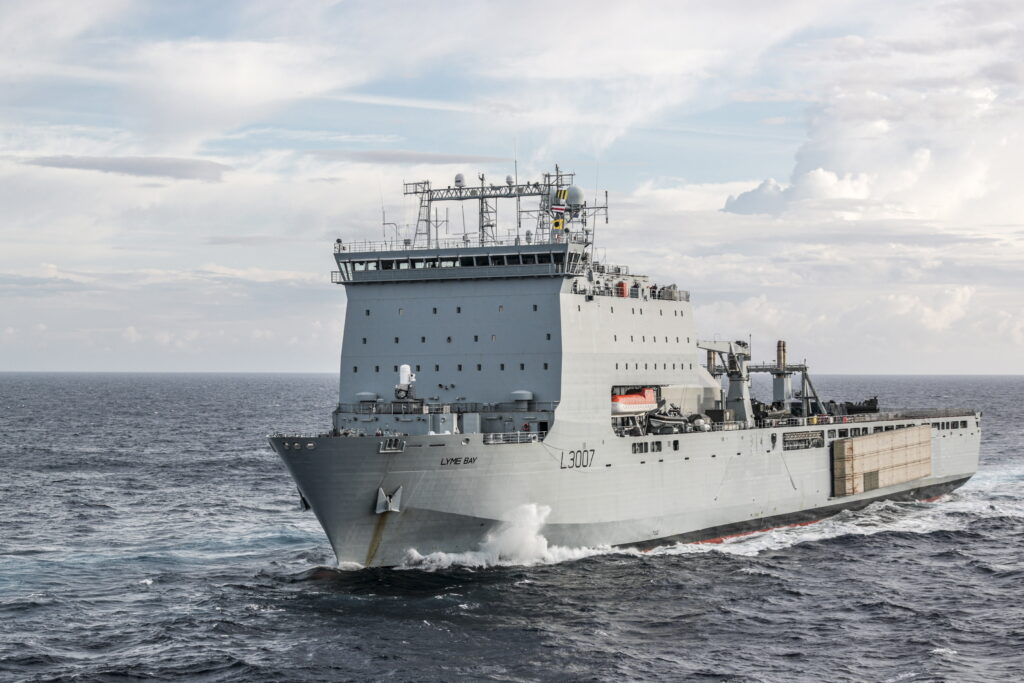
The United Kingdom is expected to contribute assets including the RFA Lyme Bay, a Bay-class auxiliary dock landing ship equipped to support advanced mine countermeasure operations.
Unlike traditional minehunters, which required sailors to operate directly in dangerous waters, modern autonomous systems rely on uncrewed vehicles, advanced sonar, artificial intelligence, and remote operators to locate and neutralize mines from a safe distance.
The technology is designed as a modular “system of systems.”
Uncrewed Surface Vehicles, or USVs, act as mobile platforms that can deploy equipment, tow sensors, and relay communications. Autonomous Underwater Vehicles survey large sections of the seabed independently using high-resolution sonar and other sensors. Once a potential mine is identified, Remotely Operated Vehicles can be sent in for close inspection and, if necessary, neutralization.
The result is a process that is significantly faster and safer than older methods.
Traditional mine-clearing operations could take weeks or months and often required ships and crews to operate directly in minefields. Modern autonomous systems can cover much larger areas, identify threats with greater precision, and handle increasingly sophisticated “smart” mines designed to target specific ship signatures.
Reopening Hormuz is critical for energy markets
The stakes extend far beyond military operations.
The Strait of Hormuz serves as the primary export route for much of the oil produced in the Persian Gulf. Since the waterway’s effective closure in early March, energy markets have experienced significant volatility.
U.S. gasoline prices have jumped roughly $1.04 to $1.50 per gallon nationally since the outbreak of the Iran War. Certain regions — particularly California — have seen average prices surpass $4.26 per gallon. Diesel and jet fuel markets faced even sharper pressure, contributing to transportation cost increases throughout the economy.
Natural gas markets were also affected. Qatar, one of the world’s largest exporters of liquefied natural gas, depends heavily on access through Hormuz. Disruptions to those shipments pushed up energy costs across Asia and added pressure to already strained global gas markets.
Higher fuel prices eventually spread through the broader economy, increasing costs for transportation, food production, chemicals, manufacturing, and other sectors. Some estimates suggested petroleum product prices rose by 10% to 12% or more during the height of the disruption.
A gradual recovery remains likely
Even if a ceasefire agreement is reached and mine-clearing operations begin immediately, a full recovery of shipping traffic is unlikely to happen overnight.
Removing naval mines is a complex and time-consuming process, particularly in a narrow waterway carrying some of the world’s busiest commercial traffic. Shipping companies, insurers, and energy producers will also need confidence that the route is secure before normal operations fully resume.
Still, the deployment of advanced autonomous mine-hunting systems could significantly shorten the timeline compared with previous generations of mine-clearing efforts.
The United Kingdom, France, and the United States have been at the forefront of developing these technologies, and military planners increasingly view them as essential tools for maintaining access to critical waterways during periods of conflict.
For global energy markets, the success of the operation could mark the first major step toward restoring normal oil and gas flows after months of disruption. Prices remain highly sensitive to ceasefire negotiations, mine-clearing progress, and inventory levels, but a successful reopening of the Strait of Hormuz would likely ease pressure on consumers and businesses worldwide.
READ NEXT: Platner Accuser Blasts New York Times: ‘This Really Was A Set Up’