






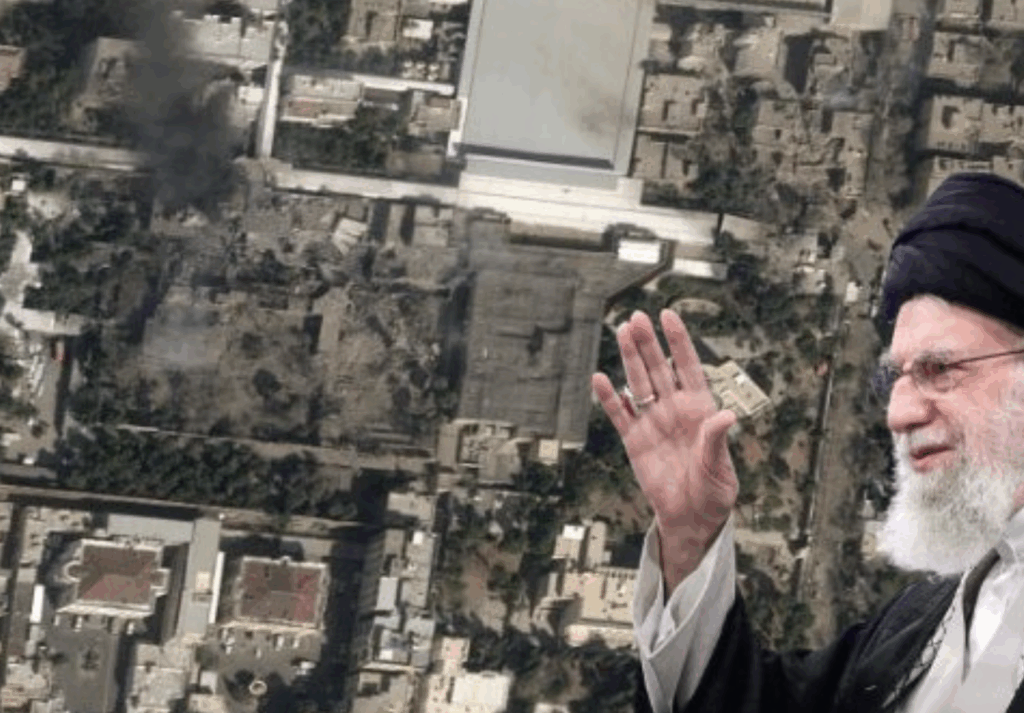
Last night, President Donald Trump ordered targeted military strikes against Iran. Critics immediately declared the action unconstitutional. Representative Thomas Massie and others argued that, absent a formal declaration of war, the president had exceeded his authority. These objections are serious. They deserve a serious reply. When examined carefully, the strike stands on firm constitutional ground. It is lawful under Article II. It is consistent with the War Powers Resolution. It accords with modern presidential precedent across both parties.
Begin with the Constitution itself. Article I grants Congress the power to declare war. Article II names the president commander in chief of the armed forces. These clauses are not redundant. Nor are they mutually exclusive. They allocate different forms of authority. Congress decides whether to initiate a state of general war. The president directs the use of military force in defense of national interests and U.S. forces. The question is not whether Congress has war powers. It plainly does. The question is whether every discrete use of force constitutes a war in the constitutional sense. History answers no.
Imagine a naval commander whose ship is threatened by hostile missiles. Must he first convene a legislative body before responding? Of course not. The commander in chief clause would be hollow if it denied the executive the power to repel threats or conduct limited operations necessary to protect American lives and interests. From the earliest days of the Republic, presidents have used force short of declared war. Thomas Jefferson ordered naval actions against the Barbary pirates. James Madison approved limited engagements before formal declarations. The practice is longstanding.
After World War II, the pattern became even clearer. Presidents of both parties have conducted military operations without formal declarations of war. Korea, Vietnam, Grenada, Panama, Kosovo, Libya, Syria. In each case, the executive relied on Article II authority, sometimes supplemented by statutory authorization, but rarely dependent on a formal declaration. One may debate the wisdom of each action. But the legality has rested on a shared understanding that the president possesses independent constitutional authority to use limited force.
Consider how modern presidents have treated the War Powers Resolution of 1973. The Resolution requires that the president report to Congress within 48 hours of introducing US forces into hostilities and limits such engagements to 60 days, absent congressional authorization. Every modern president has complied with the 48-hour reporting requirement. Yet each has done so while maintaining that the Resolution does not diminish Article II authority.
Ronald Reagan reported to Congress after initiating the 1983 Grenada invasion. He did not concede that congressional permission was required to begin. George H W Bush notified Congress following the 1989 Panama operation. Bill Clinton transmitted notice during the 1999 Kosovo air campaign. George W Bush filed notice after launching the 2003 Iraq invasion. Barack Obama reported within 48 hours of commencing the 2011 Libya strikes. Joe Biden notified Congress following his 2023 Syria airstrikes. In each instance, the president acted absent a direct attack on the U.S. homeland. In each instance, a formal War Powers report was transmitted. In each instance, the executive branch described its submission as consistent with the Resolution, not as a concession that Article II authority was subordinate to it.
This pattern matters. Law is not only text. It is also practice. When all branches repeatedly operate under a shared framework, that framework acquires constitutional significance. The Iran strike fits squarely within that settled pattern. A limited operation, justified by threats to US forces and allies, reported to Congress within the statutory window, undertaken by the Commander in Chief in the exercise of independent authority.
Critics respond that Article I gives Congress the sole power to initiate hostilities. But this overreads the Declare War Clause. The framers distinguished between declaring war and conducting military operations. A declaration changes the legal state between nations. It triggers domestic consequences. It authorizes the full mobilization of national resources. A targeted strike does not necessarily do these things. The constitutional category of war is narrower than the category of military force.
Moreover, Congress has already legislated in this domain. The 2001 and 2002 Authorizations for Use of Military Force remain on the books. Presidents have cited these AUMFs to justify actions against terrorist threats and destabilizing regimes in the region. Even if one argues that the Iran strike rests primarily on Article II authority, the broader statutory landscape demonstrates that Congress has long authorized force in contexts that overlap with Iranian conduct and regional threats. The executive does not act in a statutory vacuum.
What of the War Powers Resolution’s 60-day clock? The answer is straightforward. The clock limits sustained hostilities. It does not forbid initial action. If the Iran operation remains limited in scope and duration, it falls comfortably within the historical practice of short-term engagements. Should the conflict expand, Congress retains the power of the purse and the authority to enact binding restrictions. The constitutional system anticipates dialogue, not paralysis.
— @amuse (@amuse) January 10, 2026
Some object that absent an attack on U.S. soil, the president lacks defensive authority. But this too misstates the doctrine. Presidents have repeatedly acted to defend U.S. personnel abroad, protect allies, deter escalation, and enforce red lines concerning weapons proliferation and terrorism. Obama’s Libya strikes were not triggered by an invasion of the U.S. homeland. Biden’s Syria and Yemen actions were justified by regional threats and attacks on U.S. partners. Yet few argued that the mere absence of a domestic invasion stripped the president of constitutional authority. The relevant inquiry is whether the use of force serves national defense and foreign policy interests entrusted to the executive.
— @amuse (@amuse) January 4, 2026
Trump has justified the Iran strikes based on Iranian attacks on U.S. forces and allies, Iran’s designation as a state sponsor of terrorism, and its persistent defiance concerning nuclear development. One may debate the intelligence assessments. One may question strategic prudence. But constitutionality turns on authority, not on unanimous agreement about policy. The commander in chief must sometimes act on incomplete information. The Constitution entrusts that judgment to a single executive precisely because speed and secrecy are often indispensable.
Here, a familiar confusion arises. Some believe that recognizing executive authority implies endorsing unchecked power. It does not. The War Powers framework creates a structured interaction. The president acts, reports within 48 hours, and continues engagement only if Congress does not object within 60 days. Congress may authorize, restrict, or defund. This equilibrium has governed American military practice for 50 years. The Iran strike sits comfortably within it.
To see the point, consider a sculptor holding her finished work aloft. If we reject the possibility of two objects occupying the same space, we must choose what she holds. Is it clay or statue? The choice depends on our theory of identity. Likewise here. If we define every use of force as war, then the Declare War Clause swallows the commander in chief clause. But if we distinguish general war from limited hostilities, as historical practice does, then the constitutional structure becomes coherent. The president may initiate limited force. Congress may escalate, authorize, or terminate.
The critics’ strongest argument is not textual but prudential. They fear executive overreach. That fear is not irrational. Yet prudential concerns do not rewrite constitutional allocations. Moreover, the historical record shows bipartisan reliance on the same theory of executive power. Clinton relied on it in Kosovo. Obama relied on it in Libya. Biden relied on it in Syria. If one now denies it categorically, one must explain why decades of consistent practice by both parties were unconstitutional. That is a heavy burden.
Finally, it bears emphasis that compliance with the War Powers Resolution does not imply surrender of constitutional prerogative. Presidents have uniformly described their reports as submitted consistent with the Resolution. This phrasing is deliberate. It reflects the executive branch’s view that Article II authority exists independently, even as Congress may impose procedural requirements such as notification. The Iran strike, followed by timely reporting, continues this settled tradition.
In constitutional law, precedent is not confined to judicial opinions. It includes the durable practices of the political branches. For more than half a century, presidents have initiated limited military actions without prior declarations of war, have notified Congress within 48 hours, and have maintained that their authority derives from Article II. The strike on Iran stands in that lineage.
One may oppose the policy. One may demand debate. Congress remains free to exercise its powers. But the claim that the initial action is per se unconstitutional cannot be sustained in light of text, structure, and consistent modern practice. The Constitution creates an energetic executive, not a ceremonial one. When national security demands swift action, the commander in chief may act, report, and then engage Congress in the constitutional dialogue that follows.
— @amuse (@amuse) January 6, 2026
— @amuse (@amuse) January 3, 2026
If you enjoy my work, please subscribe: https://x.com/amuse.
Sponsored by the John Milton Freedom Foundation, a nonprofit dedicated to helping independent journalists overcome formidable challenges in today’s media landscape and bring crucial stories to you.
READ NEXT: State Media Announces World Leader’s Death — Chaos Or Calm Ahead?




















Nope.
100% Legal. Exactly what Obama and Clinton did. Biden too but he doesn’t remember.