


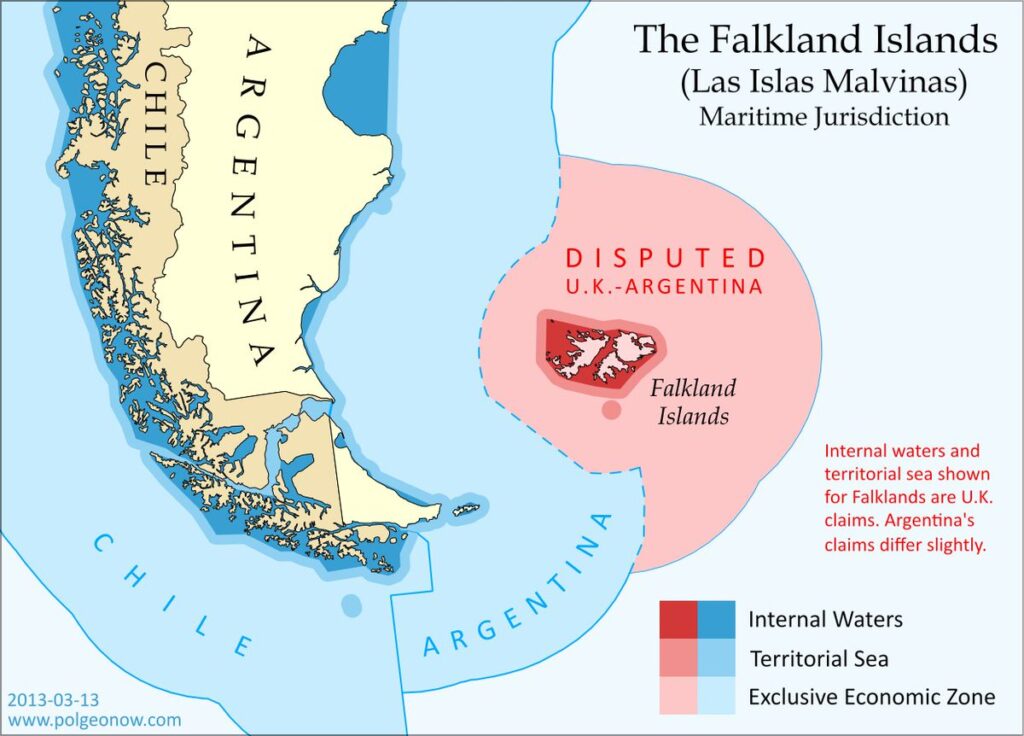
The Falkland Islands question is usually treated in the American press as settled, as if the 1982 war closed the file and the only remaining task is to admire Margaret Thatcher’s resolve. That treatment is wrong on the history, wrong on the law, and wrong on the long arc of American policy in the Western Hemisphere. The United States has never endorsed British title to the islands. It has, for 60 years, supported a negotiated transfer. Our closest hemispheric neighbors have said the same thing, in the same forum, in nearly every decade since decolonization began. The current U.S. posture, which amounts to polite silence while London treats the matter as closed, is a departure from the clear pattern of American diplomacy, not a continuation of it. Conservatives who take the Monroe Doctrine seriously, and who believe that strong allies sometimes need to be told the truth, should say so plainly.
A recent development makes that case harder to ignore. The Guardian has reported on a leaked Pentagon memo proposing a formal review of the United Kingdom’s sovereignty claim over the Falklands, among other European “overseas territories” in the hemisphere. The memo itself is not a policy declaration, and it is not, on the evidence available, a punitive instrument aimed at punishing an ally. It is something more revealing than that. It is a written confirmation that the American defense establishment, at the working level, is still operating on the same premise that State Department officials were operating on in the early 1980s, namely that British administration of these islands is an unresolved question that American policy should treat as negotiable rather than as closed. That continuity, across four decades, across administrations of both parties, across the entire post-Cold-War period, is the story. The leak is news. The underlying thinking is not.
Start with the United Nations record, because the record is unusually clean. In 1965, the General Assembly adopted Resolution 2065, which recognized the existence of a sovereignty dispute between Argentina and the United Kingdom and invited the two governments to negotiate. It passed without a single negative vote. In 1973, Resolution 3160 urged acceleration of those negotiations and passed 116 to 0, with 14 abstentions. In 1976, Resolution 31/49 asked both parties to refrain from unilateral modifications of the situation while talks continued, and it passed 102 to 1, the lone “no” coming from the United Kingdom itself. In 1982, after the war, the General Assembly returned to the same formula in Resolution 37/9, which again demanded that Britain sit down and negotiate sovereignty with Argentina. That resolution passed 90 to 12, with 52 abstentions, and the United States voted in favor.
The American “yes” on 37/9 is the single most important fact that a U.S. reader should know. It was cast months after British troops had retaken the islands. It was cast after the political pressure to stand with London in its moment of victory was at its height. It was cast anyway. Washington explained that vote by reiterating that the United States had always supported a negotiated settlement, and had never endorsed either party’s claim of sovereignty. That is still the American position on paper. It is simply not the American posture in practice, and the gap between the two is the diplomatic hole into which this issue has fallen.
Some readers will ask at this point, reasonably, whether those U.N. votes represent anything more than Cold War theater from Third World capitals looking to embarrass the West. They do. Resolution 2065 predates most of the anti-colonial posturing that characterized the later General Assembly. The vote was 94 in favor, 0 against, 14 abstentions, which means Britain itself did not vote against the proposition that this was a genuine sovereignty dispute requiring bilateral talks. Resolution 3160 was adopted by a margin that no serious reading of the Cold War bloc politics of 1973 can explain away. Subsequent resolutions through the 1980s, 38/12, 39/6, 40/21, and 41/40, kept the same line by large margins. If one wants to insist that the whole world was wrong for 20 years straight, one is welcome to that position. It is not a conservative position in any recognizable sense. It is the position of a London editorial page.
The American diplomatic record beneath those public votes is even more striking, and it is the part of the story that rarely reaches U.S. audiences. In 1981, the year before the war, the U.S. Embassy in Buenos Aires prepared an airgram that predicted Argentina would eventually regain sovereignty over the islands through bilateral negotiations. The same document described British rule over the archipelago as “anachronistic colonial rule.” That was not the language of a left-wing NGO. That was the sober internal assessment of American foreign service officers on the ground, writing for their own department, with no audience to perform for. Declassified records from the same period capture British officials privately telling their American counterparts that London was considering ceding sovereignty and leasing the islands back, on something resembling the Hong Kong model that would later be applied to the New Territories. Lord Carrington’s preferred solution before the war was reportedly exactly that, a cession of title followed by a long lease. Nicholas Ridley, then a minister in Margaret Thatcher’s own government, told Parliament in 1980 that the options under consideration included both freezing the dispute and exchanging sovereignty for a long lease-back arrangement.
The leaked Pentagon memo sits directly in that lineage. For 40 years, the State Department has been quietly operating on the assumption that a negotiated transfer is the likely eventual endpoint, while limiting its public voice to support for the U.N.’s repeated calls for dialogue. The memo now under discussion at the Pentagon extends that same analytic posture into the current decade, asking whether American support for European “overseas territories” in the hemisphere, including the Falklands, still serves U.S. strategic interests. The honest answer, if one reads the 1981 embassy airgram alongside the 2024 Brasilia Consensus alongside the 2025 hemispheric landscape, is that the analysis has never meaningfully changed. The islands remain a disputed decolonization case in every major forum outside London. Our own internal documents have said so for two generations. A written review of that position, conducted by serious people in the executive branch, is not a rupture. It is a long-overdue audit.
This matters because the standard English-language retelling treats the British claim as self-evident, ancient, and never seriously questioned by serious people. The British government itself questioned it, at ministerial level, on the floor of the House of Commons, within living memory. A 2022 House of Lords Library review summarized the late-1970s British diplomatic preference as a leaseback scheme. A 1982 Commons debate, held in the shadow of the Argentine invasion, acknowledged on the record that British governments had for two decades been willing to negotiate sovereignty. Those are not marginal documents. Those are the primary British sources. The notion that sovereignty was never on the table is a retrospective construction, assembled after the military victory made it politically unthinkable to admit that cession had been a live option.
Readers trained in U.S. political rhetoric will recognize the structure here. A policy that was perfectly discussable before a military event becomes undiscussable after it, not because the underlying legal or moral facts changed, but because the political cost of acknowledging continuity rose. The conservative instinct, the real conservative instinct, is to notice that pattern rather than defer to it. Edmund Burke did not ask what was politically convenient to say about the American colonies in 1775. He asked what was actually true about them, and he said so in the Commons at considerable cost. The Falklands question deserves that same kind of honest treatment from American conservatives, rather than reflexive deference to the British line.
The deeper American interest here is the Monroe Doctrine, and this is where the op-ed turns from diplomatic history to something closer to first principles. In 1823, President James Monroe told Congress, and through Congress told Europe, that the American hemisphere was closed to new colonization and to the extension of European political systems. The Falklands case has always sat awkwardly inside that doctrine, because Britain reasserted control of the islands in 1833, a full decade after Monroe’s message, and did so by sending a warship to remove Argentine military authorities and reimpose colonial administration. A 1954 State Department historical paper, prepared for internal use, explicitly recorded that Latin American states had long tied the Falklands to hemisphere-wide hostility toward extra-continental colonial occupation. That paper captured what American foreign policy professionals have understood for a long time. Our neighbors treat the Falklands as a live Monroe Doctrine case, and they have been treating it that way since the 1830s.
A reader might ask, reasonably, whether the Monroe Doctrine applies to a possession that predates it in any form. The answer in Latin American state practice has been consistent for two centuries. The 1833 reassertion was an act of extra-continental power projection against a newly independent Western Hemisphere republic that had declared succession from Spain in 1816 and taken formal possession through Colonel Jewett in 1820. Argentina’s title claim is not a modern nationalist invention. It rests on the classic international-law doctrine of uti possidetis, the principle that newly independent states inherit the territorial boundaries of the colonial administrative units from which they emerged. That doctrine is the basis on which every Spanish-American republic, from Mexico to Chile, traces its borders. If it is sound enough to define the boundaries of our immediate southern neighbor, it is sound enough to define the southern edge of Argentina.
The regional consensus has hardened rather than weakened over time. The Organization of American States adopted declarations on the question of the Malvinas Islands in both 2023 and 2024, each reiterating support for renewed negotiations. Brazil’s foreign ministry in 2024 reaffirmed support for Argentina’s “legitimate rights” in the sovereignty dispute. The 2024 Brasilia Consensus intervention at the U.N. Special Committee on Decolonization said South American states supported Argentina’s legitimate rights and opposed British unilateral acts in the disputed area. The Community of Latin American and Caribbean States, MERCOSUR, and essentially every major hemispheric body have taken the same position. On this issue, the Western Hemisphere speaks with a single voice. The United States is the only major hemispheric power that mumbles.
Now consider what that mumbling costs us. The Trump administration has correctly identified the Western Hemisphere as the proper focus of American grand strategy, and has pushed back on Chinese penetration of South American economies, on Iranian footholds in the region, and on the broader drift of Latin American capitals toward Beijing. Argentina under President Milei has been one of the most pro-American governments in the region in a generation. Javier Milei is a libertarian who has praised Margaret Thatcher personally while continuing to insist that the Malvinas are Argentine, because every serious Argentine political figure of every ideological persuasion insists on that point. It is a national consensus, not a partisan one. Continuing to treat the Falklands question as closed gives Beijing and Moscow a permanent, cost-free opening to position themselves as the real anti-colonial powers in the hemisphere, and it forces friendly governments in Buenos Aires to perform distance from Washington on an issue where the American record, if told honestly, is actually on their side.
There is also the question of what Britain itself has signaled, quietly, over time. London’s own parliamentary library acknowledges that U.N. decolonization texts on this dispute consistently omit direct reference to self-determination, and instead refer to the “interests” of the inhabitants. That language is not accidental. It was negotiated that way in 1965, when British diplomats were in the room, and it was preserved that way through every subsequent resolution. The distinction between “interests” and “wishes” is the whole ballgame in decolonization law. “Wishes” implies a plebiscite. “Interests” implies that the welfare of the inhabitants must be protected in the negotiated settlement, but does not give those inhabitants a unilateral veto over the sovereignty question itself. Britain accepted that framing at the time because it was the reasonable framing.
What changed was not the law. What changed was the 1982 war, after which London elevated the islanders’ preference from one input into the settlement into the entire content of the settlement. That elevation has no grounding in the U.N. texts. It has no grounding in the historical British position before 1982. It has no grounding in the classic law of decolonization, which has never treated small settler-descended populations as holders of absolute sovereignty vetoes. It is a post-hoc political rule, manufactured to freeze in place the military outcome of a war Britain happens to have won. American conservatives who believe that outcomes should be governed by law rather than by the most recent military fact on the ground should recognize that move for what it is.
None of this requires accepting that Argentina’s position is perfect, or that the islanders’ concerns should be ignored, or that a transfer tomorrow morning is either feasible or desirable. A serious negotiated settlement would address language rights, property rights, pension portability, continuing British passport access for existing residents, and guarantees against political retribution. It might involve a transition period, a leaseback structure of the kind Lord Carrington originally preferred, or a condominium arrangement of the kind occasionally discussed in the diplomatic literature. What it would not involve is the current posture, in which Britain treats a 60-year U.N. record, a two-century hemispheric consensus, and its own historical willingness to cede sovereignty as if none of them existed.
This is the context in which the leaked Pentagon memo should be read. The Guardian‘s reporting describes a document that proposes reviewing American support for European overseas territories in the hemisphere, with the Falklands among them. That is not an act of diplomatic aggression. It is an act of institutional housekeeping. The review asks whether a position that was adopted in one strategic environment still makes sense in a very different one, and it aligns with more than 40 years of consistent U.S. policy thinking, inherited from the Reagan-era embassy analysts who predicted eventual Argentine sovereignty, carried through the Clinton and Bush and Obama administrations as a quiet preference for negotiation, and now surfacing again in a Pentagon document because the strategic environment in the hemisphere has shifted. There is no evidence in the reporting that the review is meant as punishment of an ally. There is substantial evidence that it is meant as clarity, of a kind this question has lacked for a generation.
The American role in all of this is the narrow and specific one Washington has always claimed for itself. We have never endorsed either sovereign. We have consistently supported negotiation. We should now say, clearly and at the presidential level, that negotiation means actual negotiation, not an indefinite British veto on whether negotiation can occur. That is not a departure from American policy. It is a reaffirmation of the policy we voted for at the General Assembly in 1965, in 1973, in 1976, and most importantly in 1982, when Ronald Reagan’s own administration cast the American ballot in favor of Resolution 37/9 and then explained that vote by saying we had always supported a negotiated settlement. We did. We still do. The leaked memo is not a scandal. It is a reminder. It is time to act like it.
If you enjoy my work, please subscribe: https://x.com/amuse.
Sponsored by the John Milton Freedom Foundation, a nonprofit dedicated to helping independent journalists overcome formidable challenges in today’s media landscape and bring crucial stories to you.
READ NEXT: Trump’s New Currency Plan Could Remake Wallets Overnight


















So who should we give Guam and all those other islands to? Duh!
England settled that island before anyone else was there.
It’s belongs to England!
Just because it is closer to Argentina than to England doesn’t mean that it belongs to them.
If that was the case, the American owned islands in the Caribbean Ocean should go to Cuba.
I DON’T THINK SO!