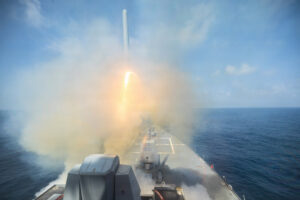
Iran launched missiles and drones at several Gulf states hosting U.S. military forces Thursday after the United States carried out another wave of airstrikes against Iranian targets, marking the fifth straight day of renewed fighting between Washington and Tehran. Egypt condemned the attacks as a “grave escalation” and warned they threaten regional stability.
U.S. Central Command (CENTCOM) forces have disabled the Curaçao-flagged tanker M/T Belma after the vessel ignored repeated warnings and continued toward Kharg Island, Iran's primary oil export terminal, in violation of the reimposed U.S. naval blockade.
— OSINTdefender (@sentdefender) July 15, 2026
According to CENTCOM, a… pic.twitter.com/M2EQpUPHxE
The latest exchange targeted American military facilities in Bahrain, Kuwait, and Jordan, prompting Bahrain and Kuwait to activate their air defense systems. Both countries reported intercepting incoming Iranian projectiles.
Footage, reportedly taken during Iranian drone and missile strikes against Kuwait earlier, shows a Shahed-136 impact. The U.S. continues to trade strikes with Iran, as targets inside Bahrain and Kuwait are now bearing the brunt of Iranian fires. pic.twitter.com/AC07mtqi96
— OSINTdefender (@sentdefender) July 15, 2026
Egypt denounces attacks on Arab states
Egypt’s Foreign Ministry sharply criticized Iran’s strikes, calling them a violation of the sovereignty and security of Arab nations.
In a statement, Cairo described the attacks as a “grave escalation” that undermines regional peace and stability, while urging all parties to avoid further military escalation and return to diplomacy.
Iran declared the Strait of Hormuz an inviolable "red line" on Thursday, warning that any U.S. strikes on Iranian infrastructure, including the power plants and bridges President Donald J. Trump has threatened to target, would trigger retaliatory strikes against critical… pic.twitter.com/lVQinqHRZ8
— OSINTdefender (@sentdefender) July 16, 2026
Egypt has repeatedly sought to position itself as a voice for de-escalation throughout the widening U.S.-Iran conflict while maintaining close security ties with Gulf allies.
U.S. expands air campaign
The Iranian retaliation followed a fresh round of U.S. strikes against command centers, air defense systems, missile and drone facilities, and coastal surveillance sites, including targets near Bandar Abbas on the Strait of Hormuz.
U.S. Central Command said the operation was intended to degrade Iran’s ability to threaten commercial shipping after Tehran renewed attacks on vessels transiting the strategic waterway. U.S. forces also disabled a Curaçao-flagged tanker that officials said was attempting to violate the American naval blockade of Iran.
Separately, U.S. forces struck coastal defense and cruise missile positions on Greater Tunb Island, another strategic location overlooking the Strait of Hormuz.
Hormuz tensions continue
The renewed fighting comes as both countries continue battling over control of the Strait of Hormuz, one of the world’s most important maritime chokepoints for oil exports.
Iran has maintained that the strait remains closed to unauthorized traffic, while the Trump administration insists commercial shipping will continue under U.S. naval protection despite the escalating confrontation. The uncertainty has contributed to higher global oil prices and renewed concerns about energy supplies.
The Telegraph, citing sources in Yemen, reports that the Houthis are preparing contingency plans to close the Bab al-Mandeb Strait in coordination with Iran if Tehran decides to escalate the conflict further.
— OSINTdefender (@sentdefender) July 16, 2026
According to the report, the Houthis are expanding ties with Somalia's… pic.twitter.com/2ugHuY5Wde
Regional war fears grow
The latest missile exchanges have heightened concerns that the conflict could expand into a broader regional war involving additional U.S. allies.
Although diplomatic efforts continue through regional mediators, neither Washington nor Tehran has shown signs of backing away from military operations. U.S. officials have warned that additional strikes remain possible if Iran continues targeting commercial shipping or American interests, while Iranian leaders have threatened further attacks on regional military infrastructure.
READ NEXT: A Terror Group Just Put International Airlines On Notice