




Tennessee Republicans pushed through a sweeping new congressional map Thursday that effectively dismantles the state’s only majority-Black U.S. House district — a move set to reshape Memphis’ political voice for years to come.
Gov. Bill Lee is expected to sign the legislation into law soon, which would divide Memphis into three separate congressional districts, scattering its voting power across broader, more Republican-leaning regions of the state.
Critics say the result is straightforward: a once-cohesive urban district diluted into pieces that will be far harder for Democrats to win.
Memphis at the Center of the Map Fight
Under the new boundaries, Memphis would no longer anchor a single congressional seat.
Instead, the city would be carved into three separate districts, each combined with large rural or suburban areas that vote heavily Republican. The move effectively ends the current configuration of Tennessee’s 9th District, long represented by Rep. Steve Cohen, the state’s lone Democratic member of Congress.
The practical impact is significant:
- Memphis voters lose unified representation in Washington
- The only majority-Black district in Tennessee is eliminated
- Republicans gain a path to potentially all nine congressional seats in the state
Supporters of the plan argue it better reflects Tennessee’s overall conservative electorate, noting the GOP’s dominance in statewide elections and presidential contests.
Lee Expected to Sign as GOP Seeks Full Delegation Control
The legislation now heads to Gov. Bill Lee, who is widely expected to sign it into law.
That signature would lock in one of the most consequential redistricting changes in the South since the 2020 census cycle — but this time happening mid-decade, after lawmakers reopened the map through a special session.
Republicans have framed the move as a correction to what they see as outdated district lines that no longer match Tennessee’s political reality.
The result, if finalized, could give Republicans control of all nine of Tennessee’s U.S. House seats heading into the next election cycle.
🚨 BREAKING: The Tennessee House has officially PASSED the new Congressional maps, which will ELIMINATE the state’s only Democrat district
— Nick Sortor (@nicksortor) May 7, 2026
And as expected, the Democrats in the chamber started SCREAMING and MELTING DOWN 🤣🔥
They’re like CHILDREN 😂🤡
KEEP THIS UP, GOP! pic.twitter.com/usIzUxhlfo
Democrats Call It a Power Grab
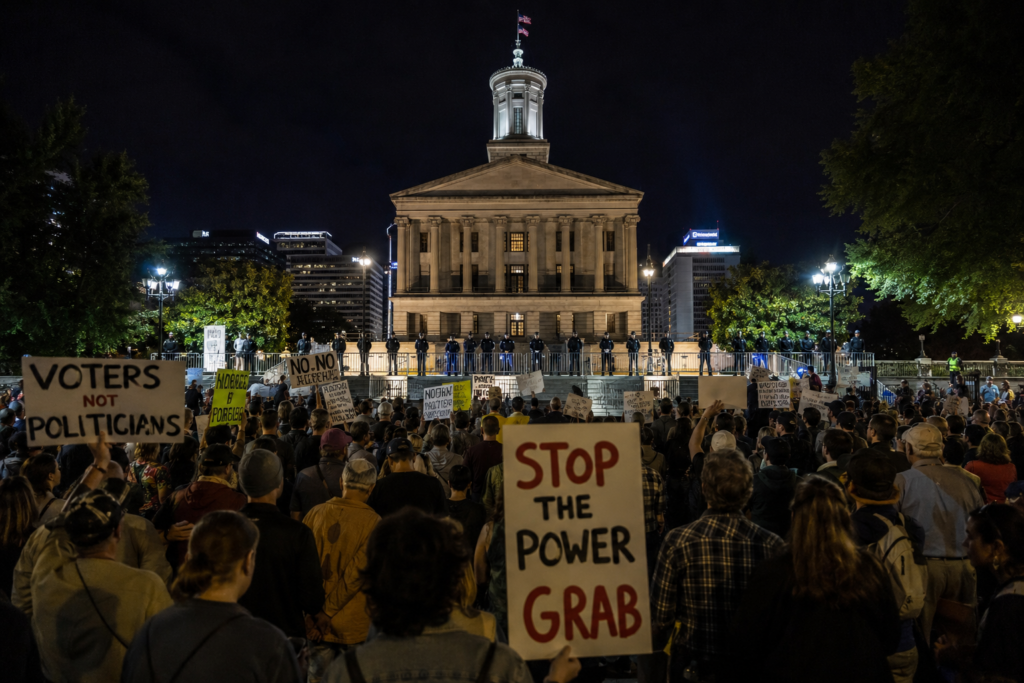
Democrats in Tennessee and beyond are blasting the plan as an overt political maneuver designed to weaken Black voting power in Memphis.
During heated floor debate, Democratic lawmakers accused Republicans of targeting minority representation under the guise of redistricting reform. Protests broke out inside and outside the Capitol as the bill advanced.
Opponents argue the split is not just political — it is structural.
Breaking Memphis into three districts, they say, ensures that urban voters are consistently outnumbered by rural and suburban blocs, effectively neutralizing their ability to elect a candidate of choice.
A Broader National Redistricting Battle
Tennessee’s move doesn’t exist in isolation.
Across the country, both parties are aggressively revisiting maps after a recent Supreme Court decision narrowed certain Voting Rights Act interpretations tied to race-based districts. The ruling has opened the door for states to redraw boundaries with fewer federal constraints.
That shift has triggered a fast-moving redistricting wave in Republican-led states, particularly across the South.
Common strategies emerging include:
- Splitting urban Democratic strongholds into multiple districts
- Expanding rural influence into metro regions
- Targeting the few remaining competitive seats in heavily partisan states
Tennessee is now the first major state to fully act on that opening.
What Memphis Loses in the New Map
Beyond partisan implications, the restructuring would significantly alter how Memphis is represented in Congress.
The result is a structural shift: a once-cohesive Memphis district divided into three, and a federal political voice that becomes less urban and less centralized overnight.
This is a breaking news story. Please check back for updates.
READ NEXT: White House Star Shares Heartwarming Baby News