

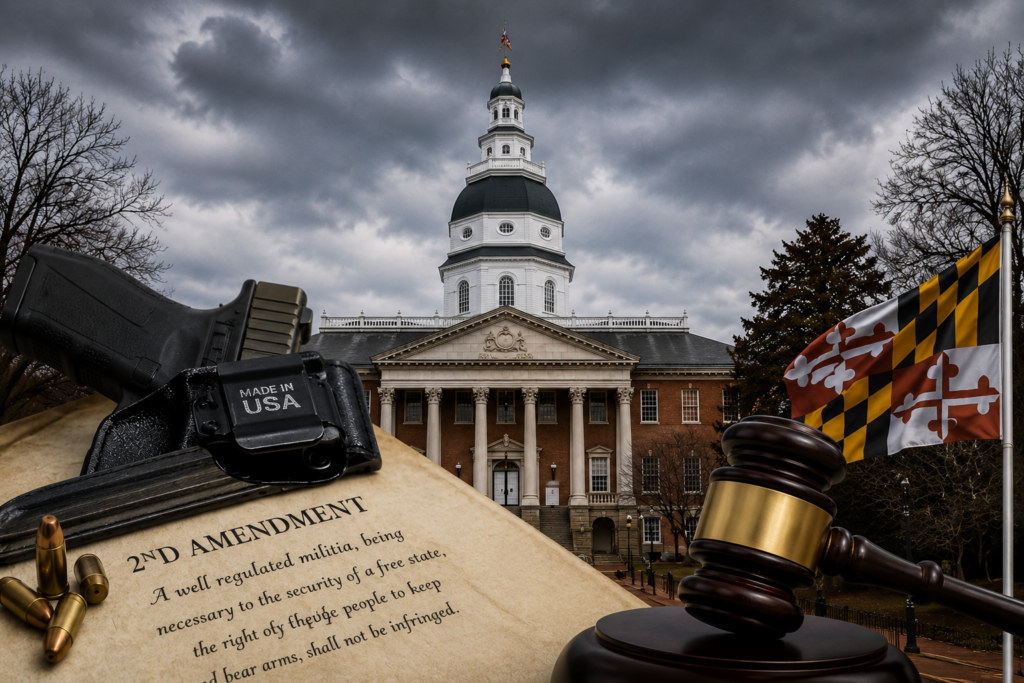
A major legal fight over firearm restrictions in Maryland is entering a new phase after the Maryland Supreme Court struck down portions of Montgomery County’s controversial concealed-carry ordinance.
The ruling, issued in late April, found that several parts of the county’s “sensitive places” restrictions exceeded local authority under Maryland law — particularly provisions that effectively prevented licensed gun owners from traveling through large sections of the county.
At the center of the dispute was Montgomery County’s broad definition of “places of public assembly.”
Under the ordinance, concealed-carry permit holders were prohibited from carrying firearms within 100 yards of many public gathering locations, including schools, parks, demonstrations, and government buildings. Opponents argued the policy effectively transformed major roadways and transportation corridors into prohibited carry zones.
Because many roads passed within 100 yards of schools, parks, or other restricted locations, lawful gun owners could potentially violate the ordinance simply by driving through the county while legally carrying a firearm.
Gun rights organizations argued the restrictions effectively turned public highways into unlawful carry zones for state-permitted firearm owners.
The Maryland Supreme Court ultimately agreed in part, ruling that Montgomery County lacked the authority to regulate individuals merely traveling on public roads while carrying firearms legally permitted under state law.
According to the court, portions of the ordinance improperly imposed restrictions on state-issued handgun permit holders beyond what local governments are authorized to regulate under Maryland’s firearm preemption statutes.
The court also invalidated portions of the county’s restrictions on unserialized firearms, commonly referred to as “ghost guns.”
Specifically, the ruling found that some county regulations conflicted with existing Maryland law in cases where firearms had already been serialized in accordance with federal and state requirements.
Another section struck down involved broad firearm restrictions tied to the presence of minors.
The court concluded parts of that provision extended too far and interfered with otherwise lawful firearm possession.
Despite the setback, county officials quickly signaled they intend to preserve as much of the ordinance as possible.
As Bearing Arms reports, lawmakers in Montgomery County quickly began drafting revisions aimed at preserving the county’s strict concealed-carry restrictions while attempting to comply with the Maryland Supreme Court’s ruling.
Councilmember David Luedtke (D-Dist. 7) introduced proposals designed to revise the ordinance while preserving what supporters describe as critical public safety protections:
The bill would redefine a “place of public assembly” as a park, place of worship, school, library, recreational facility, multipurpose exhibition facility, polling place, courthouse or legislative assembly. The revised definition would also include a building that is “generally open to the public for the business of government,” according to a council staff report.
Finally, Luedtke’s bill would add an exemption for “the possession of a handgun by a person who has a permit to carry the handgun under State law while the person travels on public highways within 100 yards of a place of public assembly” — another issue that came up in the state Supreme Court’s opinion.
The county might be able to get away with banning guns at some of these locations, but I think officials are just inviting more litigation by defining places of public assembly so broadly. Multiple courts, for instance, have struck down prohibitions on lawful concealed carry in houses of worship. It’s one thing to say that worship leaders can ban the practice if they choose, but depriving church officials of the ability to decide for themselves whether they want to have armed parishioners is a regulation that has no real analogue in the nation’s history and tradition of gun ownership.
Luedtke’s revised ordinance also touches on another aspect of Montgomery County law struck down by the Maryland Supreme Court; its ban on home-built firearms. The new proposal declares that an unserialized firearm can be rendered legal to possess if a federally licensed firearms dealer adds a serial number in accordance with Maryland state law.
The case is likely to remain a closely watched legal battle as courts nationwide continue defining the constitutional limits of “sensitive places” firearm restrictions in the post-Bruen legal landscape.
READ NEXT: Washington Faces New China Problem With No Easy Answer
















And again, what part of “Shall NOT Be Infringed” do these people NOT understand.
Ignorance, or in this case WILLFUL ignorance of a law is NOT an excuse or a defense.
A woman who needs an abortion is threatened with imprisonment or even death in some right-wing states, but the hundreds of American children who are killed by guns yearly are just the price we pay for the blessed Second Amendment.