President Donald Trump on Wednesday morning abruptly delayed the Senate confirmation process for his nominee to lead the U.S. intelligence community, saying he wants Congress to first act on a voter ID measure that currently lacks enough support to become law.
The move puts national security, election policy, and Senate politics on a collision course as the administration attempts to secure passage of the president’s election integrity agenda while also filling one of the government’s top intelligence positions.
Confirmation put on hold
Trump announced at the G7 summit in France that Jay Clayton’s nomination to serve as director of national intelligence would be delayed, despite a confirmation hearing already being on the calendar. Clayton, the former chairman of the U.S. Securities and Exchange Commission and current U.S. attorney for the Southern District of New York, was tapped for the intelligence post last week following the planned departure of outgoing DNI Tulsi Gabbard.
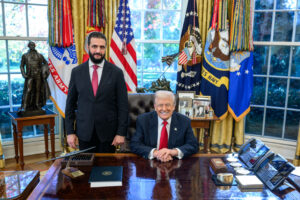
Instead, Trump said Bill Pulte will remain acting director of national intelligence for the time being, even as lawmakers from both parties have questioned his qualifications and lack of intelligence experience.
The president also said he wants James McDonald, his nominee to replace Clayton as Manhattan’s top federal prosecutor, confirmed before Clayton leaves his current position.
Voter ID fight takes center stage
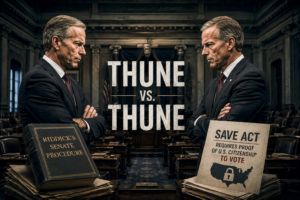
Trump tied the nomination delay to his push for the SAVE America Act, a Republican-backed election bill that would require proof of citizenship to register to vote and impose additional election security requirements nationwide.
The legislation has already cleared the House but faces significant obstacles in the Senate, where Republicans currently lack the votes needed to overcome a Democratic filibuster. Senate Majority Leader John Thune has publicly acknowledged that the measure does not currently have enough support to pass.
FISA battle complicates negotiations
The nomination dispute is also intertwined with the ongoing fight over Section 702 of the Foreign Intelligence Surveillance Act, commonly known as FISA, which recently expired after Congress failed to approve an extension. The surveillance authority has long been viewed by intelligence officials as a critical national security tool, though it has also drawn criticism from civil liberties advocates.
Trump has insisted that any effort to revive the surveillance program should be paired with passage of the SAVE America Act, a position that has further complicated negotiations on Capitol Hill.
The administration had initially hoped Clayton’s nomination would help resolve bipartisan concerns surrounding intelligence leadership and clear the way for broader negotiations over surveillance authorities. Trump’s decision to pause the confirmation process now threatens to prolong uncertainty surrounding both issues.
New front in Trump’s legislative strategy
The maneuver reflects Trump’s willingness to use nominations and executive branch appointments as leverage in larger legislative battles.
By delaying Clayton’s confirmation, the president is effectively signaling that progress on intelligence leadership and surveillance authorities may remain stalled until Congress addresses his election-related priorities. Whether that strategy produces movement on the SAVE America Act remains unclear, but it guarantees that the debate over voter ID requirements will remain at the center of Washington’s political battles in the weeks ahead.
READ NEXT: Did Your Doctor Know? Health Giant Settles After Allegations That Changed Patients’ Lives