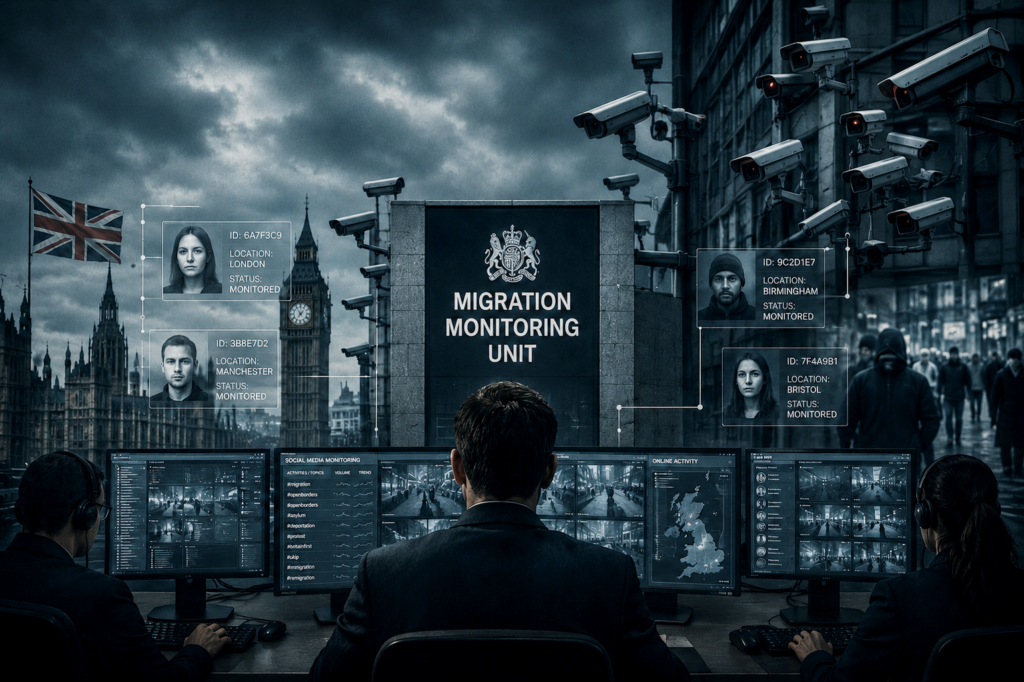
A British government program designed to monitor online discussions about immigration is drawing sharp criticism from free speech advocates and opposition politicians, who argue the effort amounts to state-backed surveillance of public opinion on one of the country’s most contentious issues.
The controversy centers on the government’s Counter Disinformation Unit and related monitoring programs that track online narratives surrounding immigration, asylum policies, and social unrest. Critics contend the initiative has evolved beyond combating foreign influence campaigns and now functions as a tool for monitoring lawful political speech.
The debate intensified after reports revealed government officials had worked with outside organizations to identify and track online conversations related to migration, border security, and asylum policies. Civil liberties groups argue that such monitoring risks blurring the line between combating misinformation and policing political viewpoints.
Government Says Program Targets Harmful Falsehoods
British officials reject claims that the program is designed to suppress dissent.
The government maintains that the monitoring effort is focused on identifying coordinated disinformation campaigns, foreign influence operations, and false information that could contribute to public disorder or violence. Officials argue that social media has become a major vehicle for the rapid spread of false claims and that governments have a legitimate interest in understanding how such information circulates.
Supporters of the program point to previous instances in which inaccurate reports spread online during periods of civil unrest, arguing that government agencies need tools to identify potentially dangerous misinformation before it contributes to real-world consequences. (RELATED: Migrant Man Found Guilty In Viral ‘Scottish Axe Girl’ Case That Sparked International Outrage)
Critics Warn of Mission Creep
Opponents say the problem is not the stated purpose but the scope of the monitoring itself.
Several free speech organizations have warned that government agencies increasingly appear interested in tracking opinions and narratives rather than simply identifying demonstrably false claims. Critics argue that debates over immigration levels, asylum policies, and border enforcement are inherently political questions that should be resolved through public discussion rather than government oversight.
The concerns echo broader debates taking place across Western democracies over the role governments should play in moderating information online. Similar disputes have emerged in the United States, Europe, and Australia as officials attempt to address misinformation while avoiding accusations of censorship.
Immigration Remains a Major Political Flashpoint
The controversy comes as immigration continues to dominate British politics.
Record levels of both legal and illegal migration have fueled public frustration, helping drive support for parties advocating stricter border controls and reduced immigration levels. The issue has become one of the defining political challenges facing Prime Minister Keir Starmer and his government.
Critics argue that government monitoring of migration-related discussions is particularly concerning because it touches on a subject where public confidence in official institutions has already been strained. Supporters counter that online misinformation can inflame tensions and complicate efforts to address legitimate policy concerns.
A Growing Debate Over Free Speech
At the center of the dispute is a broader question facing many Western governments: where is the line between monitoring misinformation and monitoring citizens?
For a growing number of critics, the migration monitoring effort represents another example of governments expanding their role in shaping public discourse.
As pressure mounts for greater transparency, lawmakers and civil liberties groups are likely to continue demanding answers about exactly what information is being collected, who is being monitored, and how those monitoring programs are being used.
READ NEXT: One Of Washington’s Most Secret Spaces Is About To Be Exposed