
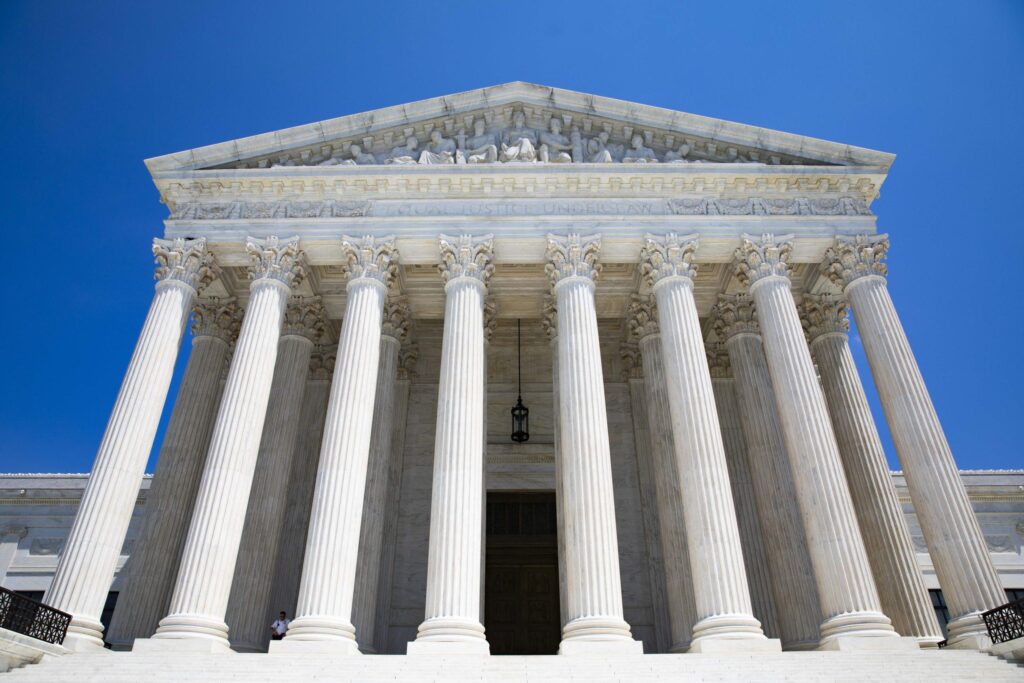
The Supreme Court on Tuesday handed Republicans and advocates for women’s sports a major legal victory, ruling that states may bar transgender athletes from competing in girls’ and women’s sports without violating the Constitution or federal civil rights law.
In a pair of closely watched cases—West Virginia v. B.P.J. and Little v. Hecox—the Court upheld laws in West Virginia and Idaho requiring student-athletes to compete on teams based on their biological sex, concluding the policies are consistent with both the Equal Protection Clause of the 14th Amendment and Title IX.
The ruling marks the Supreme Court’s first major decision on transgender participation in school athletics and is expected to strengthen similar laws already enacted in more than half the country. The decision also represents another significant victory for the Trump administration and Republican-led states that have made protecting women’s sports a central policy priority.
Writing for the majority, Justice Brett Kavanaugh said states may separate athletic competition based on biological sex while emphasizing that transgender students should still be treated with dignity and respect. He also indicated that policy debates over transgender participation in sports are best resolved through the democratic process rather than by the courts.
The cases centered on West Virginia’s Save Women’s Sports Act and Idaho’s Fairness in Women’s Sports Act, both of which had been blocked by lower federal courts after legal challenges from transgender athletes.
The transgender plaintiffs—Becky Pepper-Jackson of West Virginia and Lindsay Hecox of Idaho—argued the laws violated Title IX and the Constitution’s Equal Protection Clause. They were represented by the American Civil Liberties Union (ACLU) and Cooley LLP. West Virginia and Idaho were represented by Alliance Defending Freedom.
The Supreme Court rejected those challenges, allowing both laws to take effect.
The decision is expected to bolster similar statutes across the country. More than half of U.S. states have enacted laws limiting girls’ and women’s sports to biological females, while roughly two dozen states—including California, New York and Massachusetts—continue to allow transgender athletes to compete based on gender identity or have legal protections for transgender participation.
West Virginia Attorney General John McCuskey called the ruling a landmark victory.
“This is a monumental victory for every female athlete who has ever competed, or dreamed of competing, on a fair and safe playing field,” McCuskey said in a statement provided to Fox News Digital. “Today’s Supreme Court decision affirms what common sense and the law have long made clear: states have the right to designate sports teams based on biological sex, not gender identity. Without that delineation, Title IX is turned on its head and decades of hard-fought progress to advance female athletes is erased.”
McCuskey also praised his legal team for securing what he described as a nationwide precedent.
“This landmark victory will give all states, not just West Virginia, the clarity and confidence to ensure fairness and safety for female athletes today and for generations to come.”
Idaho Attorney General Raul Labrador likewise celebrated the ruling.
“Today’s decision is a victory for common sense, fairness, and the countless girls and women who dedicate themselves to athletics,” Labrador said in a statement to Fox News Digital. “The Supreme Court has now confirmed that states can preserve fair competition and protect the opportunities that generations of women fought to secure.”
Education Secretary Linda McMahon also praised the Court’s decision, arguing it restores the original purpose of Title IX.
“Today’s ruling affirms the common sense right of states to prohibit men from competing in women’s sports, safeguard the integrity of female spaces, and ensure no woman faces discrimination on the basis of sex,” McMahon said. “The Trump Administration has fought to restore Title IX’s protections for women and girls since Day One. Today’s ruling cements those reforms and builds on decades of work to secure equal educational opportunities for women and girls.”
The legal battle had drawn national attention after the Supreme Court agreed last year to hear both cases following conflicting lower court rulings.
During oral arguments in January, several conservative justices expressed skepticism toward the challengers’ claims. Chief Justice John Roberts pressed ACLU attorney Joshua Block over the meaning of “sex” under Title IX, stating that the term “must mean something.”
After initially urging the Court not to define the term, Block later acknowledged that, for purposes of the case, the Court could treat biological sex as the relevant definition, according to Fox News Digital’s reporting.
The Court’s three liberal justices disagreed with portions of Tuesday’s decision. Justice Sonia Sotomayor filed an opinion concurring in part and dissenting in part, joined by Justices Elena Kagan and Ketanji Brown Jackson. Jackson also filed a separate opinion concurring in part and dissenting in part.
The ruling follows a series of actions by President Donald Trump aimed at restricting transgender participation in women’s sports, including an executive order directing federal agencies to interpret Title IX as protecting athletic competition based on biological sex. Following that order, both the NCAA and the U.S. Olympic and Paralympic Committee revised their participation policies for women’s sports.
READ NEXT: Supreme Court Strikes Down Executive Order Restricting Birthright Citizenship