

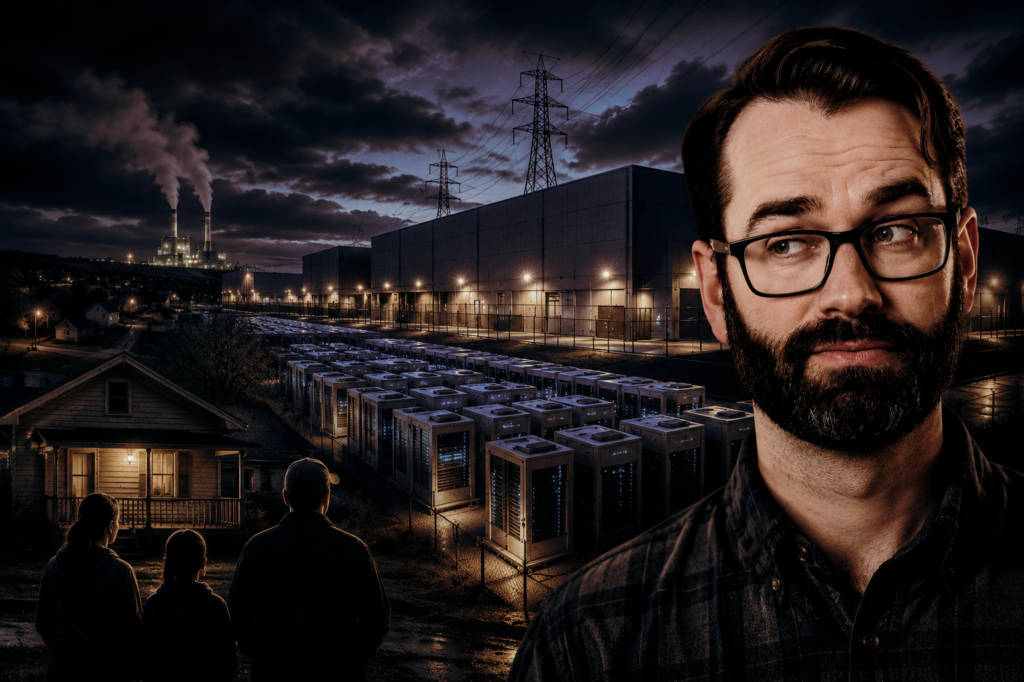
Imagine a tenant who signs a lease everyone agrees is temporary, then asks the landlord for an extension, and another, and a third, across 16 years, because he never quite gets around to finding his own apartment. When the landlord at last says the arrangement will end, the tenant does not blame himself. He blames the new neighbor who just moved in down the hall. That, in miniature, is the story told about Lake Tahoe, and it is worth understanding why the reporting itself refutes the headline it carried.
The headline, in Fortune, announced that nearly 50,000 Lake Tahoe residents must find a new power source because their utility is redirecting lines to data centers. Matt Walsh, who deserves credit for warning his audience against hysteria more often than not, took the premise whole and told his listeners that a utility had decided it was more lucrative to power server farms than family homes, and that ordinary people were being priced out of the market. It is a clean, infuriating story. It has a villain, a victim, and a moral. It has only one defect, which is that it is not true, and the evidence that it is not true sits inside the very article that launched it.
Begin with the keystone admission. NV Energy’s own spokesperson, asked directly, called this a planned transition rooted in a longtime understanding that took shape well before data center load growth was even a consideration, and described it as a transition planned for many years, not a reaction to recent developments. When the accused party states for the record that the cause predates the alleged culprit, a careful reader should slow down. The headline says the data centers did it. The source quoted three paragraphs later says the robots had nothing to do with it. Both cannot be right, and the one with the documents is the utility.
The documents go back to April 2009. That year NV Energy’s subsidiary, Sierra Pacific Power, sold its California distribution and generation assets for roughly $116 million to a newly formed company jointly owned by Algonquin and Emera, the system now operated under the Liberty Utilities brand. The buyer took the wires and, with them, the obligation to eventually stand on its own. NV Energy agreed to keep supplying power on a temporary basis while Liberty built or contracted for an independent supply. That bridge was supposed to be crossed. Instead it was extended in 2015, extended again in 2020, and extended once more in late 2025, and each extension happened for the same reason, which was not artificial intelligence. It was that Liberty had not secured its own power. A utility that for 17 years sourced three-quarters of its electricity from a contract everyone knew was temporary is not the casualty of a new technology. It is the casualty of its own deferral.
Here the reader may reasonably object. Surely, you might say, the demand from data centers is real, and surely it is that demand which finally forced the contract to end. This is the natural objection, and the article quietly dismantles it too. In testimony to Nevada regulators in October 2024, the economist Rose Anderson of Synapse Energy Economics warned that NV Energy’s major-project load forecast is highly uncertain, and that existing customers could be made to pay for infrastructure built to serve industrial demand that never materializes. A projection of 5,900 megawatts from a dozen proposed data center projects by 2033 is a forecast, not a meter reading, and forecasts of this kind have a long and embarrassing record.
We do not have to take a single economist’s word for it, because the people who would profit most from soaring demand are the ones conceding it is inflated. James Burke, the chief executive of Vistra Energy, told investors that interconnection requests are overstated anywhere from three to five times what might actually materialize. Joseph Dominguez, who runs Constellation Energy, told investors plainly that the headlines are inflated. When two of the largest independent power producers in the country, the firms with every commercial incentive to talk the numbers up, instead talk them down, the panic narrative loses its foundation. The Rocky Mountain Institute notes that data centers account for about 2% of global electricity demand today and roughly 10% of projected growth through 2030, and that utilities have historically built about 17% more capacity than they needed between 2006 and 2023. The phenomenon even has a name. Analysts call it phantom load, the double-counting that results when developers file the same project with multiple utilities. The cleanest illustration comes from Ohio, where AEP’s data center demand forecast collapsed from roughly 30 gigawatts to about 13. Forecasts, in this business, are sales documents, not deliveries.
So if the demand is uncertain and the contract was always temporary, what actually determines Tahoe’s deadline? The answer is a California energy policy that retires firm generation faster than it can build the replacement. Consider Diablo Canyon, the 2,240-megawatt nuclear plant that supplies about 9% of California’s in-state generation and 17% of its carbon-free electricity. Regulators approved its retirement, then reversed themselves in 2022 under Senate Bill 846 because, by the governor’s own account, the replacement renewables and storage were delayed and grid reliability was at risk. The state has likewise delayed planned gas plant retirements more than once, because the firm capacity meant to replace those units was not ready. A state that cannot retire its own gas plants on schedule without courting blackouts is not a state with spare power to spare a small community on its eastern border.
The household consequence of this pattern is not abstract. California electricity rates rose 39% between 2019 and 2025, the largest increase of any state, and now sit close to double the national average according to the nonpartisan Legislative Analyst’s Office, which attributes the climb to wildfire costs and to the state’s ambitious greenhouse gas programs. Liberty itself sought a 19.1% revenue increase in its 2025 rate case and the regulator granted 11.4%. The affordability crisis predates any data center and runs far deeper than one not to mention the fact that no one is building significant data centers in the state. To blame the server farm is to miss the policy that has been raising your neighbor’s bill for a decade.
There is also a governance failure here that conservatives have warned about for years, and it is the better villain. Three regulators touch this grid, the California Public Utilities Commission, the federal energy regulator, and Nevada’s own utilities commission, and not one of them can command the others to act. This is jurisdictional fragmentation producing an accountability vacuum, a structural defect in the architecture rather than a flaw in any technology. It is a stronger argument than blaming the data centers precisely because it indicts the system that was supposed to prevent exactly this outcome, and it points toward a fix.
A fix, in fact, already exists and is being resisted. In April 2026 a data center developer asked Nevada regulators for permission to build more than 350 megawatts of its own on-site generation, a first for the state, precisely so it would not draw on the shared grid that Tahoe depends on. The Sierra Club is fighting the request on the ground that on-site power locks the public out of the process. Pause on the logic. The obvious relief valve, letting large new loads supply themselves rather than competing for the common grid, is being blocked by the environmental left, not by any market constraint. If self-supply were routine, the competition for NV Energy’s capacity would ease, and Tahoe’s position would improve. The resistance to the solution comes from the same quarter that authored the policy.
Which brings us, finally, to the press. It is telling that a hard story about 49,000 people, two states, three regulators, and seventeen years of contract law was filed under Travel and Leisure. That placement is the tell. The story was never reported as energy policy or regulatory failure, because energy policy and regulatory failure do not generate clicks. Data center doomerism does. The headline that data centers stranded a community writes itself; the headline that a 2009 wholesale supply contract lapsed on its long-scheduled timetable does not. This is the laziest move in journalism, reaching for the freshest available villain, and the cost of it is that the people who actually made the decisions walk away clean.
Walsh, to his credit, raised real concerns about eminent domain, surveillance, and job displacement, and those debates are worth having. But none of them bears on why Liberty’s wholesale contract is ending, and the specific factual error is the part his audience will repeat. When our own side adopts the drive-by media’s causation, the correction has to come from inside the house. So here it is, in one line. NV Energy did not choose data centers over Tahoe families. It ended a temporary supply contract from 2009 that Liberty had 17 years and three extensions to replace, and the data center demand supposedly driving the decision is, by the experts’ own testimony, a forecast nobody can verify. The villain is real, but it is not the machine. It is the men who deferred, and the press that preferred a panic.
If you enjoy my work, please subscribe https://x.com/amuse/creator-subscriptions/subscribe.
Sponsored by the John Milton Freedom Foundation, a nonprofit dedicated to helping independent journalists overcome formidable challenges in today’s media landscape and bring crucial stories to you.
READ NEXT: What Was An Anti-Trump Prosecutor Doing Behind Closed Doors With Federal Judges?



















Is this nationwide with data centers?
Cant utilities Plan ahead for power
Bad Optics for data centers