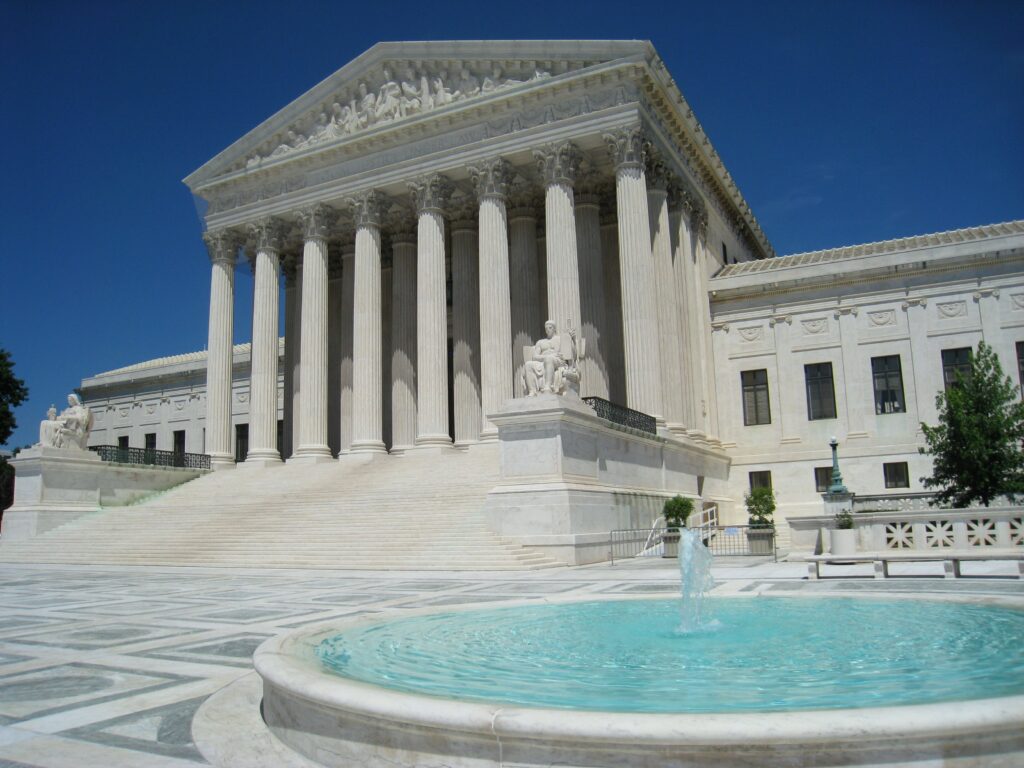
Louisiana has suspended its May primary elections for congressional races following the Supreme Court ruling on Wednesday on its congressional map, as districts need to be redrawn in order to be legally compliant.
The Supreme Court ruled that one of the state’s majority-minority districts was illegally racially gerrymandered. (RELATED: Supreme Court Strikes Down Louisiana Congressional Map)
The 2nd opinion is in Louisiana v. Callais, on race-based discrimination and the Voting Rights Act. A 6-3 court held that Louisiana's map creating a 2nd majority-black district was "an unconstitutional racial gerrymander." Court didn't strike Section 2.https://t.co/2hxEyNwWJ2
— SCOTUSblog (@SCOTUSblog) April 29, 2026
“Yesterday’s historic Supreme Court victory for Louisiana has an immediate consequence for the State. The Supreme Court previously stayed an injunction against the State’s enforcement of the current Congressional map,” Gov. Jeff Landry (R-LA) and Attorney General Liz Murrill (R-LA) said in a statement on Thursday. “By the Court’s order, however, that stay automatically terminated with yesterday’s decision. Accordingly, the State is currently enjoined from carrying out congressional elections under the current map. We are working together with the Legislature and the Secretary of State’s office to develop a path forward.”
🚨 MASSIVE DEVELOPMENT: Louisiana Gov. Jeff Landry is preparing to SUSPEND the House primaries originally set for May 16 so the state can re-draw their map for the 2026 midterms — WaPo
— Eric Daugherty (@EricLDaugh) April 30, 2026
All thanks to the Supreme Court GUTTING raced-based VRA districts
GOOD! REDRAW ASAP and WIN!… pic.twitter.com/MWQZRCP6XL
Justice Samuel Alito wrote in his majority opinion of the court that, “the State’s attempt to satisfy the Middle District’s ruling, although understandable, was an unconstitutional racial gerrymander.”
How the Legal Battle Unfolded
The dispute dates back to the aftermath of the 2020 census, when Louisiana’s Republican-led legislature approved a congressional map with only one majority-Black district, despite Black residents making up roughly one-third of the state’s population.
In 2022, a group of Black voters sued under the Voting Rights Act, arguing the map diluted their political influence by concentrating many Black voters into a single district while dispersing others across multiple districts.
A federal court agreed, blocking the map for failing to include a second majority-Black district that better reflected the state’s demographics.
In response, lawmakers passed a revised map during a January 2024 special session, signed by Gov. Jeff Landry (R), creating a second majority-Black district stretching diagonally across the state.
New Map Triggered Fresh Lawsuits
The revised map quickly faced new legal challenges, this time from non-Black voters who argued race had been used too heavily in drawing district lines, violating the Equal Protection Clause.
A three-judge panel sided with those challengers and blocked the map. However, the Supreme Court later allowed it to be used in the 2024 election, when Democrat Cleo Fields won the newly created district.
This is a breaking news story. Please check back for updates.
READ NEXT: 85-Year World War II Mystery May Finally Be Solved