







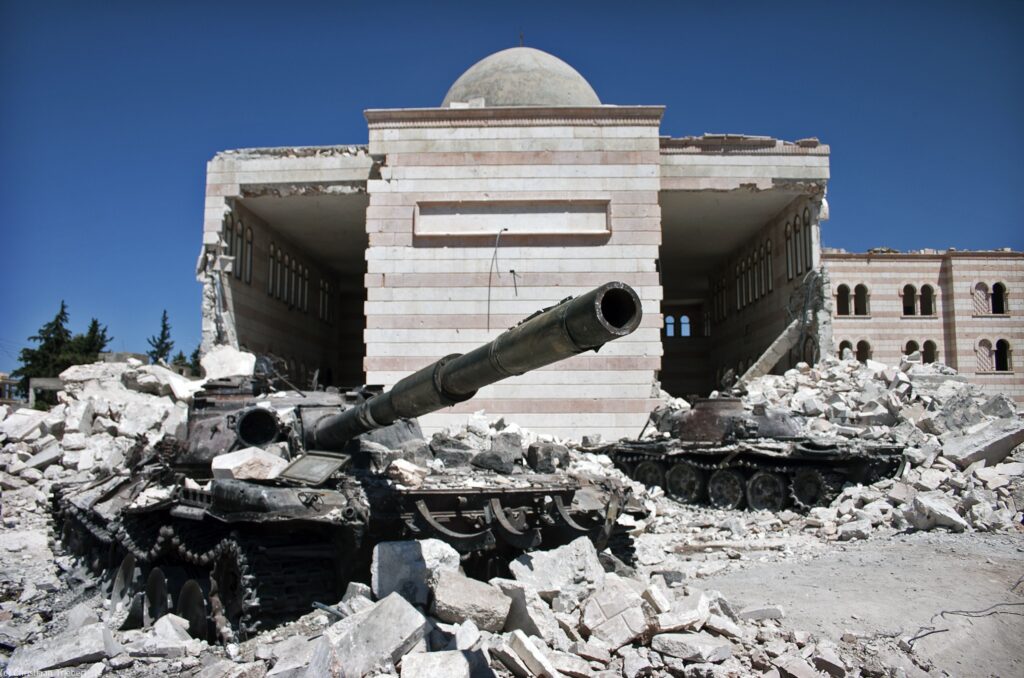
Including Assad’s chemical weapons facilities?
The Syrian government, along with its allies Russia and Iran, faced a significant setback as al-Qaeda-linked insurgents, determined to create a “Talibanesque society” in the country, made a stunning advance into Aleppo. This symbolic and strategic city, Syria’s second-largest, has long been a focal point of the nearly 14-year-old civil war. The insurgents, primarily led by Islamist group Hayʼat Tahrir al-Sham (HTS), surged into Aleppo just two days after launching an offensive from rebel-held territories in northwestern Syria.
The assault comes eight years after Aleppo fell to the forces loyal to Syrian President Bashar al-Assad, following a grueling siege. The insurgents’ lightning moves mark one of the most dramatic shifts in Syria’s power dynamics in recent years, drawing renewed attention from international stakeholders like the United States, Turkey, Israel and others.
Wow, a Hayat Tahir al-Sham (HTS) Fighter poses for a Picture tonight at the Governors Mansion in the Center of Aleppo. pic.twitter.com/W1XGw87znO
— OSINTdefender (@sentdefender) November 29, 2024
Assad’s Narrow Escape and Brutal Crackdown
In 2011, al-Assad narrowly evaded a potential coup during an armed insurrection sparked by widespread protests against his rule. These demonstrations were part of the Arab Spring, a wave of pro-democracy uprisings across the region. Assad’s response was swift and ruthless—deploying heavy artillery, chemical weapons and mass arrests to quell dissent. He relied heavily on Russian airpower and Iran’s military and financial backing, including support from Hezbollah forces.
Aleppo, once Syria’s vibrant economic hub, became a symbolic heart of the rebellion. Anti-government forces claimed parts of the city in 2012, following the initial 2011 protests. However, a devastating siege and relentless bombardment by Russian and Syrian forces led to its recapture in 2016.
Shifting Power and a Fractured Syria
While Assad retained control over Damascus and other key territories, the ongoing conflict forced him to cede large portions of Syria. In the northwest, rebel factions have maintained strongholds. In the northeast, U.S.-backed Kurdish-led militias, bolstered by their campaign against ISIS, now dominate vast swaths of land.
The recent insurgent offensive around Aleppo coincides with mounting pressure on Assad’s allies. Russia, stretched thin by its ongoing invasion of Ukraine, has diverted significant military resources away from Syria. In an attempt to stymie the advancing enemy, the Russian Air Force launched strikes on Aleppo and the surrounding area for the first time in years, following its capture by opposition forces. Some of the strikes targeted residential neighborhoods in western Aleppo, resulting in at least 12 deaths.
Strikes by the Russian Air Force in and around the Opposition-Controlled City of Idlib in Northwestern Syria tonight, with reports of several Casualties. pic.twitter.com/ZtMWygJ7B5
— OSINTdefender (@sentdefender) November 29, 2024
Analysts speculate that the most recent campaign in Syria threatens Assad’s grip on the highly volatile country.
Speaking to Fox News Digital, Jason Brodsky, policy director of United Against Nuclear Iran, expressed concerns over reports that Islamist rebels have gained access to the Syrian Scientific Studies and Research Center (SSRC), a key institution in Syria’s chemical weapons program. Established in 1971, the SSRC has been involved in the development and production of chemical agents, including sarin, VX and mustard gas:
He continued, “Given the background of some of these groups which were formerly affiliated with Al-Qaeda, it raises serious questions and could have implications for Israeli national security.”
The government of Benjamin Netanyahu reportedly met on Friday night to discuss the latest news coming out of Syria.
Former President Barack Obama cut a widely criticized deal with Syrian regime dictator Bashar Assad in 2013 to remove his chemical weapons program. U.S. officials later said that Assad likely retained part of his chemical warfare apparatus. Assad has repeatedly used poison gas on his population to dissolve the democratic revolt that unfolded against his regime in 2011.
There are currently about 900 American soldiers in Syria as part of a mission to defeat the Islamic State. The U.S. military presence in Syria, according to Mideast experts, also helps to blunt the Iranian regime’s attempts to absorb of parts of Syria.
Fragile Ceasefires and Shifting International Stances
Earlier this week, a tentative ceasefire was brokered between Israel and Lebanon, reflecting the tenuous nature of peace in the region. Notably, these developments occurred on the eve of the second administration of U.S. President-elect Donald Trump, who had previously pursued a policy of “maximum pressure” on Iran. During his first term, Trump authorized airstrikes on Syrian government assets and withdrew from the Iran nuclear deal.
The intensifying fighting underscores the volatility of the Syrian conflict, where the balance of power remains precarious. With international attention once again fixed on the region, the question looms: will these shifts signal a turning point in Syria’s long and bloody war, or are they just another chapter in its unrelenting turmoil?
Russian and Syrian Forces seen earlier withdrawing from Hama Airbase, with the Base and the City likely to fall to Rebel Forces in the coming hours. pic.twitter.com/43EHgqx72c
— OSINTdefender (@sentdefender) November 30, 2024
Assad’s Syrian Arab Army (SAA) is in Full Retreat across Northern Syria, as Turkish-Backed Forces advance from the Northwest and U.S-Backed Forces advance from the East. pic.twitter.com/obJ5hvuIma
— OSINTdefender (@sentdefender) November 30, 2024
READ NEXT: [VOTE NOW] What’s Your Take On Trump’s Deep State Strategy?
















Wasnt that destroyed years ago or damaged
Perilous times. Could result in butchery, could create an opening for liberty. Depends on how the world plays it’s cards. Thank God a real leader is coming to the Oral Office.
This whole part of the WORLD has been Boiling Pot of conflict from recorded time. No matter what this one say or that one says. Both sides believe they are the chosen. Nether side has ever wanted PIECE. Only total ratification of the other. Plain and simple TUTH.