






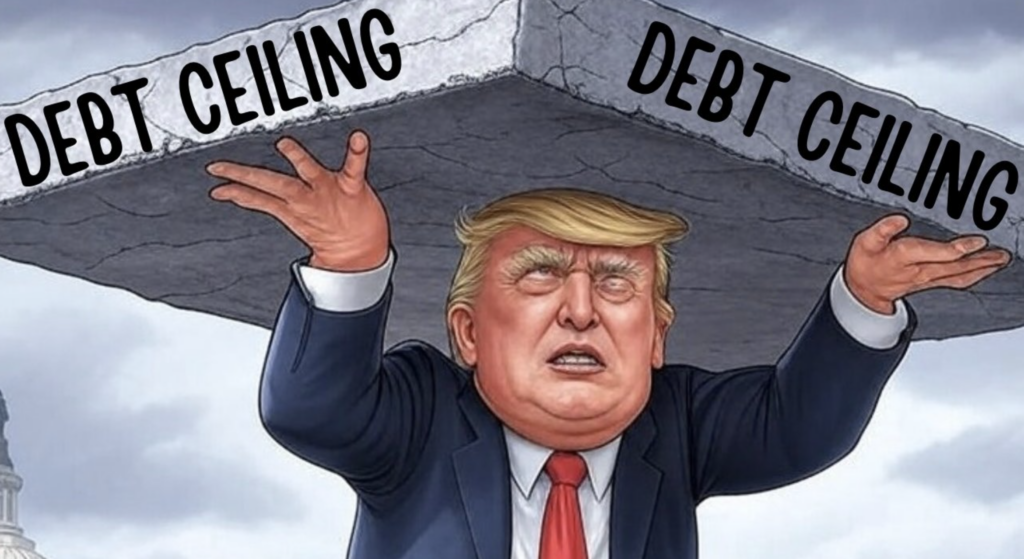
Imagine this: A homeowner takes out a mortgage, moves in and then refuses to pay the bill—risking foreclosure. This absurd scenario perfectly encapsulates America’s debt ceiling debates. The federal government approves spending plans, borrows to meet obligations and then, in a fit of legislative melodrama, toys with defaulting on those very commitments.
Just days before Congress adjourned for the holidays, lawmakers attempted to ram through a bloated 1,500+ page omnibus bill—a pork-stuffed monstrosity drafted in backrooms and dropped with no time for scrutiny. This legislative ambush was met with a tidal wave of opposition from the American people, amplified by President-elect Trump, Elon Musk and Vivek Ramaswamy. Faced with such uproar, the omnibus was scrapped, but Democrats, predictably, turned to their favorite hostage: the federal government.
Now, they threaten a government shutdown just before Christmas. In response, President-elect Trump has called for a clean continuing resolution that funds essential government operations, delivers aid to hurricane victims and includes a debt ceiling increase. It’s a necessary, pragmatic move—but it doesn’t go far enough. The debt ceiling itself is the problem, a dysfunctional relic that does nothing to rein in spending and everything to invite chaos. It is time for Congress to eliminate it altogether.
The debt ceiling does not reduce spending, does not shrink the deficit and does not encourage fiscal responsibility. Rather, it creates economic instability, emboldens political brinkmanship and damages America’s credibility. Worse still, it routinely fails to prevent the very excess it pretends to remedy.
To paraphrase Cicero—more laws, less justice. In this case, one arbitrary law fosters more dysfunction, less stability, and greater fiscal peril.
The Debt Ceiling: A Misguided Relic
The debt ceiling emerged in 1917 under the Second Liberty Bond Act, a mechanism to streamline war financing during World War I. Before then, Congress micromanaged every bond issued by the Treasury. The debt ceiling was created to ease borrowing, not to act as a speed bump for government expenditures. Yet like many relics of early 20th-century governance, it has devolved into a political weapon, used not for fiscal restraint but for theatrical posturing.
The critical irony is this: the debt ceiling does nothing to curb government spending. In fact, history shows the opposite. During the 2011 debt ceiling standoff, political brinkmanship led to a credit rating downgrade and cost taxpayers an estimated $1.3 billion in increased borrowing costs for that fiscal year alone. Far from controlling debt, such crises often add to it—a self-inflicted wound masquerading as fiscal discipline. It merely prevents the Treasury from borrowing to pay debts that Congress itself has already approved. It is the legislative equivalent of approving a shopping spree, handing over the credit card, and then refusing to pay the bill.
This system would be laughable were its consequences not so serious. History has shown, repeatedly, that debt ceiling fights damage the economy, cost taxpayers billions, and increase the very debt Congress claims to fight.
Economic Instability: A Manufactured Crisis
Debt ceiling debates do not exist in isolation; they ripple through markets, businesses and households. For example, small businesses reliant on loans face higher interest rates as markets grow uncertain, while families planning for mortgages or college tuition see their costs rise amid economic instability. The anxiety compounds, leaving both Main Street and Wall Street at the mercy of political dysfunction. Every time Congress threatens to breach the debt limit, investors grow skittish, stock prices wobble and borrowing costs rise. The 2011 debt ceiling crisis is a cautionary tale: the political brinkmanship caused the first-ever downgrade of America’s credit rating. The ripple effect triggered a $2.4 trillion drop in stock market value and higher interest rates, forcing taxpayers to foot the bill for unnecessary chaos.
The sheer absurdity of this system is magnified when one considers its impact on vulnerable citizens. When debt ceiling debates drag on, government payments—Social Security checks, veterans’ benefits, salaries for servicemembers—hang in the balance. These are not abstract line items; they are promises to real Americans. Threatening those commitments to score political points is not governance. It is legislative hostage-taking.
To borrow from Marcus Aurelius: The art of living is more like wrestling than dancing. Yet Congress, in its tortured debt ceiling debates, resembles neither a wrestler nor a dancer. It behaves like a gambler, recklessly wagering America’s economic stability.
Undermining America’s Creditworthiness
The United States enjoys an enviable position as the issuer of the world’s reserve currency. That privilege depends on confidence in America’s financial system. Each debt ceiling standoff chips away at that confidence. Every time Congress flirts with default—even rhetorically—credit rating agencies take notice. Investors begin to question the United States’ ability to manage its finances, and the cost of borrowing rises.
Let us be clear: a U.S. default, even a partial one, would be catastrophic. It would send shockwaves through global markets, undermine the dollar’s supremacy, and shatter faith in America’s full faith and credit. Ironically, by playing chicken with the debt ceiling, Congress risks creating the very fiscal instability it claims to fear.
A Political Weapon
Beyond its economic folly, the debt ceiling has become a political cudgel. It is no longer a mechanism for oversight; it is a stage for partisan theatrics. Both parties have weaponized it to extract concessions, leading to standoffs that hurt the economy and erode trust in government.
Consider this: Most developed nations have no debt ceiling. Denmark, the lone exception, sets its limit so high that it is effectively meaningless. America’s addiction to manufactured debt crises is unique and self-destructive.
Thomas Jefferson once wrote, “The government closest to the people serves the people best.” Today, however, Washington’s dysfunction is anything but close to the people. The debt ceiling saga—a purely self-inflicted wound—epitomizes the disconnect between Congress’ theatrics and the public’s desire for stable governance.
Responsible Alternatives
Eliminating the debt ceiling does not mean abandoning fiscal discipline. Congress already holds the power of the purse. Annual budget processes, appropriations bills and oversight mechanisms offer ample opportunity to debate spending priorities and enact reforms. If lawmakers wish to reduce the deficit, they must confront spending head-on during those processes—not at the eleventh hour with America’s credit on the line.
Moreover, alternative tools like “pay-as-you-go” rules and independent fiscal commissions can provide the oversight and discipline Congress claims to seek. But these tools operate transparently and responsibly, unlike the debt ceiling, which thrives on manufactured crisis.
Conclusion
The debt ceiling is a legislative anachronism—a misguided relic that fosters dysfunction rather than discipline. It does not reduce spending, but it does create economic instability, undermine America’s creditworthiness, and empower political brinkmanship. President-elect Trump’s pragmatic call to raise the ceiling is necessary for now, but it falls short of the bold reform America needs.
Eliminating the debt ceiling would not solve all fiscal woes, but it would eliminate a recurring source of chaos. Congress would no longer have the luxury of using America’s full faith and credit as a bargaining chip. Instead, lawmakers would be forced to confront spending through responsible governance, not crisis management.
To govern is to choose. By eliminating the debt ceiling, Congress can choose stability over chaos, responsibility over gamesmanship and progress over perpetual crisis. In doing so, they might just reclaim a modicum of the trust the American people have lost in their government’s ability to lead.
Sponsored by the John Milton Freedom Foundation, a nonprofit dedicated to helping independent journalists overcome formidable challenges in today’s media landscape and bring crucial stories to you.
READ NEXT: House Republicans Reach Deal To Avert Gov’t Shutdown























The debt ceiling does not reduce spending, does not shrink the deficit and does not encourage fiscal responsibility. Rather, it creates economic instability, emboldens political brinkmanship and damages America’s credibility. Worse still, it routinely fails to prevent the very excess it pretends to remedy.
I agree, what we heed is fiscal responsibility and elimination of all the “Pork Barrel” spending.
The system has been rigged by Congressional members buying each other’s votes with “someone else’s” money.
so, shut it down
Don’t pay any political salaries to Congress, take away their Christmas vacation and make them work for the next 44 days for FREE. Trump gave away his $450,000 annual salary for FOUR years.
Take away all the freebies given to the illegals we are footing the bill for. Let them go find jobs and pay for themselves. We could save BILLIONS by shutting down certain parts of government for just a few weeks. BILLIONS
The US Government is the largest employer in the USA with the worst employee performance. Let’s just get a jump start on getting rid of the nonsense. $37 TRILLION in debt and counting.
What causes out of control inflation, the devaluation of the American Dollar. What causes he devaluation of the American Dollar, American Debt. The dollar is backed up by a promise. Since when as the US Government paid any attention to a promise. Tomorrow they could issue new currency, in which you get $1 for every $100 you turn in and there is nothing you can do about it. What do you think happened in 1932 when Gold was recalled, when a $20 Gold Double Eagle was one troy ounce of gold ? Gold was worth $20/oz. Only 2 years later the govenment declared Gold worth $36 an ounce, the very first devaluation of our money. OH but wait, we were on the Silver standard then, that is until 1959. An ounce of silver was worth a dollar, hence the silver dollars. We got off the silver standard but did not recall it because we use it in industry etc. From that point on Gold and Silver seemed to be going up in price. Not so, you have to look at it in value or buying power. We sit with paper Federal Reserve notes, and watch the price of gold and silver go up. Lets get off the dollar and sit on gold or silver, look at the dollar and what is happening, it is plunging down in value. Prices of that silver dollar in silver value alone has increased to about $32 to $34 an ounce. Ouch. Gold well its well over $2200.00 an ounce now. Why, due to American Debt. Not only debt for our nation but personal debt is at an all time high for the average American. Credit is easy to get. Meanwhile to make up for those that go bankrupt the rest of us have to make up the losses with our buying prices. It is rare to see anyone with their home paid off, no car debts, having assets, an education, money in the bank. What is the problem, debt is to easy to get sucked into. A very wise man once said, don’t buy on credit, save for what ever and pay cash for it and not only will it not be as expensive but you save your interst. The only excepts should be a home but pay that off as rapidly as possible so you are mortgate free. That person was my father and the thought has saved me tens of thousands of dollars. Even in cars, I do not change them up every year or two, I drive them until I have 150,000 miles or more, but I take care of them as they are only machines that require maintenance. Force yourself to save, put money into precious metals, such as silver or Gold coins. At the worst case, if the dollar is deemed worthless you have base metals and they only go up. What kind of coins, American Silver and Gold eagles, or Canadian Silver and Gold Maple Leafs. Put them in a safe deposit box and only add to them. Let it be an nest egg for retirement. Put 10, 25, 50 or a hunded away each year and you will be surprised. You will never regret that decision as we will never see our Congress ever try to save money, they love to spend other peoples money, ours!
Need Balanced Budget Amedt NOW
A FAR more accurate analogy to the Federal Debt limit is opening a credit card, and setting your own credit limit. Then, when you approach the limit, instead of cutting your spending, you vote to increase the limit on the card. This has NOTHING to do with defaulting, but proves the limit is meaningless.