











China recently unveiled new prototypes of its sixth-generation stealth fighter (and bomber?) aircraft. The emergence of not one, but two Chinese advanced tailless tactical combat aircraft sent shockwaves around the globe.
We now have had some time to absorb their impact.
And, coming directly on the heels of an announcement that the U.S. may scrap its Next Generation Air Dominance (NGAD) program, they could potentially challenge U.S. aerial dominance in Asia.
However, let’s remember that the U.S. Air Force reached a sixth-generation milestone years before China’s recent unveilings, with the NGAD prototype flight in 2020.
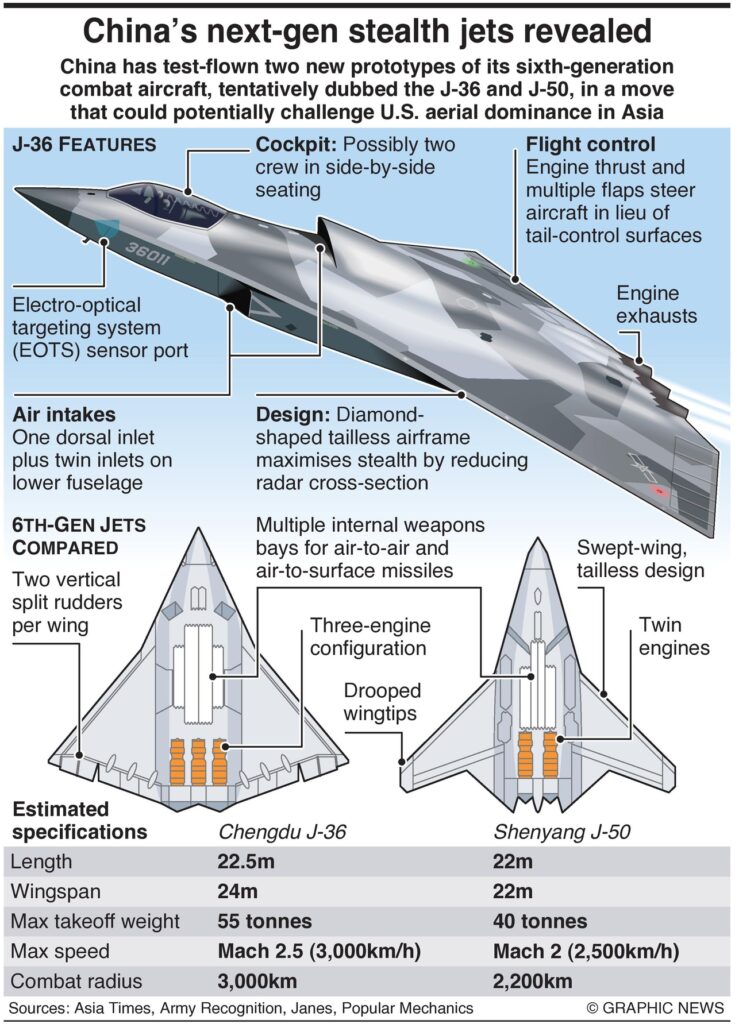
Both aircraft, produced by different manufacturers, tentatively dubbed the Chengdu J-36 and Shenyang J-50, share tailless airframes. This configuration maximizes stealth by reducing the radar cross-section but at some cost to maneuverability.
Both also appear designed for supersonic cruise flight without using afterburning.
🇨🇳 𝗖𝗵𝗶𝗻𝗮'𝘀 𝗻𝗲𝘄 𝟲𝘁𝗵-𝗴𝗲𝗻 𝗳𝗶𝗴𝗵𝘁𝗲𝗿 𝗷𝗲𝘁 𝗰𝗼𝗻𝗱𝘂𝗰𝘁𝘀 𝗺𝗮𝗶𝗱𝗲𝗻 𝗳𝗹𝗶𝗴𝗵𝘁
— The Global Beacon (@globalbeaconn) December 26, 2024
China's advanced sixth-generation fighter jet completed its maiden flight today, showcasing potential new capabilities in stealth and combat.
Observed with a Chengdu J-20, the… pic.twitter.com/haGB5B1bGJ
Of the two, the J-50 is slightly smaller and more conventional in terms of size and its twin engine, swept-wing configuration. The J-36, by contrast, features a modified delta wing design and a third jet engine on its spine in addition to two underslung engines.
It may be a truly multirole aircraft that will fulfill strike as well as air combat roles.
As Popular Mechanics noted, no operational combat aircraft, past or present, has three forward-thrust jet engines.
But as The War Zone (TWZ) notes:
…there is a lot we do not know about these aircraft. We have the benefit of much better imagery of the larger of the two — the one that garnered the most interest. The other may be more ambiguous due to the lack of good imagery, but its existence is important regardless.
TWZ continues:
Exactly what role these aircraft are intended to fulfill is not perfectly clear. They could be competitors for China’s next-generation heavy fighter initiative, one being markedly larger with different performance goals than the other but still looking to fulfill a future tactical airpower vision, with Chengdu as the manufacturer of the heavier example and Shenyang likely the smaller design. This would make some sense based on the timing of their emergence and the fact that they are both tailless next-generation designs in the heavy fighter class, at least generally, with one clearly possessing a much higher gross weight potential than the other. They could also be intended for separate, but related programs. We just don’t know.
China’s next-generation tactical air combat vision is understood to be similar to that of the United States. It would likely include central manned aircraft that will play direct kinetic and non-direct kinetic-enabling roles, serving as independent ‘shooters’ and command and control platforms for drones that possess a high level of autonomy. It will also work as a key intelligence gathering and communications node, as well as a potent electronic warfare platform in its own right.
But are these planes game changers?
Popular Mechanics notes that: “China’s new avant-garde prototypes will heighten the debate in Washington as to whether a manned sixth-generation fighter is an expensive luxury in the age of drones or a critical necessity for maintaining U.S. air superiority in the coming decades.”
It adds that American sixth-generation design concepts and possible demonstrators may be just as avant-garde as China’s, but none have been made public yet.
Still, the U.S. has something potentially better that it has been test-flying for years. It just might be too expensive to produce.
PopMech continues:
China’s approach to the J-36 appears to embrace the concept of “system of systems.” That is, rather than a manned jet being designed to handle a full range of tasks by itself, it’s considered one element of a web of systems including drones, long-range missiles, and friendly forces on land, in the sea, air and even space, all connected with the fighter’s battle network.
That allows a combination of elements in the network to serve as eyes (for target acquisition and tracking) or as shooters in order to minimize potential retaliation. For example, a J-36 might discretely scout ahead until it can locate the position of an enemy carrier—then, rather than exposing itself by directly attacking, transmit guidance data to a surface-launched anti-ship ballistic missile racing toward the carrier from 1,000 miles away. Conversely, the same jet might unleash a volley of missiles at enemy fighters while keeping its radar off and relying on multiple friendly drones for target detection/tracking.
The greater range, endurance, and payload of a J-36-like heavy fighter would be especially helpful for China to interdict U.S. aircraft and ships before they get close to Taiwanese airspace. Thus, a heavy fighter could theoretically rely on stealthiness, extra-powerful radar and jammers, long-range missiles, drones, and supersonic surge speed to avoid being forced into a close-maneuvering fight—which, in turn, makes some reductions to maneuverability palatable.
My preliminary assessment for "J-36" for @Diplomat_APAC
— Rick Joe (@RickJoe_PLA) December 30, 2024
In many ways this piece is not only about the new aircraft itself but also about PLA watching at large.
Happy new year.https://t.co/nVlrOwBlsy
In the end, as TWZ concludes:
…these two aircraft are what China wants to show us. You can look at that as a play to push America’s hand in the development of the wrong systems or as a bold warning designed for domestic and international consumption — a rattle of the technological saber in the face of the world’s most powerful military. And yes, there are many other things China has not and does not intend to show us at this time. We are only seeing part of the puzzle and a small part of it — the one they want us to see.
So, when you look at the total picture, to blow off China’s achievements with these new aircraft — and considering they are clear indicators of where they could be headed for future air combat capabilities — is a naive and dangerous act. While the U.S. remains superior in most all technological aspects of tactical combat aviation, there is no denying that with each year China closes what was once a gaping technological gap. If anything else, the evidence presented in the form of these two aircraft underlines that fact and should be a cause for real concern and reflection as a result.
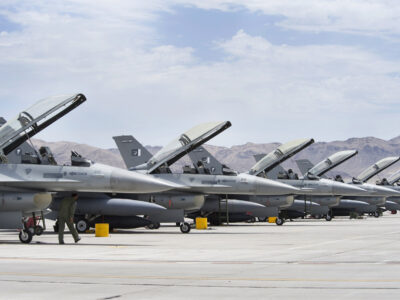
Meanwhile here is one U.S. military response.
The opinions expressed in this article are those of the author and do not necessarily reflect the positions of American Liberty News.
READ NEXT: Dark Blue Enclave Sparks Constitutional Battle Over Court Orders




















OK, the Red Chinese flew these craft around the sky over a city, but given the lack of use in any combat situation, just how really good are they! The Chinese equivalent of Russia’s SU-57? Of which we also know little. I am not going to worry just yet. I am old enough to remember when the MiG-25 was speeding across the skies and everyone was in a panic. Then we got one and it turned the engines needed to be replaced after every flight.