







White House Hosts Major Semiconductor Expansion Announcement
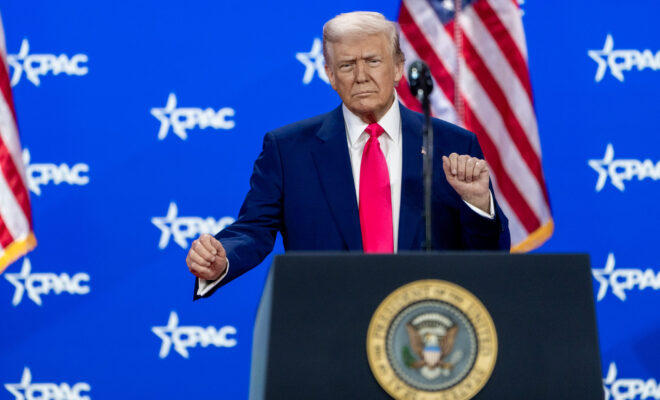
Taiwan Semiconductor Manufacturing Company (TSMC) will invest at least $100 billion in the United States to expand its chip production capacity, marking a significant step toward bolstering American semiconductor manufacturing and reducing dependence on Asian suppliers. The announcement was made Monday at the White House during a press conference featuring President Donald Trump, U.S. Secretary of Commerce Howard Lutnick, TSMC CEO C.C. Wei and “White House Crypto and AI Czar” David Sachs.
During a presser with U.S. President Donald J. Trump, U.S. Secretary of Commerce Howard Lutnick, TSMC CEO C. C. Wei, and “White House Crypto and AI Czar” David Sachs, the president announced that TSMC will be investing at least $100 billion in new capital towards building out… pic.twitter.com/nPyX8sHDQy
— OSINTdefender (@sentdefender) March 3, 2025
Bringing Semiconductor Production to America
The investment will be directed toward expanding TSMC’s footprint in Arizona, where the company already operates fabrication plants. The chipmaker plans to produce advanced four-nanometer chips by 2024 and introduce cutting-edge two-nanometer technology by 2028 at a second Arizona facility. These developments are expected to enhance domestic semiconductor production, making the U.S. more self-reliant in critical technology sectors. (RELATED: Masayoshi Son: The Risk-Taker Securing America’s Future In AI)
Commerce Secretary Lutnick described the initiative as part of a broader effort to “bring production to America” and circumvent tariffs that threaten to complicate global supply chains. The U.S. government has actively incentivized semiconductor investment, including awarding TSMC $6.6 billion in subsidies under the CHIPS and Science Act, which allocates $52.7 billion to strengthen American chipmaking capabilities.
Economic and National Security Implications
The expansion comes at a time of growing concern over supply chain vulnerabilities. The COVID-19 pandemic exposed the risks of America’s heavy reliance on Asian semiconductor manufacturing. Any future disruption—whether due to geopolitical tensions, trade restrictions or natural disasters—could severely impact industries ranging from consumer electronics and medical technology to military defense systems and energy infrastructure. (RELATED: How Automation And Artificial Intelligence Can Help Warfighters In High-Stress Situations)
Maintaining America’s Technological Leadership
Semiconductors are the backbone of modern electronics, powering everything from smartphones and laptops to fighter jets and missile defense systems. The U.S. government sees boosting domestic production as essential for maintaining leadership in artificial intelligence, quantum computing and next-generation communications technologies. Meanwhile, China continues to invest heavily in achieving semiconductor self-sufficiency, intensifying the global race for technological dominance.
TSMC’s commitment aligns with broader U.S. efforts to secure critical supply chains, strengthen economic resilience and ensure the country remains a leader in the rapidly evolving tech landscape. With billions pouring into domestic chip manufacturing, the future of American semiconductor production looks stronger than ever.
READ NEXT: Trump Reveals Groundbreaking Economic News For Critical Voting Bloc





















Hooray & needed