












On March 25, 2025, Senator Markwayne Mullin stated in a video posted to X that “Hillary Clinton was sending classified documents that were stamped TS or TSSCI.” Madison Czopek of the Soros-backed Poynter Institute’s PolitiFact quickly labeled this claim “false.” Her article, titled “Hillary Clinton sent emails ‘stamped’ Top Secret? No, government reviews paint a different picture,” sought to dismiss Mullin’s statement as political fiction. In truth, however, Czopek’s so-called fact check constitutes a more egregious misrepresentation of the public record than the claim she attempted to debunk.
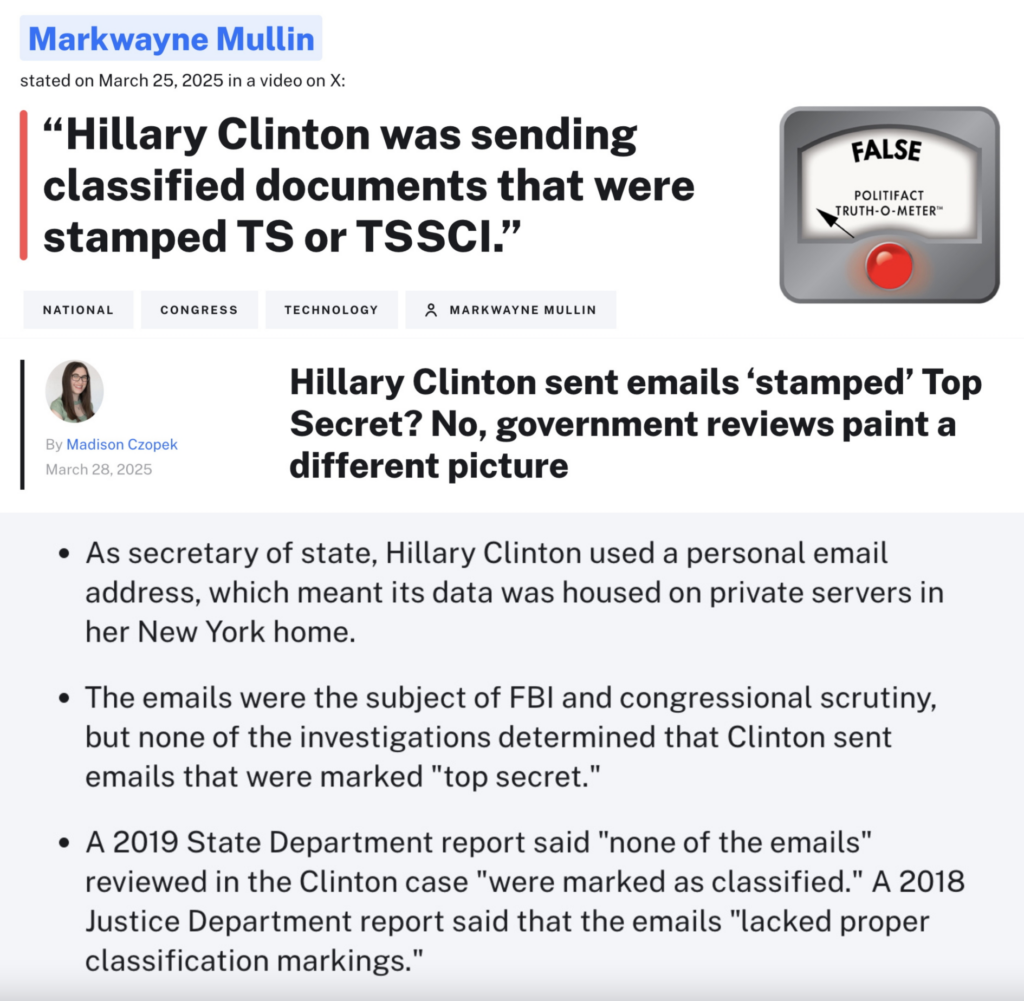
To see this clearly, we must trace the facts back to their origin: the FBI’s 2016 investigation into Clinton’s use of a private email server and the subsequent State Department review. The record is complex, yes, but not opaque. And the clarity that emerges is not flattering to Clinton, nor to PolitiFact.
Start with the basics. Hillary Clinton, during her tenure as secretary of state, exclusively used a private email server housed in her Chappaqua, New York home. From this server, she conducted official State Department business. In 2014, after the existence of this server came to light, Clinton turned over roughly 30,000 emails to the State Department. The FBI later reviewed these communications.
Their findings were anything but exculpatory. In July 2016, FBI Director James Comey disclosed that 110 emails, across 52 distinct chains, contained classified information at the time they were sent or received. Not retroactively classified. Not borderline or ambiguous. Classified, period. Of these, eight chains contained Top Secret information, the highest classification level. Some of those even involved Special Access Programs, the narrowest and most sensitive category of national security data. These are precisely the kinds of communications that Markwayne Mullin referenced.
Czopek’s argument turns on a pedantic distinction. She claims that since the emails were not physically “stamped” as classified, Clinton cannot be said to have sent marked classified information. This is misleading in the extreme. Federal classification markings often include headers and paragraph markings, but the absence of a stamp does not mean a document is not classified. The FBI, for instance, noted that only three of the thousands of emails bore even a small “(C)” to denote confidential material. The rest, while lacking formal markings, were nonetheless classified in substance—a point Comey emphasized in his public remarks.
Czopek’s attempt to equate the absence of a rubber stamp with the absence of classification is akin to arguing that a stolen Rembrandt is not stolen because it wasn’t labeled as such at the time of theft. The issue is not the form but the content. And the content of Clinton’s emails, by the FBI’s own standards, included Top Secret intelligence.
Indeed, one of the most damning elements of the FBI’s findings was the inclusion of material related to Special Access Programs, or SAPs. These are not casual classifications. They encompass operations so sensitive that even many with Top Secret clearances are not allowed access. In fact, Comey noted that some of this information concerned the U.S. drone program, which, while publicly reported, remained technically classified at the SAP level. The idea that such information could travel across an unsecured, private server without consequences defies both legal logic and common sense.
But perhaps the most glaring oversight in Czopek’s piece is the omission of Clinton’s authorship. Of the 2,093 emails that were later up-classified—designated as classified after the fact—Clinton herself wrote 104. While Czopek places weight on the idea that classification markings were absent, she omits the material reality that Clinton, as the email’s author, was in the best position to know what should or should not have been transmitted over unsecure channels.
To be clear, there is a distinction between information that is classified and information that is marked as classified. But the absence of markings does not render the content benign. This is precisely what Comey meant when he described Clinton’s conduct as “extremely careless.” No reasonable reading of the facts absolves her of mishandling sensitive government material. And yet, this is precisely the implication of PolitiFact’s so-called fact check.
Furthermore, a 2019 State Department review identified 588 security violations involving 38 individuals, many of whom sent classified information to Clinton’s account. The report did not find systematic intent, but it did conclude that the use of the private server introduced systemic vulnerabilities. To say, as Czopek does, that no emails were “marked” classified is to sidestep the entire issue. Markings matter, but so does content, especially when that content includes sensitive national security data.
To summarize the facts: Clinton sent and received at least eight email chains containing Top Secret information while serving as Secretary of State. The classification level of these emails was not speculative, it was determined by the FBI at the time of their transmission. That they lacked proper markings is not exculpatory, especially when one considers that the server itself was unauthorized and unsecured.
PolitiFact’s error, then, is twofold. First, it misrepresents the significance of classification markings, treating them as the sole determinant of classification status. Second, it fails to account for the substance of the FBI’s findings. Whether out of ignorance or ideological bias, the result is the same: a false narrative cloaked in the trappings of journalistic authority.
It is worth noting that this is not an isolated incident. PolitiFact, like many contemporary fact-checking organizations, often frames its analysis in a way that protects progressive political actors while casting aspersions on conservatives. The mechanism is subtle, usually phrased in the language of nuance and contextualization, but the outcome is unmistakably partisan. In the present case, the article’s headline primes readers to disbelieve Mullin’s statement. The body of the piece then narrows the claim to a straw man—suggesting that Mullin meant the emails were physically rubber-stamped—before knocking it down.
This strategy has the superficial appearance of rigorous scrutiny, but it ultimately obscures rather than illuminates. A fact check that deliberately ignores the central facts of a case cannot rightly be called a fact check at all. It is, rather, a rhetorical maneuver dressed in the language of empirical adjudication.
We are left, then, with a paradox. The fact check meant to debunk a claim about Hillary Clinton’s mishandling of classified material is itself false. Worse, it inverts the proper relationship between fact and fiction, granting a veneer of truth to a narrative that omits critical context, elides damning evidence and relies on a standard of proof that would exonerate almost any form of bureaucratic malpractice.
In a media environment increasingly saturated with selective interpretation and institutional bias, this episode serves as a reminder that even the watchdogs need watching. Markwayne Mullin’s statement was broadly correct, substantiated by the FBI’s findings and supported by publicly available documentation. PolitiFact’s denial of this reality reveals less about Mullin’s credibility and more about the ideological commitments of those who presume to arbitrate truth.
Truth, as always, is not determined by majority vote or media consensus. It resides in the records, the transcripts, the evidence. And in this case, the evidence speaks clearly: Clinton sent classified emails, some at the Top Secret level, from an unauthorized private server. The only thing false here is the fact check that said otherwise.
Sponsored by the John Milton Freedom Foundation, a nonprofit dedicated to helping independent journalists overcome formidable challenges in today’s media landscape and bring crucial stories to you.
READ NEXT: Grassroots Leaders React To Trump Ending Patel’s Term






















go get her enough of her treasons behavior
So HiLIARy is exposed again ?…..WHEN IS SOMEBODY GOING TO DO SOMETHING ABOUT IT ?!?! She should be in jail…..oh, I forgot, she has alot of money !