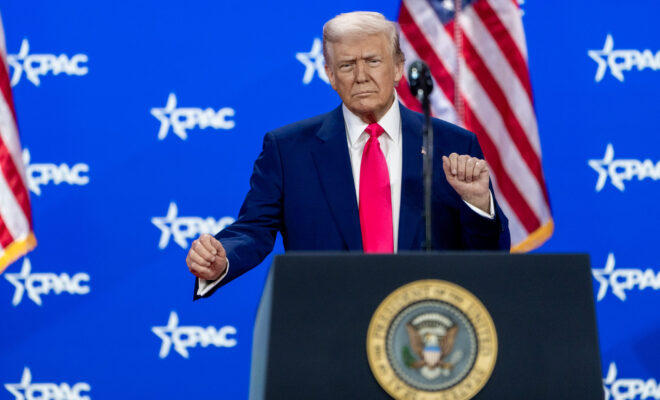




President Donald Trump announced over the weekend that he is directing federal agencies to begin the process of imposing a 100% tariff on films produced outside of the United States, arguing that the flight of movie production abroad poses a threat to national security and American culture.
The announcement, made via Trump’s Truth Social platform, comes amid a prolonged slump in U.S.-based film production, which has been steadily declining as studios seek more cost-effective or incentive-laden locations overseas. According to industry estimates, domestic film and TV production is down by approximately 40 percent.
“The Movie Industry in America is DYING a very fast death,” he wrote on Sunday. “Other Countries are offering all sorts of incentives to draw our filmmakers and studios away from the United States. Hollywood, and many other areas within the U.S.A., are being devastated. This is a concerted effort by other Nations and, therefore, a National Security threat. It is, in addition to everything else, messaging and propaganda! Therefore, I am authorizing the Department of Commerce, and the United States Trade Representative, to immediately begin the process of instituting a 100% Tariff on any and all Movies coming into our Country that are produced in Foreign Lands. WE WANT MOVIES MADE IN AMERICA, AGAIN!”
While some states like Georgia, Louisiana, and New Mexico have drawn productions away from Hollywood with their own incentives, the exodus has increasingly gone global, with countries like the U.K., Canada, Australia, and France offering more generous packages and access to experienced crews.
The film industry’s reaction to Trump’s proposal was immediate—and overwhelmingly negative. Studio executives, producers, and international partners blasted the tariff threat as unrealistic, misguided, and potentially devastating to global film production.
“It implies that a U.S. film is meant to shoot in the U.S. But the Harry Potter films, Lord Of The Rings, Gladiator, Mission Impossible—these are U.S. films shot abroad. This makes no sense,” one U.K.-based producer told Variety.
Critics argue that film productions often require locations that simply do not exist in the U.S., and trying to force domestic-only shooting could compromise both artistic vision and financial viability. Others note that classifying films as taxable goods under trade policy may not be legally or logistically possible.
“Technically, films are services on which you can’t impose tariffs,” said one French film official. “It could end up in court and take months.”
Some insiders worry that if such tariffs are enacted, studios may double down on automation and artificial intelligence to avoid international shoots altogether. Former Abu Dhabi film commissioner Hans Fraikin warned that “it’s just going to push the studios to make much heavier use of A.I.,” leading to fewer traditional film jobs and potentially accelerating trends already reshaping the industry.
Others warned that a tariff policy could have the opposite of its intended effect, driving global film productions to fully disassociate from the U.S. market, particularly if retaliatory trade actions follow.
While Trump’s proposed film tariff is still just a declaration at this stage, industry professionals are keeping a close eye on Washington for concrete action. For now, many are taking a cautious approach.
“We just have to wait and see what Trump’s next move is,” said Italian producer Marco Valerio Pugini. “It’s like in chess. We don’t know where this is going to go.”
READ NEXT: China Rolls Back Tariffs On US Goods — Quietly