




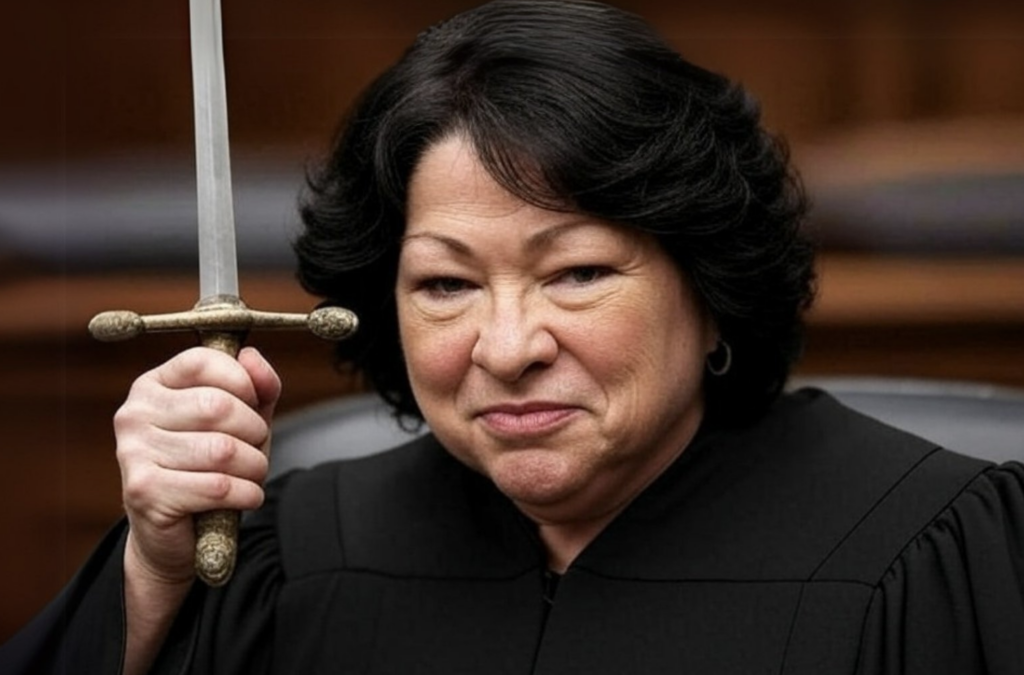
In her recent address to the American Bar Association, Justice Sonia Sotomayor spoke not as a neutral jurist interpreting the Constitution, but as a partisan urging mobilization against the sitting administration. Her remarks, delivered with careful modulation, carried all the marks of political rhetoric under the guise of moral urgency: “This is our time to stand up and be heard.” To the untrained ear, these words may sound like little more than civic encouragement. But context clarifies tone, and tone unmasks motive. Coming from a sitting Supreme Court Justice, in a polarized environment, during open legal battles between the ABA and the Trump administration, such language functions as a judicial call to arms. It is not merely inappropriate, it is corrosive.
Let us be precise. It is not that justices are required to be mute. Judicial silence is not a constitutional command. But there is a long-standing, deeply American norm of judicial restraint in public speech, particularly concerning contemporary political issues. The preservation of trust in the judiciary depends on an appearance of detachment from the heat of daily partisan conflict. In legal theory, we call this the ideal of the apolitical court, the vision of a bench immune to the passions of the agora. That ideal is not naïve. It is aspirational, and like all healthy aspirations, it functions as a stabilizing restraint.
Sotomayor’s defenders point to speeches by Justice Alito or Justice Thomas as justification. True, others have erred. But missteps, even those made by colleagues, do not eliminate the line. They merely show how dangerous it is to forget that it exists. The wrong of a conservative justice speaking injudiciously does not absolve the left-leaning justice of her own transgressions. Rather, it marks the beginning of a slippery descent into institutional rot. When both teams play dirty, the field is soon unplayable.
Some might argue that Justice Sotomayor’s comments were mild, barely discernible as partisan to anyone not steeped in the day’s political trench warfare. But this is a misreading. Her choice of venue and timing is not coincidental. The ABA, long associated with progressive jurisprudence and currently involved in litigation before the Court, is no neutral forum. Her speech occurred amid well-publicized disputes between the ABA and the Trump administration, including the barring of federal lawyers from participating in ABA events over ideological disagreements. Thus, her call to “stand up and be heard” cannot be isolated from its audience or context. It reads not as moral exhortation, but as judicial cheerleading for one side of an ongoing conflict.
Consider the response of Carrie Severino of the Judicial Crisis Network, who argued that Sotomayor’s remarks make “a mockery of any appearance of objectivity in cases challenging the administration or involving the ABA.” The concern is not hypothetical. United States v. Skrmetti, a pending case involving controversial state laws on gender-transition procedures for minors, features the ABA as a vocal participant. A justice publicly aligning herself with the institutional litigant’s values raises reasonable fears about her impartiality in adjudicating the matter. The irony here is rich. While Sotomayor rallies lawyers to fight for those who cannot fight for themselves, she is, perhaps unwittingly, undermining the very judicial mechanism designed to offer equal justice without fear or favor.
Some will insist that her speeches are expressions of her identity, a continuation of the sentiments voiced in her 2001 Berkeley lecture, where she famously suggested that a “wise Latina woman” might reach better conclusions than a white male. That speech, widely criticized during her confirmation hearings, signaled her belief that personal experience shapes judgment. In its charitable reading, it is a recognition of the complexity of legal interpretation in a pluralist society. But in its less generous, and more realistic, interpretation, it amounts to a redefinition of objectivity itself: from the impartial application of law to the empathetic projection of personal narrative.
This, in the end, is the heart of the matter. If justices are to be philosophers-kings, their robes must conceal the team colors underneath. But Sotomayor increasingly appears unwilling to play this part. She is not merely sympathetic to progressive causes, she champions them from the lectern. Her defenders claim this is virtue. But a justice who fights losing political battles from the bench is no longer a judge, she is a surrogate. Her speeches do not merely blur the line between adjudication and activism, they erase it.
And this is not an idle concern. A 2024 poll cited by PBS found that seven in ten Americans now believe justices rule based on ideology rather than law. That statistic should terrify anyone who values the legitimacy of our constitutional order. Once the Court becomes perceived as a political extension of party platforms, its rulings will be obeyed less out of respect than out of necessity. The moment compliance becomes conditional, the Court has lost the very power that Marshall so presciently defined in *Marbury v. Madison, not the power of the purse or sword, but of judgment. Lose that, and robes become costumes.
The suggestion that Sotomayor’s behavior is part of a broader trend does not diminish its significance. Trends in judicial behavior are not morally self-justifying. If the court is trending toward public partisanship, then it is trending toward institutional suicide. Justice Alito’s warnings about attacks on traditional values, while perhaps unwise, were not delivered amid litigation involving institutions explicitly aligned with his message. Nor did Alito ever urge organized resistance against a sitting administration from a national professional guild. That distinction matters. It separates rhetorical warning from political organizing. One is intemperate, the other insurrectionary.
It is tempting to dismiss this all as the usual grumbling from one side of the aisle. But here, form matters as much as substance. The robe is not merely fabric, it is symbol. It tells the citizen that, regardless of politics, they will be heard by someone who has, at the very least, remained silent long enough to listen. When a justice breaks that silence not for clarification or caution, but to rally political allies, the robe becomes a cloak for partisanship.
There is a final, deeper irony to consider. In urging the bar to rise against the Trump administration, Sotomayor invokes the language of battle. But the judge is not meant to fight. The judge is meant to adjudicate, to wait, to hear, and then to rule. The very dignity of her office depends on the presumption that she is the last one to speak, not the first to rally. To confuse the two is not merely a rhetorical slip, it is a fundamental abandonment of role.
One can believe that Justice Sotomayor is sincere, compassionate, even brilliant, and still believe her speeches are reckless. Indeed, it is precisely her intelligence and stature that make them so dangerous. When someone in her position lends the moral authority of the Court to one side of a political fight, she transforms the institution from guardian to gladiator. And that, for a republic founded on the rule of law, is the gravest betrayal of all.
If you like my work please consider subscribing: https://x.com/amuse
Sponsored by the John Milton Freedom Foundation, a nonprofit dedicated to helping independent journalists overcome formidable challenges in today’s media landscape and bring crucial stories to you.
READ NEXT: Nuclear Powers Respond To Trump’s Latest Diplomatic Move




















Here we go again (and again) judges at ALL levels are supposed (at least in theory) to be neutral and base their rulings/decisions on the letter of the law, NOT their personal biases/beliefs. If they are incapable of making those rulings/decisions without bias, they are supposed to recuse themselves from that case. They are still certainly allowed to have their own opinions – and even express them in public but when those personal beliefs/biases bleed over into their judicial decisions the law has become corrupted and ineffective. THAT is why so many of us no longer trust the system – it has become judicial activism at its worst. Prove me wrong.
The whole judicial system has become corrupt just like our political system has become.
Although Sotomayor is just now broadcasting to the world the actions the SCOTUS is scheming and has been practicing, are any further overt actions and rhetoric really required to impeach Sotomayor and any other justices, that have been and will be practicing that judicial protocol against the duly elected and sitting president of the United States? I think not! Let the administration and republican controlled congress immediately begin the procedures to impeach each and every justice that is a party in support of the coup! Thomas, Alito and perhaps Gorsuch are the only justices not engaged with the coup. The corrupt democrats must be held accountable for the formation of the coup. Since this is a treasonous act those involved or complicit must pay the harsh price of threatening our nation’s sovereignty.
She never has been anything other than a pawn for the extreme left. Sonya Sotomayor and Ketanji Brown Jackson are there with her in support of everything far left and anti-American.
That judge looks evil. Bitten by the dimwit nitwit side of reasoning. It seems she really needs to be replaced. Her soul is corrupt!
Not a new thought — but it’s getting imperative that Sotomayor be removed ASAP by demanding term limits and other ways to legally remove treasonous SCOTUS members! Guilty of treason – gone!
Sonya needs to say, “seeya”….She’s simply a leftTard plant.
Not what a Supreme should be thinking. It is the law, not the politics.
This is not appropriate, but then Sotomayor was not an appropriate pick for SC except as a partisan. My response to her message would be bring it on. And then we’ll see who doesn’t want a street fight. I don’t want a street fight, but I don’t want judges making their own law either as so many of them seem to think they are entitled to do.
Superb essay.