






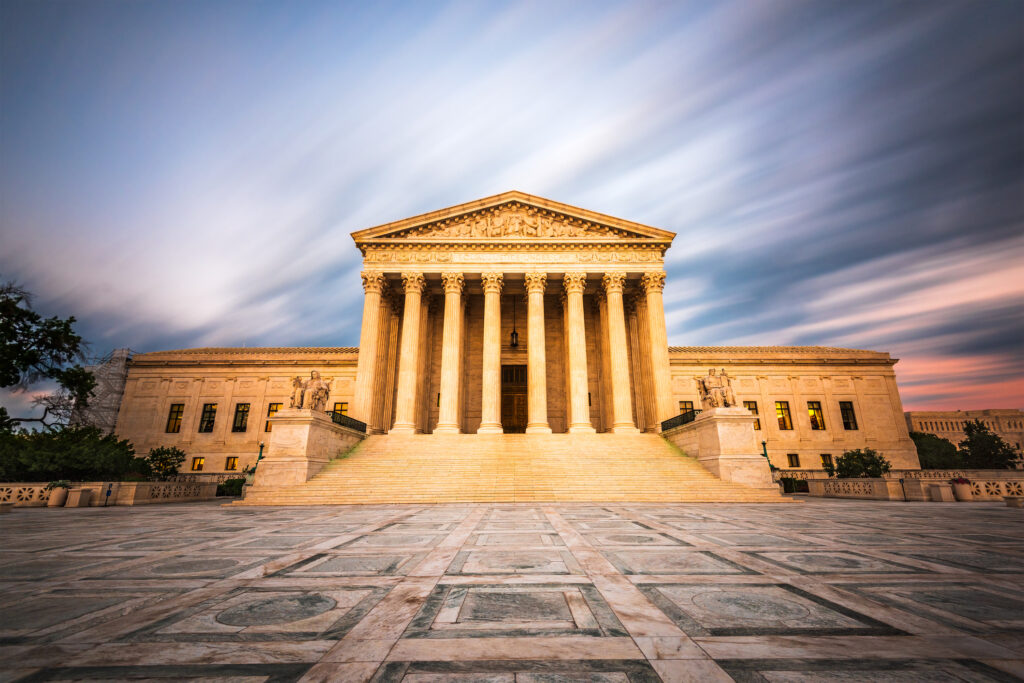
Based on this morning’s oral arguments I predict the Supreme Court will rule 6 to 3 to curb, though not abolish, the use of nationwide injunctions by district courts. The decision, which will likely be authored by Chief Justice Roberts, will hold that lower courts may only issue relief commensurate with the injury suffered by the named plaintiffs, unless Rule 23 class certification or explicit congressional authorization permits broader relief. The consolidated injunctions entered by courts in Maryland, Washington, and Massachusetts will be vacated and remanded with instructions to tailor them narrowly. What emerges from Trump v. CASA is a ruling of judicial modesty: a boundary drawn, not a revolution sparked.
This result is not speculative bravado. It is a forecast drawn from a close reading of the oral arguments, the institutional temperament of the Roberts Court, and the deeper jurisprudential philosophies of its individual justices. This is a Court that still believes in judicial restraint, even if it wears a different robe than in generations past. At issue is not merely the reach of injunctions, but the very architecture of constitutional adjudication: who decides, for whom, and with what legal tools.
Chief Justice Roberts made plain his discomfort with injunctions that ripple across the nation from the pen of a single district judge. Yet his inquiry was not ideological but procedural, focusing on the availability of narrower remedies and the need for institutional predictability. Roberts, as always, is the Court’s thermostat, not its thermometer. His likely opinion will recognize that equity, while flexible, is not unbounded, and that the constitutional role of federal courts must reflect limits rooted in Article III.
Justice Barrett zeroed in on enforcement, asking what happens when beneficiaries of an injunction have never appeared in court. Her line of questioning evinced deep concern with the logical terminus of judicial overreach. If contempt proceedings can be initiated by nonparties, who exactly is empowered to ensure compliance? That question, on its face procedural, belies a more fundamental worry about standing, separation of powers, and the integrity of adversarial adjudication.
Justice Kavanaugh, often perceived as a bellwether, focused on Rule 23. His interest in class certification was not a digression, but a constitutional outlet. If broader injunctions are needed, then plaintiffs should seek class certification. The message is clear: equity, properly channeled through procedural rules, provides a lawful and predictable vehicle for collective relief. What Kavanaugh rejects is not fairness, but improvisation.
Justice Gorsuch, ever the institutional minimalist, emphasized “percolation” and the need for legal issues to mature through the lower courts. His skepticism of nationwide injunctions stems not from partisanship, but from a historical aversion to judicial fiat. In his view, nationwide injunctions short-circuit the judicial process, replacing the slow cultivation of doctrine with a single act of national nullification.
Justice Thomas, the Court’s originalist conscience, opened with history and never strayed. He has long rejected remedies that lack 18th-century pedigree. It is likely he will write separately, perhaps arguing that nationwide injunctions are a modern invention without constitutional warrant. His concurrence will supply the jurisprudential ballast for the majority, tethering the outcome to a longer legal tradition.
Justice Alito, whose pragmatism often cloaks deeper philosophical commitments, focused on the real-world consequences of expansive relief. He warned of trial court monarchs, unelected and unmoored, wielding power over federal policy. Alito’s concern was not theoretical. He sees, in the modern universal injunction, the seeds of judicial tyranny, a drift from adjudication toward governance.
The liberal bloc presented a robust, if ultimately outvoted, defense of expansive relief. Justice Kagan was the most tempered. She worried aloud about the “catch-me-if-you-can” problem: if relief is limited to named plaintiffs, the government could simply shift jurisdictions. Her concern was practical, even strategic. But Kagan is also a realist. Her prior speeches questioning universal injunctions suggest she may concur in judgment, joining a narrow opinion that trims the practice while keeping its door ajar.
Justice Sotomayor, by contrast, offered a full-throated defense of universal relief. Her framing was moral and immediate: constitutional rights must be vindicated broadly, not parceled out by geography. Her hypotheticals involving gun confiscation hinted at her core fear, a piecemeal regime of constitutional enforcement that betrays the very essence of federal rights. Justice Jackson echoed this sentiment. Her remarks painted the executive branch as a potential abuser of jurisdictional complexity. Both will dissent.
The likely holding will clarify that district courts may not issue relief broader than what is necessary to redress the named plaintiffs’ injuries. Nationwide injunctions, once a favored tool of litigants seeking immediate, expansive remedies, will become exceptional. Courts will be instructed to ground broader relief in certified classes under Rule 23, statutory authority, or truly indivisible injuries.
Importantly, the Court will not declare such injunctions categorically unconstitutional. That path, favored by Justice Thomas, will not command a majority. Instead, the Court will remand the cases below with instructions to recalibrate the injunctions to fit the parties. This is not a guillotine but a scalpel.
The implications are profound. First, forum shopping will diminish. The ability of litigants to find a friendly district court and obtain nationwide relief will be curtailed. Strategic litigation will now focus on class certification and appellate channels, not geography. Second, the emergency docket may breathe easier. With fewer coast-to-coast rulings to stay, the Court can let issues percolate and mature. Finally, Congress is put on notice. If sweeping relief is needed, particularly in fields like immigration and environmental regulation, statutory clarity is the solution.
The Court will sidestep the underlying question of birthright citizenship. That issue, fraught and constitutionally complex, remains for another day. Yet the separate writings of Thomas and Gorsuch may hint at future challenges to United States v. Wong Kim Ark, the 1898 precedent often cited as sacrosanct. That originalist reckoning is yet to come.
To the extent that Trump v. CASA is remembered, it will not be for fireworks but for architecture. The Court, in a moment of judicial modesty, will reinforce the scaffolding of constitutional litigation. That might disappoint the ideological crusaders, but it restores a balance long overdue.
If you enjoy my work, please consider subscribing: https://x.com/amuse.
Sponsored by the John Milton Freedom Foundation, a nonprofit dedicated to helping independent journalists overcome formidable challenges in today’s media landscape and bring crucial stories to you.
READ NEXT: Top Dem Facing Serious Campaign Trouble – What It Could Cost Him






















“All persons born or naturalized in the United States, and SUBJECT TO THE JURISDICTION THEREOF, are citizens of the United States and of the State wherein they reside.” Are citizens of other countries who enter the United States illegally, or enter the Country to have the baby (birth tourism) subjugating themselves to the jurisdiction of the United States? No, they are not. They are taking advantage of legislating from the bench over a few times in the last 100 years or so. This amendment was for those that left slavery after the emancipation proclamation and not for any other reason!
Our Supreme Court is so compromised as to be useless. Two or three members should be removed Stomper,Roberts and Amy BarretT.
I wish they would take a stronger stance against courts that legislate new/reinterpret instead of enforcing the existing law and Executive orders.