

In a case with profound implications for the balance of powers in the U.S. government, the Supreme Court heard oral arguments Thursday in Trump v. CASA, a legal showdown that may determine whether district judges can continue issuing universal injunctions—broad judicial orders that block federal policy nationwide.
At the heart of the case is former President Donald Trump’s executive order curtailing birthright citizenship, which was swiftly blocked by multiple district courts through universal injunctions. These sweeping rulings halted the order not just for the plaintiffs involved in the lawsuits but across the entire country, effectively overriding the president’s ability to enforce national policy.
The Trump administration argues that this legal tool—long criticized by constitutional scholars and increasingly used during his second presidencies—has empowered lower court judges to become de facto policymakers, subverting the will of elected officials and the American electorate.
Universal injunctions emerged as a potent instrument of opposition during Trump’s first term, when liberal-leaning judges issued 64 such injunctions—more than half of all ever issued between 1963 and 2023. That number has accelerated under Trump’s second term, with over 40 injunctions issued in just four months, tripling the rate faced by President Biden in his first three years.
Critics say these rulings amount to judicial vetoes of presidential policy, handed down by any one of the 680 federal district court judges, regardless of jurisdiction or national consensus.
“This is about whether judges’ power extends to non-parties to a case and whether that power can be wielded to systematically disempower a president,” said one constitutional scholar following the case.
The Trump administration has asked the Court to not only uphold the executive order but to prohibit universal injunctions entirely, or at least limit court rulings to the parties involved in a case.
The consolidated case, Trump v. CASA, involves three lawsuits where district courts blocked the implementation of the birthright citizenship order. The administration contends that such injunctions represent a radical and recent departure from judicial tradition—one that destabilizes the constitutional separation of powers.
Until the 1960s, courts generally confined their rulings to the specific plaintiffs involved. The rise of universal injunctions, opponents argue, is a modern invention with dangerous implications.
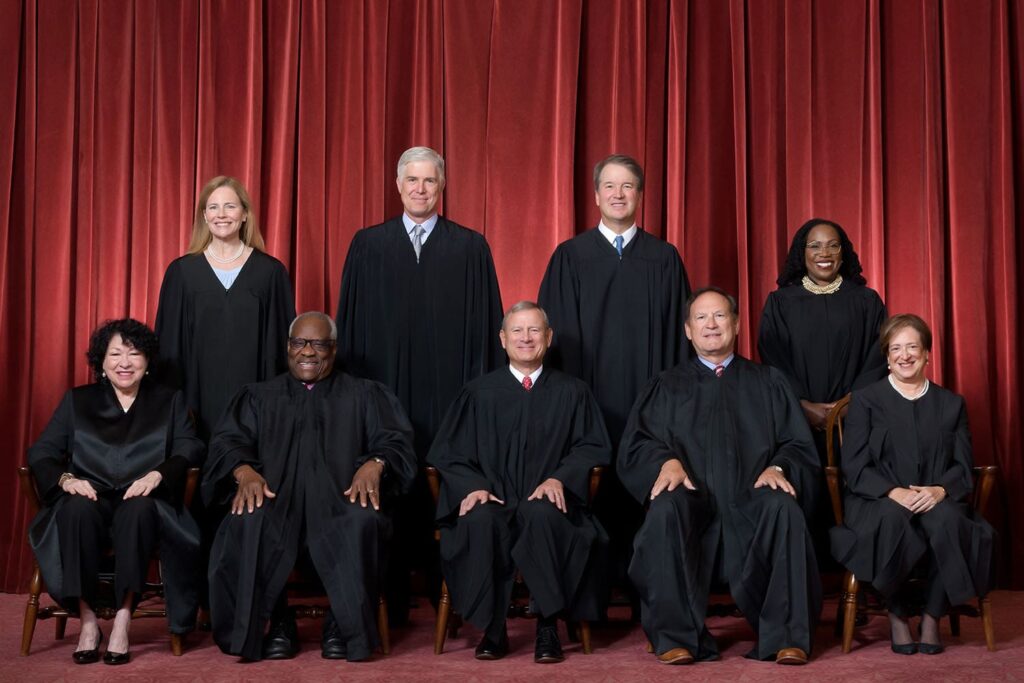
The oral arguments Thursday revealed sharp divisions among the justices.
Justices Thomas, Alito, and Gorsuch signaled strong skepticism of universal injunctions, in line with their past writings.
Justice Kavanaugh appeared open to the administration’s arguments, particularly probing the use of class-action lawsuits as a more legitimate means of achieving broad relief without the constitutional concerns raised by universal injunctions.
Justice Amy Coney Barrett appeared cautious, pressing the government on its willingness to comply with adverse lower court rulings in the meantime.
Justices Sotomayor, Jackson, and Kagan expressed strong resistance to curbing the practice, with Kagan—despite past reservations—arguing the need for courts to act swiftly against potentially unlawful executive actions, leaving Chief Justice John Roberts as the likely swing vote.
Roberts largely stayed quiet but intervened at a critical moment to defend the Court’s ability to act quickly when necessary—countering Justice Kagan’s concerns that restricting lower courts would allow illegal policies to remain in effect for years. Roberts’ ultimate decision could not only determine the fate of Trump’s birthright citizenship order but reshape the limits of judicial authority.
The legislative branch is also tackling the issue. Lawmakers have held hearings and begun crafting bills to restrict the power of district courts to issue universal injunctions. Proponents argue that restoring judicial restraint is necessary to prevent unelected judges from becoming partisan actors.
As the Court deliberates, many see Trump v. CASA as a defining test for the separation of powers and the role of the judiciary in American life.
A decision is expected by late June. If the Court rules in favor of the administration and limits or ends the use of universal injunctions, it could mark a significant shift in how legal challenges to federal policy are litigated—and return greater authority to elected officials.
For now, all eyes are on Chief Justice Roberts and whether he will move to restore judicial restraint—or allow lower court judges to continue rewriting national policy from the bench.
READ NEXT: Trump V. CASA: Reading The SCOTUS Tea Leaves















1. EVERYONE WITH ANY COGNITIVE REASONING NEEDS TO READ THE FEDERALIST PAPER #78, WRITTEN BY ALEXANDER HAMILTON! Hamilton reassures critics that the judiciary is the weakest of the three branches, as it has neither enforcement power nor control over public funds. Its strength comes solely from its ability to interpret and uphold the law, making it an essential check on government power while posing no threat to democratic governance. In presenting his argument for the independence of the judiciary, Hamilton claimed that it was by far the weakest of the three branches. It did not, he said, have the “sword” of the executive, who is commander in chief of the nation’s armed forces, nor the “purse” of the legislature, which approves all the tax and spending measures of the national government. It had, according to Hamilton, “neither FORCE nor WILL but merely judgment.” Critics of the Constitution claimed that judicial review gave the judiciary power superior to that of the legislative branch. Hamilton responded to them in Federalist, No. 78, by arguing that both branches are inferior to the power of the people and that the judiciary’s role is to ensure that the legislature remains a “servant” of the Constitution and the people who created it, not a “master”. WITH THIS LAST STATEMENT, IT INCURS THE WILL OF THE PEOPLE!!! TRUMP WAS VOTED INTO OFFICE BY 77 MILLION VOTERS BASED ON HIS PLATFORM! HE WAS GIVEN BOTH HOUSES TO WORK OUT HIS PLATFORM!! ONE OF WHICH WAS THE DEPORTATION OF ILLEGAL ALIENS!! YOU HAVE THE DISTRICT FEDERAL JUSTICES INTERFERING WITH HIS PLATFORM, AND THE SCOTUS TOO!!! WE HAVE ACTIVIST JUDGES IN THE DISTRICTS AND THE SCOTUS!!! THIS NEEDS TO BE ADDRESSED ASAP!!!
Its not reshaping judicial powers. It is simply putting them back to where they should be. Legislation from the bench is against the law!