





Elon Musk, never one to shy away from audacity, has predicted that solar power will eventually constitute 100 percent of global energy production. A bold claim, on its face, and one that might provoke either admiration or ridicule depending on the ideological lens through which it is viewed. A sober, conservative analysis of global energy trends, grounded in empirical data, physical limits, and the principles of economics, yields a striking conclusion: solar power, once a niche technology subsidized into relevance, is now on a trajectory that could make it the world’s dominant source of energy by 2050.
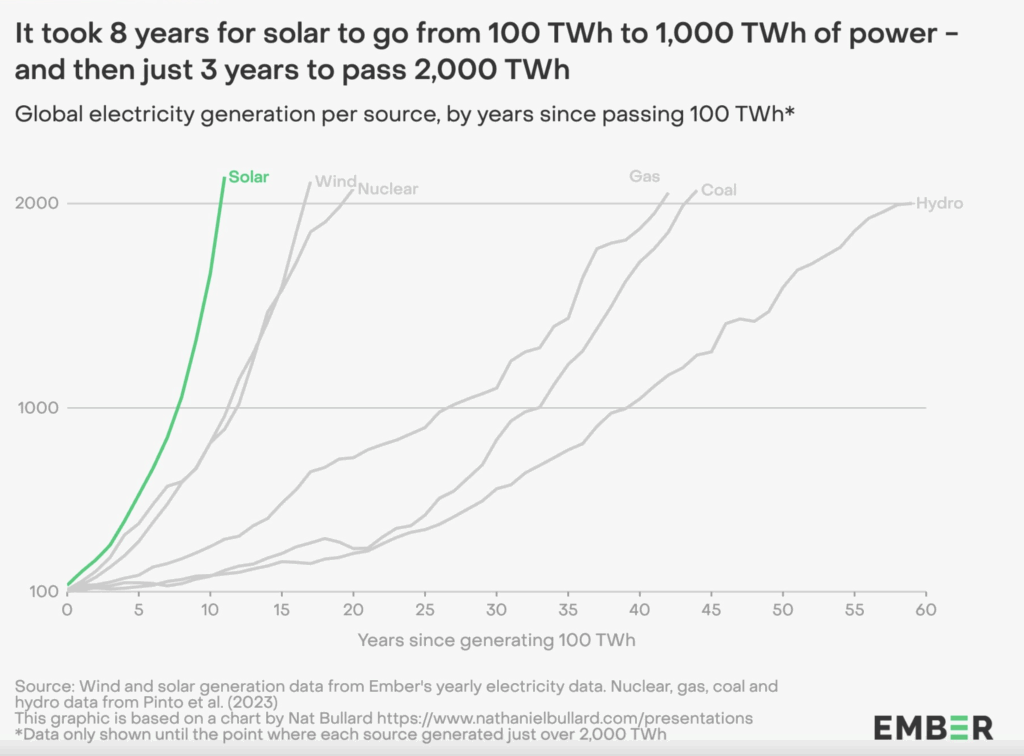
This argument does not rest on utopian dreams, nor does it presume miraculous breakthroughs. Rather, it proceeds from currently available technologies, extrapolates along established empirical curves, and accounts for physical constraints such as efficiency limits and material availability. At its core lies the interaction of two fundamental laws: the Shockley-Queisser limit and Swanson’s Law.
Start with efficiency. In 2025, commercial photovoltaic (PV) panels operate at 15 to 22 percent efficiency. This is already remarkable, considering sunlight is a diffuse and variable resource. Most of the panels installed today use crystalline silicon, a material that is theoretically capped at about 33.7 percent efficiency due to the Shockley-Queisser limit. However, innovation within these constraints continues. Annual improvements of 0.5 to 1 percent in efficiency, modest yet persistent, have been observed for more than a decade, and there is no compelling reason to believe they will cease before either the theoretical ceiling is reached or new technologies render the current ones obsolete.
Critics might argue that this cap renders solar inherently limited. But this misunderstands the economics of scale. Enter Swanson’s Law: for every doubling of global installed solar capacity, the price of PV modules falls by approximately 20 percent. Over the past two decades, this trend has proven robust. From 2012 to 2024, solar capacity grew from 100 gigawatts to over 1,400 gigawatts, roughly doubling every 3.5 years. If this doubling rate persists, we will reach between 400 and 700 terawatts of solar capacity by 2050. For context, global energy demand in 2050 is projected to require no more than 40 terawatts of continuous capacity across all sources. If that forecast is even directionally accurate, solar could constitute the overwhelming majority of installed power.
What enables this exponential growth is not just economics but also the inherent scalability of solar. Unlike nuclear or hydroelectric plants, solar installations are modular. Panels can be deployed on rooftops, deserts, reservoirs, and even integrated into infrastructure. Their installation does not require immense permitting, decades of lead time, or billion-dollar capital infusions. They benefit from standardization, automation, and global supply chains that continue to scale. Perhaps most crucially, solar’s distributed nature allows generation to occur near the point of consumption, reducing transmission losses and alleviating pressure on the electric grid, which, in the US, remains the most fragile and outdated component of our energy infrastructure.
Moreover, storage constraints, often cited as the Achilles’ heel of solar, are increasingly solvable. Battery costs, like panel costs, have plummeted due to similar learning-curve effects. Lithium-ion prices have dropped over 85 percent since 2010, and solid-state and flow battery technologies are entering commercial trials. Coupled with smart grid optimization, demand response systems, and geographic diversification, intermittency becomes a logistical challenge, not an existential one.
Let us return briefly to the matter of innovation. While the above scenario assumes no revolutions, the likelihood of breakthroughs is nontrivial. Tandem solar cells, which layer perovskite films atop silicon, promise to push efficiencies beyond 40 percent. These are not theoretical. Oxford PV and other firms have demonstrated tandem prototypes with over 30 percent efficiency in commercial settings. Perovskites, long plagued by durability issues, have seen significant progress in stability. Meanwhile, bifacial panels, which collect light from both sides, can increase yield by another 10 to 20 percent without requiring additional real estate.
If even one of these innovations scales, the efficiency and cost assumptions outlined above become conservative. If all three scale, we will find ourselves with panels that are twice as efficient and ten times cheaper than today’s standard. This is not alchemy. It is the compounding result of deliberate engineering.
But the final pillar of this case lies in geopolitics. Fossil fuels, though abundant, are increasingly fraught. They are subject to volatile markets, foreign control, and political risk. Coal remains a pollutant. Oil requires extraction from unstable regions. Even natural gas, often seen as a cleaner alternative, suffers from transport and leakage problems. Meanwhile, solar energy is borderless, domestic, and decentralized. It requires no pipelines, no OPEC, and no military protection. It is the Jeffersonian ideal of energy: local, distributed, and immune to the tyranny of kings.
Skeptics might still protest: what about the environmental costs of mining, the challenge of scaling storage, or the sheer volume of land required? These are valid concerns. However, many of them are manageable through strategic innovation and policy. Land use, for instance, is increasingly addressed by dual-use strategies. Agrivoltaics, which allow simultaneous farming and solar energy harvesting, are gaining traction, especially in regions where maximizing land utility is crucial. Floating solar arrays now cover reservoirs and canals, reducing evaporation while generating power. In cities, rooftops, parking lots, and roadways offer enormous underutilized surfaces for panel deployment. And while batteries do require mined materials, these are already the focus of aggressive recycling initiatives and alternative chemistry research. Compared to the environmental devastation of fossil extraction, deep-sea drilling, mountaintop removal, tar sands, solar’s footprint is relatively light, distributed, and reversible.
We have reached a point where the only remaining barrier to solar supremacy is not physics or cost, but inertia. Regulatory hurdles, utility monopolies, and legacy grid structures continue to favor centralized fossil and nuclear generation. These are not insurmountable. They are political choices. As costs drop and technologies mature, the incentives for reform will only increase.
To be clear, this is not a prediction of utopia. It is a forecast of dominance. Solar will not eliminate all other sources. Nuclear will remain essential in regions with limited sunlight. Hydroelectric will persist where geography permits. And fossil fuels will not vanish, but their role will shift. Rather than fueling combustion engines, they will increasingly serve as feedstocks for the materials that underpin modern life: plastics, fertilizers, lubricants, solvents, and asphalt. In this sense, hydrocarbons will transition from being burned to being built with. But the sun, long regarded as a passive source of warmth and photosynthesis, will become civilization’s primary engine. We are witnessing the birth of a solar century.
If you enjoy my work, please consider subscribing: https://x.com/amuse.
Sponsored by the John Milton Freedom Foundation, a nonprofit dedicated to helping independent journalists overcome formidable challenges in today’s media landscape and bring crucial stories to you.
READ NEXT: Foreign Nationals Learn Charges As Team Trump Prosecutes Agroterrorism Plot






















After we pay for the solar panels to be installed, how will the world governments make us peons pay for the sun’s energy?
Nope
Garbage technology, unsustainable, most privately owned panels are purposely aligned improperly to minimize consumer benefits and shield power companies from losses.
They are terrible to manufacture, dispose of and unreliable.
Just another money grab.
Only from Orbital, see book L5 High Froniter from 1975 & use Todays Tech on idea
Ah, the beauty of miles of solar panels covering the landscapes! And how much of the basic materials have to be sourced in China?
Solar’s great. You know where the sun never sets?
https://open.substack.com/pub/alexanderscipio/p/if-team-netzero-were-serious-about?utm_source=email&redirect=app-store&utm_campaign=email-read-in-app