



In the history of American political thought, few figures have woven threads as enduring as William F. Buckley Jr. In Buckley: The Life and the Revolution That Changed America, Sam Tanenhaus delivers a monumental work that is not only a biography but a chronicle of American conservatism’s intellectual genesis. The book has rightly been heralded as exhaustive, fair, and at times unexpectedly affectionate, offering a panoramic view of a man whose influence radiates outward through Rush Limbaugh’s booming radio voice, Newt Gingrich’s congressional conquest, and ultimately, Donald Trump’s insurgent nationalism.
William F. Buckley, Jr. was a leading commentator who had a vital role in elevating Joseph McCarthy, Barry Goldwater and Ronald Reagan, catalyzing a conservative movement that reshaped the Republican Party. @Costareports talks with author Sam Tanenhaus about the "National… pic.twitter.com/91RWEDUacX
— CBS Sunday Morning 🌞 (@CBSSunday) June 29, 2025
Let us be precise. Conservatism as we know it today, populist, nationalist, combative, media-savvy, did not spring fully formed from the head of Trump. Nor was it merely a reaction to the cultural revolutions of the 1960s or the regulatory excesses of the administrative state. It was an intellectual project first, and Buckley was its architect. What Tanenhaus accomplishes in his 1,000-page biography is the detailed excavation of this foundation. His prose is brisk and often sparkling, his research thorough and layered, and above all, his tone even-handed. For conservatives wary of a center-left biographer, the relief is considerable. This is not a hatchet job. It is a portrait in full.
Buckley emerges as a man of contradictions, and yet Tanenhaus never permits the portrait to collapse into caricature. Here was a Catholic traditionalist who loved the libertine clamor of New York; a devout anti-communist who befriended JFK; a man of letters who nonetheless invented the modern television pundit. He founded National Review in 1955 with a singular mission: to create an intellectually respectable alternative to the stultifying liberalism of mid-century America. Tanenhaus captures this moment with exquisite care, showing how Buckley marshaled disparate factions, traditionalists, libertarians, Cold Warriors, into a coherent movement, all while excommunicating the John Birchers and other conspiracy-mongers who threatened to sully conservatism’s new respectability.
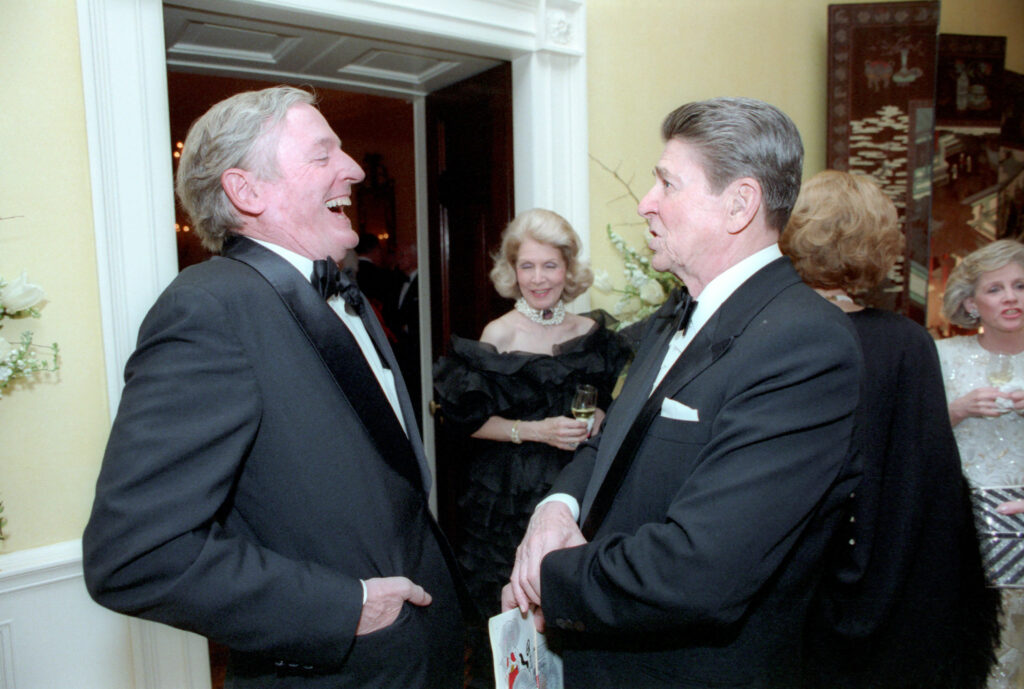
This project succeeded. The fact that Buckley could debate James Baldwin at Cambridge, joust with Gore Vidal on television, and hold court with both Reagan and liberal elites, speaks to his singular cultural resonance. The important point is not merely that he was charming, but that he built institutions, most notably National Review and *Firing Line,* that allowed conservative ideas to be propagated and defended with seriousness. It is here that Tanenhaus’s narrative becomes indispensable: by detailing Buckley’s methodical, almost missionary zeal in building a conservative intelligentsia, we see the origins of a movement that would, by century’s end, dominate American politics.
April 7, 1995. Chris Farley crashes a House Republican meeting as Newt Gingrich. pic.twitter.com/rVhgFTp3Qe
— History Defined (@historydefined) May 26, 2025
But if Buckley is the father of modern conservatism, what of his ideological heirs? Here, the temptation is to draw a straight line from Buckley to Reagan and stop. That is an incomplete story. The more revealing arc stretches from Buckley to Rush Limbaugh, to Newt Gingrich, and finally to Donald Trump. This is not a betrayal of Buckley, as some of his acolytes have charged. It is, rather, a transformation, the maturation of the intellectual seed he planted into a populist tree bearing very American fruit.
Limbaugh took Buckley’s elitist arguments and translated them into visceral rhetoric. Where Buckley sparred with the Left on the battleground of Oxford commas and Mont Pelerin principles, Limbaugh turned the microphone on the silent majority, mocking liberal sanctimony and bureaucratic bloat with theatrical bravado. As Tanenhaus’s biography indirectly affirms, this shift was not an abandonment of Buckley’s principles, but a recalibration. The target was the same: liberalism’s moral and institutional overreach. The medium had changed.
Then came Gingrich, who operationalized the ideas for legislative conquest. The “Contract with America” in 1994 was Buckleyan in content, cut taxes, shrink government, restore American values, but Limbaughite in style. Gingrich, like Buckley, understood the power of language and spectacle, but he weaponized it in the halls of Congress. Buckley might have written the script, but Gingrich turned it into political theater, and Limbaugh ensured the audience stayed riveted.
Which brings us to Trump. Critics often treat Trump as a deviation, a barbarian at the gates of Buckley’s cultivated citadel. But this misreads the genealogy. Buckley’s conservatism was never polite for politeness’s sake. It was confrontational, occasionally cruel, and unapologetically hierarchical. He denounced egalitarianism with almost theological fervor and believed the masses required leadership from a principled elite. Trump’s nationalism, rhetorical aggression, and disdain for political correctness are not Buckley’s opposites; they are his populist distillations. Indeed, Buckley’s quip about being governed by the Boston phonebook rather than the Harvard faculty anticipates Trump’s entire political ethos.
Tanenhaus wisely resists the lazy temptation to blame Buckley for Trump. What he does instead is more instructive: he shows how Buckley created a movement so intellectually powerful and culturally resonant that it could survive, adapt, and even thrive through transformations he might not have personally endorsed. A conservative movement that began in seminar rooms and salons ultimately found itself on Twitter and at mass rallies. The grammar changed. The argument remained.
Some conservatives, of course, lament this populist turn. They see in Trump an aesthetic affront to Buckley’s prose style and Ivy pedigree. But that critique mistakes style for substance. Buckley believed in American sovereignty, in the corruption of bureaucratic liberalism, in the importance of cultural cohesion and religious faith. Trump, in his Queens-accented vernacular, has not just echoed those beliefs but acted on them, often with a decisiveness that Buckley, who relished debate more than decision, might have admired.
This is not to deny real differences. Buckley believed in manners and aristocratic restraint. Trump does not. Buckley read Cicero; Trump rewrites cable news. But to the extent that conservatism is a defense of ordered liberty, of national identity, and of the moral limits of state power, the line connecting the two men remains bright and unbroken.
Tanenhaus’s biography earns its subtitle. Buckley did indeed change America. He changed it not merely by writing and debating, but by building institutions that trained generations of conservative thinkers, and by clearing the intellectual underbrush that once consigned the Right to the political margins. If Trump is the culmination of that revolution, then Buckley must be understood as its progenitor. A man of thought gave birth to a movement of action.
To read Buckley is to encounter a mind ablaze with curiosity, conviction, and contradiction. Tanenhaus gives us the full spectrum. For those who revere Buckley, the book is a reminder of the power of ideas and the legacy of a man who took on the world armed only with logic, wit, and a tireless moral compass. For those who wonder how the conservative movement arrived at its current populist phase, this biography offers not a postmortem but a preamble.
William F. Buckley Jr. was not merely the godfather of modern conservatism. He was its philosopher-king. The rest, from Rush to Newt to Donald, are his descendants. Tanenhaus has not just chronicled Buckley’s life. He has charted a genealogy.
If you enjoy my work, please consider subscribing: https://x.com/amuse.
Sponsored by the John Milton Freedom Foundation, a nonprofit dedicated to helping independent journalists overcome formidable challenges in today’s media landscape and bring crucial stories to you.
READ NEXT: Trump’s Sweeping Operation Aims To Eradicate Sanctuary Policies In Key Battleground

















I enjoy your work immensely, AMUSE – and share it with my friends and ‘enemeies’ as well!
PROCEED WITH VIGOR!
For US Victory Hooray