

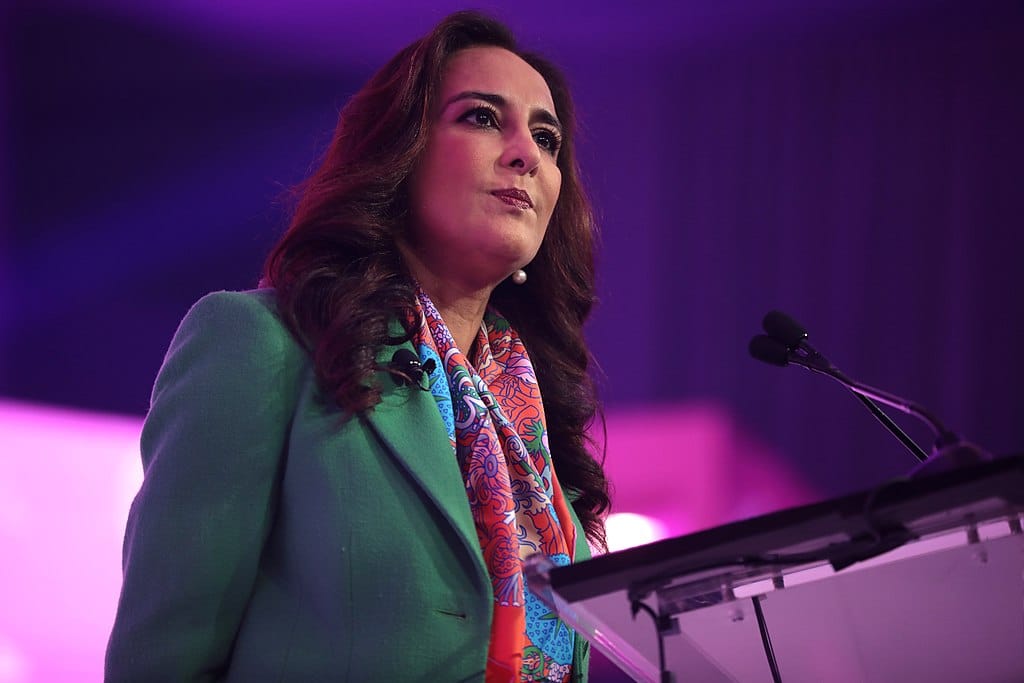
The U.S. Department of Justice has opened a formal investigation into George Mason University (GMU) to determine whether its employment practices unlawfully discriminate against white and male applicants, in potential violation of federal civil rights laws.
In a letter sent Thursday, Assistant Attorney General Harmeet Dhillon, who heads the DOJ’s Civil Rights Division, said the inquiry will examine whether the Virginia-based public university has violated Title VII of the Civil Rights Act of 1964, which prohibits employment discrimination based on race, sex, and other protected categories.
“It is unlawful and un-American to deny equal access to employment opportunities on the basis of race and sex,” Dhillon said. “When employers screen out qualified candidates from the hiring process, they not only erode trust in our public institutions — they violate the law, and the Justice Department will investigate accordingly.”
The investigation focuses on comments and policies promoted by GMU President Gregory Washington, particularly those emphasizing racial and gender considerations in faculty hiring, promotion, and tenure.
Emails Reveal Focus on Race and Gender
According to the DOJ’s letter, internal documents and emails suggest that George Mason University may have employed race-conscious criteria in hiring decisions, potentially giving preferential treatment to candidates based on race and sex in order to meet stated diversity goals.
One key piece of evidence cited by the DOJ is a July 23, 2020, email from President Washington, in which he expressed interest in redesigning the university’s promotion and tenure process to better support “faculty of color and women.”
In the same email, Washington advocated for “developing specific mechanisms” that would recognize the “invisible and uncredited emotional labor that people of color expend” in their academic roles.
The DOJ also highlighted practices where the university explicitly listed the race of participants on faculty hiring panels, allegedly to increase non-white representation during hiring deliberations.
Parallel Investigation by Department of Education
The DOJ probe comes just a week after the Department of Education opened a separate Title VII investigation into George Mason, prompted by complaints filed by a group of university professors. The complaints allege that GMU’s diversity-focused initiatives resulted in racial discrimination against white and male applicants in hiring, promotions, and tenure decisions.
In response to both investigations, GMU has denied any legal wrongdoing.
“George Mason has always operated with a commitment to equality under the law, ever since our inception,” said President Washington in a public statement. “Our diversity efforts are designed to expand opportunity and build inclusive excellence — not to exclude or advantage any group unlawfully.”
Legal and Political Implications
The federal investigation is part of a growing national debate over diversity, equity, and inclusion (DEI) policies in higher education and government institutions. Following the Supreme Court’s landmark 2023 decision striking down race-based affirmative action in college admissions, there has been increased scrutiny of whether similar policies in faculty hiring and promotions run afoul of civil rights laws.
Critics of DEI-driven hiring argue that such practices undermine equal opportunity protections by prioritizing demographic representation over merit. Proponents argue that systemic inequities require active measures to ensure inclusivity and “fairness” in academic and professional environments.
George Mason University is the latest in a series of institutions facing federal review over diversity policies. The outcome of this case could set an important precedent for how Title VII is interpreted and enforced in academia, particularly as universities across the country reassess DEI initiatives in the wake of legal and political pushback.
READ NEXT: Is Your Doctor’s MD In DEI?




















Oh, this is such poetic justice. I was once denied a position at U. of GA because I wasn’t a black female. That was before we were allowed to “identify” as whatever we chose.
“Fairness”, as many define it in a job or position/slot selection process, is the opposite of merit and capability based selection, it means that the less capable and the less intelligent must also be given a chance. The selection process must be based solely on merit and capability and if one can perform the job or task as needed without personal opinion, bias, or pre-conceived notions. It can not be based on ones sex, race, age, place of schooling, political affiliation, religion, or personal philosophy. The inclusion of sex, gender, and racial quotas in the selection process is tantamount to recognizing that some of the selectees will be less intelligent and less capable than others not selected or considered.