

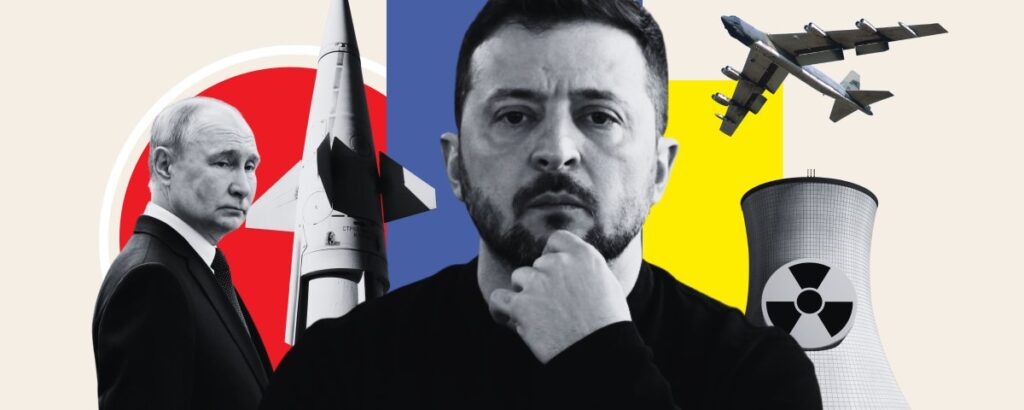
The story is compelling. In the wake of Russia’s invasions, Ukraine, stripped of nuclear arms, is portrayed as the tragic dupe in a post-Cold War morality play. President Volodymyr Zelensky leans heavily on this narrative. Ukraine, he insists, gave up the third-largest nuclear arsenal in the world in 1994, trusting solemn promises from the US, UK, and Russia. That trust, he says, was repaid with betrayal. His conclusion is blunt: those who brokered the deal should be jailed. This indictment is searing. But it is also incorrect.
Despite the emotional resonance of Zelensky’s claim, it distorts what actually happened. It rewrites history in service of a present crisis. And it misleads the West about its moral obligations. Ukraine did not, in any meaningful sense, “give up” a functional nuclear arsenal. It never had operational control over the weapons. The warheads were Soviet property, physically in Ukraine, but chained to Russian command systems. More than that, Ukraine had long since committed itself to denuclearization before independence. The 1994 Budapest Memorandum, often invoked as a security guarantee, was not a binding treaty, but a political pledge. If we are to act wisely today, we must begin with clear terms, not rhetorical fog.
Let us begin at the technical root. In 1991, Ukraine emerged from the Soviet collapse with around 1,700 strategic nuclear warheads on its soil. That number made headlines. It lent credence to the claim that Ukraine had overnight become a nuclear power. But a nuclear arsenal is more than warheads. It is the infrastructure to control, maintain, and deploy them. And Ukraine had none of these.
The warheads were fitted to missiles and bombers that remained tethered to Soviet systems. The launch codes, targeting systems, and permissive action links were all controlled by Moscow. Ukraine could not launch them. It could not maintain them. It could not replace them. Indeed, most of the warheads were aging, near the end of their operational lives. Vitaly Katayev, a Soviet defense official, documented the degraded condition of many of these arms. Even if Ukraine had seized the weapons, the ability to operate or sustain them was an illusion. The technological capacity to reverse-engineer or rewire these systems did not exist in Ukraine, a country then beset by political and economic chaos.
A useful analogy here is to imagine inheriting a fleet of exotic sports cars without keys, fuel, or a mechanic. Yes, you possess them. But drive them? Not without the entire support structure, which lay outside your control. This distinction, between possession and usability, is crucial. As the Nuclear Threat Initiative put it succinctly: Ukraine never possessed operational control. And without operational control, it never possessed an arsenal. It held onto the shells of Soviet power. Not the sword itself.
There is a further wrinkle: Ukraine had already renounced nuclear arms before the USSR fell. In July 1990, the Ukrainian parliament, still under Soviet control, declared its future state would not accept, produce, or acquire nuclear weapons. That was not a casual declaration. It was a foundational political act, written into the birth certificate of modern Ukraine. The association between nuclear arms and the Soviet military machine was not romantic. It was toxic. Chernobyl, after all, exploded in Ukrainian territory. To define independence in opposition to Soviet militarism was a natural move.
In subsequent years, Ukraine reinforced this position. The Lisbon Protocol of 1992 obligated Ukraine to join the Nuclear Non-Proliferation Treaty as a non-nuclear state. Ukraine signed willingly. The Minsk Agreement of 1991 placed all strategic arms under Russian command. This was not a trick. It was a policy, developed with Ukrainian participation. It is therefore strange to hear Zelensky speak of betrayal. Ukraine negotiated its non-nuclear status from the start. Its leaders, President Kravchuk among them, viewed nuclear weapons as more liability than asset. The idea that Ukraine was duped into disarmament is ahistorical.
Still, one might argue: Ukraine could have kept the weapons. Maybe they were old, and maybe they were hard to operate, but might not even the perception of deterrence have been useful? Perhaps. But such arguments always ignore what Ukraine gained in return. Disarmament was not altruism. It was a transaction. And it was skillfully negotiated.
The United States, alarmed by the prospect of multiple post-Soviet nuclear states, was eager to buy compliance. Under the Nunn-Lugar Cooperative Threat Reduction program, Ukraine received hundreds of millions of dollars in aid, technical support, and fuel supplies. Highly enriched uranium from dismantled warheads was converted into fuel for Ukrainian power plants. Russia committed to providing nuclear fuel assemblies. Ukraine got help, energy, and diplomatic legitimacy. All in all, a shrewd exchange.
And, of course, Ukraine received the Budapest Memorandum. The heart of Zelensky’s grievance lies here. He interprets the memorandum as a solemn guarantee of security. And so, when Russia invaded in 2014 and again in 2022, he sees betrayal not just by Russia, but by the US and UK.
But this is not what the memorandum promised. It is not a treaty. It was not ratified. It includes no mutual defense clause, no Article 5-style obligation. It merely reaffirmed existing international commitments: respect for sovereignty, territorial integrity, and abstention from the use of force. It also pledged consultation at the UN in the event of aggression.
All of this matters because Zelensky often implies, and many in the West echo, that the US pledged to defend Ukraine militarily. That is not true. The US promised to support Ukraine diplomatically. And it has done so. It has also gone beyond that pledge, providing tens of billions in military aid. What it never promised, and what it is right to resist, is direct military intervention. The difference is not semantic. It is constitutional.
There is a conservative principle here worth defending. Commitments must be precise. If a security pact is not made, it cannot be assumed retroactively. Treaties bind. Memoranda suggest. To blur that line is to risk war without consent. If Zelensky now wants a guarantee, he should ask for one. But the US has no moral or legal obligation to honor a fantasy.
It is worth pausing to consider what this rhetorical inflation enables. If we accept Zelensky’s framing, that Ukraine had real nukes and was promised real protection, then the US appears derelict. But if we reject it, as we should, then the US appears restrained and consistent. It helped Ukraine disarm, compensated it well, and provided exactly the level of support it promised. The betrayal lies not in Washington. It lies in Moscow.
That betrayal is real. Russia violated the Budapest Memorandum. But to equate Russia’s aggression with Western hypocrisy is to indulge in moral flattening. One party violated a pledge. The other honored a non-binding assurance to the letter. The difference is stark.
Still, some will argue that the West should have anticipated Russian revanchism, and that Ukraine should have kept the nukes. This is the North Korea lesson: keep your warheads, or end up invaded. But this is not an argument from history. It is an argument from fatalism. Ukraine, in the 1990s, wanted Western integration, not isolation. Holding onto Soviet weapons would have guaranteed sanctions, suspicion, and diplomatic limbo. No one in 1994 foresaw Putin’s 2022. And retroactive cynicism is not wisdom.
There is one final, more philosophical point to be made. Zelensky’s story, for all its pathos, enshrines a dangerous lesson: that international trust is foolish, that only nuclear weapons secure sovereignty. But this is precisely the message rogue states wish to hear. It is the opposite of non-proliferation. If Ukraine’s experience teaches the world that disarmament leads to betrayal, the natural conclusion is that no nation should ever disarm again. North Korea thanks him for the soundbite.
From a conservative standpoint, this is a catastrophic lesson. Conservatives value deterrence, yes, but they also value order. The non-proliferation regime, while imperfect, is one of the few global institutions that works. Undermining it through selective historical amnesia is reckless.
Ukraine has suffered grievously. It deserves support. But support must be grounded in truth. And the truth is that Ukraine never had a usable nuclear arsenal, never had operational control, and never had a US security guarantee. It chose denuclearization, negotiated compensation, and joined the community of nations. It did the right thing. That it was later attacked by Russia does not nullify that choice.
If anything, the lesson for US policy is not to shy from clarity. If we promise to defend a country, let us say so in a treaty. If we do not, let us be clear. Strategic ambiguity can be fatal. Precision is strength.
The nuclear disarmament of Ukraine was not a tragedy. It was a bargain. One that both sides honored, until Russia broke it. To now pretend that Ukraine was stripped of its defenses by Western connivance is to exchange facts for fables. That may serve wartime propaganda. It does not serve wisdom.
Sponsored by the John Milton Freedom Foundation, a nonprofit dedicated to helping independent journalists overcome formidable challenges in today’s media landscape and bring crucial stories to you.
READ NEXT: US-Ukraine Strike 50/50 Minerals Pact Aimed At Rebuilding Ukraine’s Economy















Why doesn’t anyone ever talk about the mansion–I heard it was worth over a million dollars–that Z. bought in Egypt since the war in Ukraine started??? How much other money has he siphoned from what the U.S. has given Ukraine???
There’s one problem with that article. Ukraine and Russia were in the midst of negotiating their disagreement according to the Budapest Memorandum, but NATO told Ukraine not to negotiate. Russia had every right to invade after negotiations broke down. As I understand it, Ukraine was in the midst of attacking the Donbas region that Russia opposed. The west, especially Joe Biden, wanted regime change in Russia and wanted to use the war to force that change. I thought Trump would have been able to resolve that issue, but not sure what is going on with Putin. Also, I understand that the democrats put a poison pill in some legislation that requires Trump to continue to support Ukraine or be impeached. If it were not for that poison pill, I think Trump would have said to Ukraine, go it alone. That would have ended the war very quickly.
This might be a story for after the Russians are driven back to Siberia and Putin has been dealt with. A story like this would be like criticizing France in WWII for letting Hitler walk all over them. Instead of using the effort to criticize Hitler, all the critiques go to the nasty nations that Hitler had to deal with. It’s time to wake up, give Ukraine some credit for not lying down and letting Putin grind them into the dust. They never asked for this, and neither did France, Poland, Czechoslovakia, and the rest of Europe with Hitler. Let’s maybe concentrate in the fact that Putin is a mental case, has already sacrificed 1 million Russians and killed far too many Ukrainians who wanted nothing more than to just go about their business free of Russia and the Soviet Union. We knew years ago that Putin had no good intentions for the future of Russia, so let’s concentrate on getting rid of him quickly before he decides he is ready to conquer the world. Without Ukraine standing up to Putin’s maniacal behavior, Russian forces would now be in Europe and contemplating a direct assault on the U.S.
The greatest responsibility lies with Ukrainian government, and oligarchs that robbed American taxpayers with no accountable plans on how they were going to win the war. So the average Ukrainian citizens paid with their money and lives. America taxpayers paid dearly with their taxes.
Thank you for this clarification. I knew from previous readings that the nuclear weapons in Ukraine’s possession were not able to be used by Ukraine but I did not know about the Treaties. Zelenski does not appear to be an honorable person. My opinion of our involvement in this conflict has been changing the more I learn. Your continuous excellence in your writings is greatly appreciated.