




There is a certain clarity that arrives when time runs out. The exclusive negotiation window for BlackRock’s acquisition of CK Hutchison’s port holdings, including the pivotal terminals flanking both entrances to the Panama Canal, closes on July 27. That date should be a coda, not a comma. For the sake of sovereignty, legality, and hemispheric stability, Panama ought to let the deal expire. What follows should not be a reheated arrangement with cosmetic adjustments, but a decisive break with the corrosive logic of outsourcing strategic infrastructure to multinational financiers and Chinese state champions.
The stakes are not abstract. At issue is control over the two bookends of the Panama Canal, arguably the most important maritime corridor in the Western Hemisphere. The terminals at Balboa and Cristóbal are not merely cargo depots. They are strategic choke points whose operators shape the flow of global trade, military logistics, and energy supplies. Any serious analyst understands that these nodes, like Gibraltar or Suez, are leverage points in the game of nations. Who runs them matters.
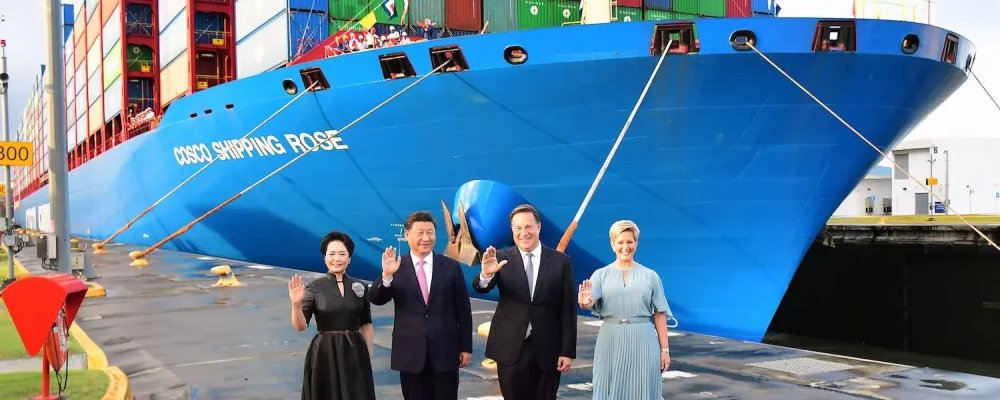
The story begins with the slow unraveling of Hutchison’s control over Panama Ports Company (PPC). While nominally a Hong Kong-based enterprise, Hutchison is in reality an appendage of the Chinese Communist Party. This is not paranoia but recognition of Chinese law, which mandates state cooperation from its corporate class. COSCO, China’s state-owned shipping conglomerate, has long enjoyed operational synergies with Hutchison. So when Panama, under US pressure, flirted with replacing Hutchison with an American-led bidder, the geopolitical game board lit up.
Enter BlackRock and MSC. On paper, their proposed acquisition of Hutchison’s port assets in 23 countries appeared to Western observers as a strategic victory. Replacing a Chinese-linked company with an American asset manager and a Swiss-Italian shipping line seemed like progress. President Trump praised it as reclaiming the canal from Beijing’s shadow. But the optics concealed a fundamental problem: the deal would not exclude China. In fact, it might ultimately entrench Beijing’s role through a backdoor equity arrangement.
We now know that China has demanded COSCO be added to the consortium. Not as a silent partner, but as a stakeholder with veto rights and operational influence. According to reporting from Reuters and Bloomberg, Chinese regulators have conditioned their approval of the broader Hutchison sale on COSCO’s participation. The leverage is both legal and commercial. COSCO is a major customer of these terminals, and its cooperation is critical to the operational viability of the ports.
This is not a free market maneuver. It is a coercive political intervention designed to secure de facto control for the Chinese state over the most sensitive infrastructure in Latin America. And it has worked. BlackRock and MSC have reportedly agreed to let COSCO in, once exclusivity lapses, as part of a reshaped deal. That means July 27 does not end the danger. It only ends the pretense.
But the real savior here may be legality. Panama’s Comptroller General and Attorney General have already declared the Hutchison concession, especially its 25-year extension in 2021, to be illegal and unconstitutional. The Comptroller has said the country forfeited over $1.3 billion in tax revenue. The AG declared the renewal an unlawful alienation of sovereign rights. A pending Supreme Court decision could nullify the original concession, making any transfer moot. If that happens, the entire transaction collapses.
That would be a blessing, not a tragedy. For once, bureaucratic inertia might serve liberty.
Some will object that such a collapse would disrupt trade or undermine investor confidence. This is myopic. Strategic infrastructure is not a sandbox for financial arbitrage. Ports are not tech startups to be flipped between asset managers. Panama has a choice: it can reclaim its sovereignty or allow itself to become the arena in which US and Chinese titans wrestle for control, with Panamanians relegated to spectators.
There are only two coherent alternatives to the BlackRock-COSCO scheme. One is nationalization: Panama could revoke the concession and operate the ports under a sovereign public entity. The Panama Canal Authority (ACP), already responsible for the canal’s operation, has expressed interest in building and operating its own terminal. Administrator Ricaurte Vásquez has warned that allowing one consortium to control both ends of the canal could violate its neutrality and erode competition. The ACP could move forward with the long-delayed Port of Corozal project, creating a state-run counterbalance to foreign-operated terminals.
The second option is geopolitical realignment. Panama could invite the US to resume a more active role in canal security, possibly through an operational lease or strategic partnership. The US once administered the canal under treaty. While full return is politically implausible, a shared governance model with the US, excluding Chinese participation entirely, could preserve neutrality while restoring strategic balance. Critics will bristle at the optics of neocolonialism. But one must ask: is a shared US-Panamanian framework more objectionable than creeping Chinese dominance?
The irony is that many in the US government believe they are countering China by backing the BlackRock-anchored deal. In reality, the deal is a Trojan horse. Once COSCO is inside, it gains insight, influence, and leverage. Even if it lacks majority control, its presence will chill policy decisions, deter US military logistics planning, and cement a perception that Panama is up for auction to the highest bidder. Worse still, BlackRock itself is already entangled with Chinese interests. A 2024 report by the Coalition for a Prosperous America found that BlackRock had facilitated investments in approximately 30 Chinese military-linked companies, including firms involved in nuclear weapons development and human rights abuses. A US House committee similarly reported that BlackRock had directed at least $1.9 billion into 63 Chinese firms blacklisted by the US government. Through broad market indices like MSCI China A Onshore, BlackRock holds stakes in dozens, if not hundreds, of Chinese companies. This is not passive exposure. It is structural alignment. Any notion that BlackRock could insulate canal governance from Chinese influence is not just naive, it is demonstrably false.
And that bidder, increasingly, is Beijing.
Panama should step back from the precipice. The expiration of BlackRock’s exclusivity should be treated not as an administrative event, but as a geopolitical fork in the road. The country should cancel the concession, reclaim its ports, and reassert its sovereign authority. The ACP should proceed with its own infrastructure projects. And if international partnerships are necessary, they should be forged with countries that respect sovereignty and transparency.
Letting this deal die is not an act of rejection. It is an act of self-respect.
If you enjoy my work, please consider subscribing https://x.com/amuse
Sponsored by the John Milton Freedom Foundation, a nonprofit dedicated to helping independent journalists overcome formidable challenges in today’s media landscape and bring crucial stories to you.
READ NEXT: Trump Doubles Down On Panama Canal
A ticking time-bomb set by Joe Biden and Kamala Harris to Hurt ElectionsThey Must Be Stopped! |










The CZ should have never been passed over to anyone. And it should be taken back NOW. There would not be a country of Panama if not for the United States. And there definitely would be no Canal. This deal spoken of above should not be allowed to happen. Number 1, it is another violation of the Monroe Doctrine. Number 2, it lays a way to strangle the US by a country that hates the United States. Anyone other than Panama and the United States should be excluded.