

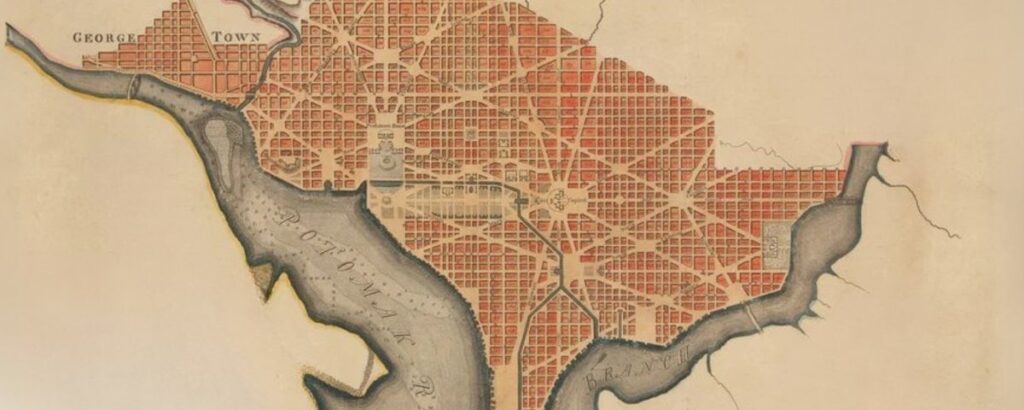
Washington, DC, is a constitutional orphan. Neither a state nor a true territory, it occupies a peculiar limbo: home to over 700,000 citizens who pay federal taxes, serve in the military, and sit on juries, yet lack full voting representation in Congress. The Left has long pounced on this grievance as a tool for permanent power consolidation, pushing statehood for the District not out of some newfound affection for equality, but to carve out two more reliable Democratic votes in the Senate. Their plan is as brazen as it is predictable. The antidote is not statehood. It is retrocession: the act of returning most of the District to Maryland, leaving a constitutionally defined federal enclave intact. If Republicans fail to act, the window may close forever.
To grasp the urgency, consider the political landscape. President Trump has been re-elected and, for now, enjoys a unified government. But power is fleeting. The Democrats have made clear their intent: should they retake Congress and the presidency, DC statehood will top their agenda. Retrocession offers a narrow, legal, and principled escape hatch. It is not a tactic to suppress representation. Quite the opposite. It restores it, while simultaneously preserving the federal balance and blocking an aggressive power grab.
Let us begin with representation. The argument that DC residents deserve full voting rights is not without merit. Eleanor Holmes Norton, the District’s long-serving non-voting delegate, has made this case for decades, and many prominent Democrats have echoed it. The District’s Black population, its civil rights history, and its tax burden make the cry of “taxation without representation” land with emotional and rhetorical force. Even figures like John Quincy Adams once acknowledged the inconsistency of disenfranchising DC residents.
But the leap from representation to statehood is neither necessary nor constitutional. The Constitution envisions a separate seat of government, immune from the control of any state. James Madison, writing in Federalist 43, warned that placing the national capital within a state would create undue influence and threaten federal independence. But Madison did not envision a sprawling metropolis. He imagined a limited enclave, centered around the machinery of federal governance. Retrocession would realize that vision precisely. It would return residential neighborhoods and business districts to Maryland, while leaving the Capitol, White House, Supreme Court, and a few vital agencies under exclusive federal control.
Some argue retrocession is impractical. But history says otherwise. In 1846, Congress returned the portion of DC south of the Potomac to Virginia. That action required no constitutional amendment. It was passed by Congress and approved by the people of Alexandria through referendum. The precedent is clear. Congress has plenary power over the federal district and may alter its boundaries by ordinary legislation. This is not speculation. It is settled law.
Opponents often raise the 23rd Amendment, which grants the District three electoral votes. What happens to those electors after retrocession? The answer is straightforward: with no permanent residents in the shrunken district, those votes become meaningless. Congress could repeal the amendment, but even if it remained on the books, its language refers to residents of the District, not land or buildings. If no one lives there, no votes are cast. This is a red herring masquerading as a constitutional crisis.
And then there is the question of governance. DC’s local government has been a case study in dysfunction. High crime rates, staggering educational failure, and bureaucratic waste have plagued the city for decades. The Washington Post may run interference, but the evidence is in plain view. By reintegrating DC into Maryland’s broader governance structure, residents would gain access to established state institutions, a larger tax base, and political accountability. The benefits are obvious.
Critics will say Maryland might object. But why should it? The state would gain over 700,000 new citizens, fresh tax revenue, and increased representation in Congress. The courts have long held that states may consent to changes in their borders. If Maryland agrees, and Congress legislates accordingly, there is no constitutional barrier. Moreover, polling suggests that many Maryland residents would accept such a plan, especially when contrasted with the specter of DC statehood and the permanent distortion of federal representation it entails.
The real obstacle is political inertia. Republicans have grown accustomed to defensive crouches. We lament the radicalism of the Left but rarely deploy our majorities with boldness or foresight. Retrocession is the type of decisive action that defines eras. It is what a party does when it intends not merely to hold office, but to govern.
Statehood, by contrast, is an open invitation to institutional collapse. If Democrats can fabricate two new senators by converting a town into a state, what stops Texas from exercising its right under the 1845 Joint Resolution of Annexation to divide itself into as many as five states, potentially adding eight new Republican senators to the chamber? This is not idle speculation. The provision remains valid federal law. If Democrats push forward with statehood for DC and Puerto Rico, Texas would be well within its legal and constitutional authority to respond in kind. The founders created a federal union, not a patchwork of weaponized territories. Retrocession preserves the structure while correcting a long-overdue oversight.
Indeed, nothing about retrocession is radical. It is a constitutional solution, with historical precedent, legal clarity, and practical benefits. It grants DC residents representation, improves local governance, and preserves the neutrality of the federal government. More importantly, it prevents a permanent shift in the Senate’s balance of power. And it can be done now, without court battles or constitutional amendments. All it requires is the political will to act.
President Trump and Congress must act before the 2030 census, before the next wave of progressive dominance, before the Left cements another irreversible advantage. This is not merely about DC. It is about the survival of a federal system designed to protect liberty by diffusing power. Letting the capital become a stronghold of one party forever is not merely bad politics. It is dangerous constitutional malpractice.
If Republicans are serious about structural reform, about preserving the Constitution, and about preventing a future in which conservatives are permanently locked out of power, then shrinking DC is not optional. It is essential.
If you enjoy my work, please consider subscribing https://x.com/amuse.
Sponsored by the John Milton Freedom Foundation, a nonprofit dedicated to helping independent journalists overcome formidable challenges in today’s media landscape and bring crucial stories to you.
READ NEXT: Trump Mulling Federal Takeover Of DC To Tackle Crime
A ticking time-bomb set by Joe Biden and Kamala Harris to Hurt ElectionsThey Must Be Stopped! |




















This sounds like what we need. Just buildings housing government agencies should be the Seat of Government. This would include Supreme Court, White House, Senate,, House of Representative, and any buildings housing government agencies. Residential, shopping, recreation and other personal properties should be annexed to they states they were taken from.
Washington. D.C.(District of Columbia). its core purpose versus the political purpose insinuated by the leftist/democrats must be reconciled. They are only interested in one thing, stealing all of the votes they can and maintaining a political majority thay permits them to rule, not serve the American people. They are dangerous, disingenuous, surreptitious people that misinform and lie to the people.
Downsize City Govt alone
Automate services
CUT staffings or reuse where needed
The Constitution addresses Washington, D.C., primarily through two clauses. Article I, Section 8, Clause 17 grants Congress the authority to establish a federal district as the seat of government, not exceeding ten square miles, separate from the states. This clause formed the legal basis for creating the District of Columbia as a federal enclave under direct congressional control.
Additionally, the 23rd Amendment, ratified in 1961, allows residents of Washington, D.C., to participate in presidential elections by granting the district three electoral votes. This amendment was designed to provide D.C. residents with a voice in the election of the president and vice president, although it does not confer full representation in Congress.
Statehood belongs to the States as mentioned in the Constitution. If residents want to be a part of a State, they can always move to one. DC is a separate and distinct entity in the Constitution. There are no merits to granting DC representation. There could be a possibility of the surrounding States absorbing those residential neighborhoods, and shrinking DC down to government buildings.
The only thing the Gutless Old Party is interested is zionism and getting paid.
Good thing Netanyahu isn’t like Jim Jones or most of the party would be drinking Kool Aid. Actually he is like Jones, but needs Americans to die for Khazaria/Israhell
I wonder how much they are making per dead Palestinian, especially Christian Palestinian….Or Jordanian, or Iranian?
WWIII and those punks will still be sucking their thumbs and checking their bank accounts