

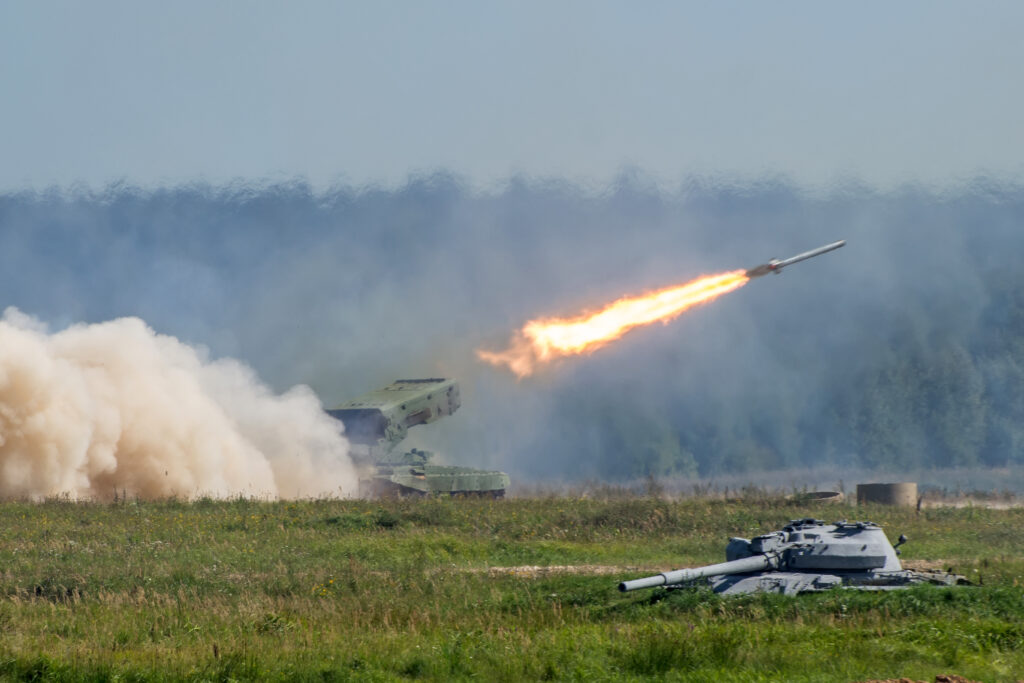
In my new occasional series on lesser-known global flashpoints that could spark major war, we have Kaliningrad, the strategic Russian enclave on the Baltic Sea left inside NATO’s vulnerable eastern flank after the fall of the USSR.
It is essentially a Russian fortress behind NATO lines.
As the most militarized area in Europe it could be one place that would spark WWIII. This was just highlighted as General Christopher Donahue, commander of U.S. Army Europe and Africa recently claimed that NATO could destroy Kaliningrad in record time, causing Russia to make its own counter claims and threats.
The Kremlin quickly warned that any attack on Kaliningrad would be seen as an attack on the Russian mainland, prompting a full response, including nuclear weapons. This means that as NATO ramps up its presence in Ukraine, any misstep in Kaliningrad could trigger a crisis of catastrophic proportions.
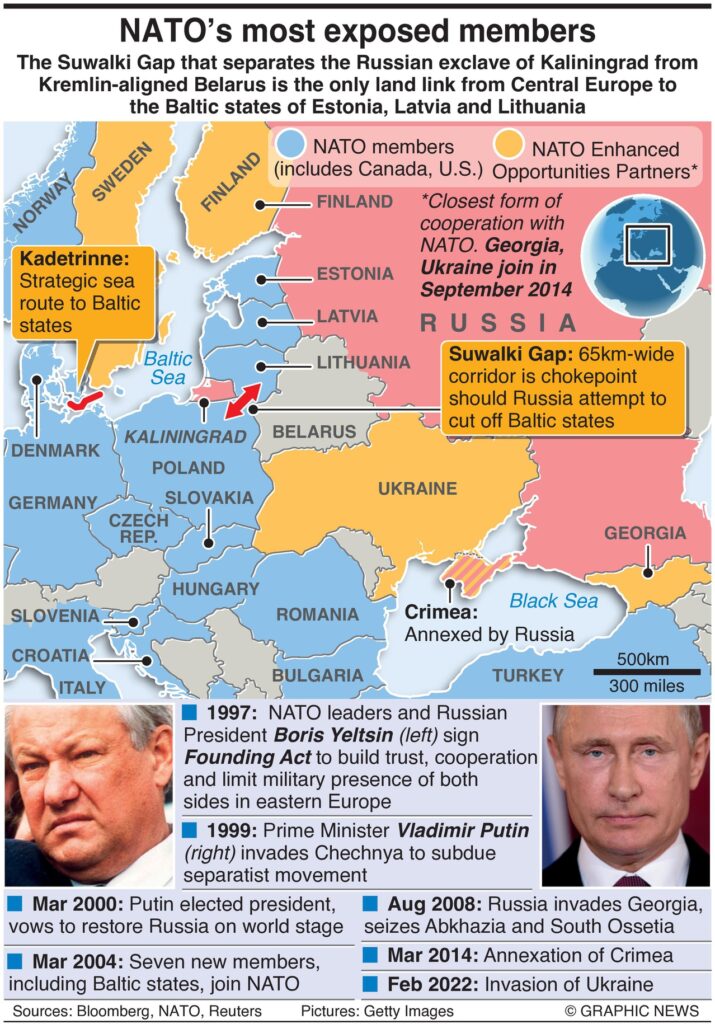
The small enclave is only 47 miles wide but with almost one million residents. Lying between Lithuania to the north and east and Poland to the south, Kaliningrad is essentially cut off from Russia with no overland connection.
However, only a narrow 40-mile space known as the Suwalki Gap separates the Russian enclave and Russia’s vassal state Belarus.
The distance to the Russian border is about 225 miles.
In the event of a war between NATO and Russia, Russian and Belarusian forces linking up across the Suwalki Gap would cut off the only land route to all three Baltic States from the rest of NATO.
Since the launch of Russia’s full-scale invasion of Ukraine, a steady stream of Western officials has issued increasingly stark statements on the likelihood of a direct military confrontation between Russia and NATO.
Last month, NATO Secretary General Mark Rutte warned that Russia could be ready to launch an attack against the alliance within five years, and a recent German intelligence assessment said Moscow may seek to start a lower-intensity confrontation that will test the U.S.’s willingness to fulfill its obligations under Article 5.
Most vulnerable and exposed NATO members are the three Baltic nations of Lithuania, Estonia and Latvia. All on the Baltic coast and directly bordering on and exposed to Russian and Belarussian forces.
They are the most likely to be attacked.
This could include hybrid warfare such as jamming GPS signals.
But it could also be more direct.
“There’s a reason why the Russians have been training to take the Suwalki Gap for a long time,” Dr. Stephen Hall, lecturer in Russian and post-Soviet politics at the University of Bath, told the Kyiv Independent.
“I’m fairly certain that if the Russians were to attack the Baltic states, one of the first places to be bombed by NATO — if it isn’t Moscow or St. Petersburg — would be Kaliningrad,” Hall added.
Adding to tensions, the enclave was renamed Królewiec by Poland, the Polish translation of Königsberg, which was the traditional Prussian-German name of the region prior to WWII, after Russia’s invasion of Ukraine, sparking fury from Moscow.
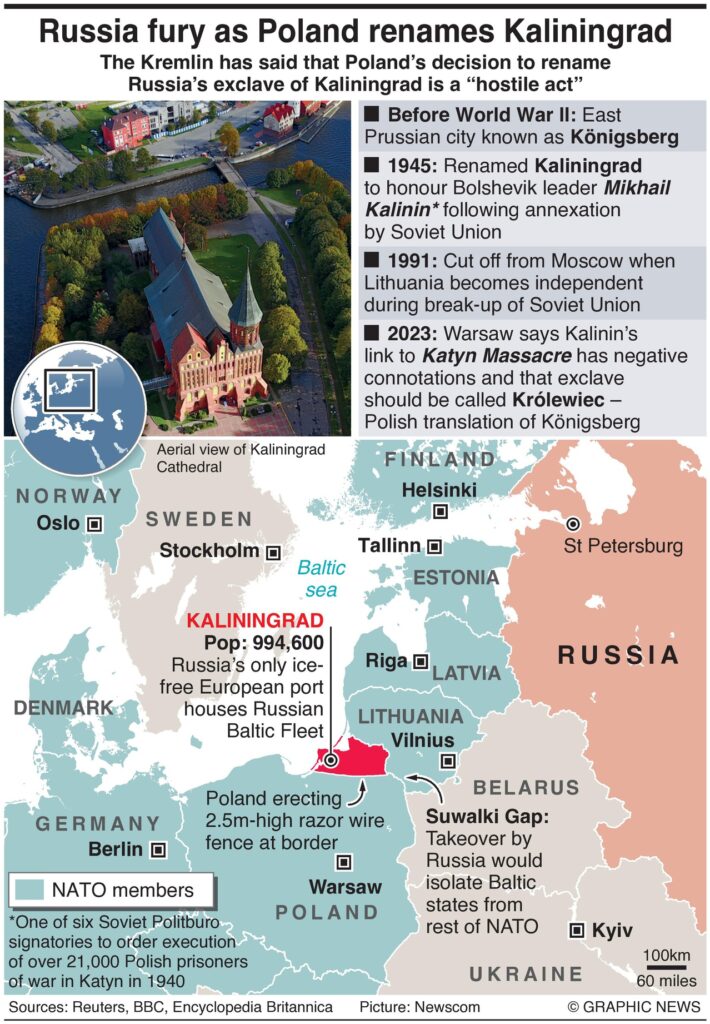
Poland has also begun to fortify its border with the exclave following Russia’s invasion of Ukraine and remains concerned about Russian artillery and missile attacks emanating from the Kaliningrad oblast against NATO nations. Poland recently moved a U.S.-made HIMARS rocket battery near the Kaliningrad border.
Lithuania still refers to the Kaliningrad oblast as the “biggest threat in the region.”
The enclave is the Kremlin’s isolated but heavily fortified home to the Russian Baltic Fleet at the port of Baltiysk, one of Russia’s only ice-free European ports. It has advanced air defenses, and mobile nuclear-capable Iskander-M missiles that can reach much of Europe.
As the war in Ukraine has shown, these missiles can wreak havoc. Apart from Patriots, no other defense system can defend against them.
Meanwhile, the Russian Air Force, based in the region, has two airfields about 60 combat aircraft and 40 helicopters. These include Su-24 attack aircraft, Su-30 multi-role aircraft and Su-27 fighters, complemented by Mi-24 attack helicopters, Mi-8 multi-role helicopters and Ka-27 and Ka-29 naval anti-submarine and multi-role helicopters
On August 18, 2022, the sending of three MiG-31K aircraft equipped with Kindzhal hypersonic missiles to Königsberg was met with great fanfare. These missiles can travel at speeds 8-10 times faster than hypersonic speeds, reaching 8-10 times the speed of sound.
Called a fortress or Russia’s unsinkable aircraft carrier, it is also used for surveillance and intelligence operations against NATO. Besides its land-based Iksander missiles on Kaliningrad, Russia’s small fleet of corvettes based there carry medium range Kalibre-NK missiles.
But the Baltic Sea fleet can easily be augmented by Russia naval forces from elsewhere.
As WorldCrunch notes:
“Having four fleets around the entire territory — the Baltic, Northern, Black Sea and Pacific — the Russians have the ability to make quick transfers,” explains Tomasz Witkiewicz from the Maritime Operations Center. “The connections between the Black Sea, Baltic and White Sea allow for fairly free redeployment of units. And larger ships can be redeployed even before the outbreak of conflict.”
On the ground, the Russian Army maintains a significant military presence. When Russia invaded Ukraine in 2022, Russian ground forces numbered about 11,000 soldiers, including the 18th Mechanized Division, which has two mechanized regiments, a tank regiment, an artillery regiment in the city and an independent reconnaissance battalion.
However, as the war has progressed, many of these troops have been moved to fight in Ukraine, lowering their end strength.
The bigger conventional threats are air, naval, and missiles.
Still, despite the impressive ground, air, naval, and missiles forces arrayed in the enclave, Russia’s nukes in Kaliningrad are the biggest concern. Russia’s use of nuclear weapons in defense of Kaliningrad may impede any major Western efforts against Russia’s Kaliningrad oblast.
WorldCrunch notes:
“In the early 1990s, as part of subsequent disarmament agreements between the United States and the Soviet Union, the Russians declared that they had withdrawn tactical nuclear weapons from Kaliningrad,” says [Andrzej] Wilk, [at the Eastern Studies Centre.]
“Despite full transparency and openness to international inspections, we are unable to confirm this. And since 2008, there have been constant signals that nuclear weapons are still there. I believe that they have never withdrawn them.”
Polish Foreign Minister Radoslaw Sikorski said in June 2024 that up to 100 tactical nuclear warheads might be stored at a suspected nuclear weapons storage site in the exclave.
The question now remains, is Kaliningrad a dangerous, impregnable fortress or a vulnerable “Russian Alamo”? Let’s hope we don’t need to find out.
The opinions expressed in this article are those of the author and do not necessarily reflect the positions of American Liberty News.
READ NEXT: CNN Mocked For Wildly Inaccurate Reporting On Manhattan Shooter
A ticking time-bomb set by Joe Biden and Kamala Harris to Hurt ElectionsThey Must Be Stopped! |
















Last time I looked BOTH Sweden and Finland were NATO members. Your maps need to be updated
Mendelev is a talking head for Putin. He makes statements on the edge, which Putin can deny or approve depending on the response. Always the nuclear threat! Putin realizes that if he were to initiate a nuclear war, that Russia would lose as well as the West, and probably more so. So what needs to happen is for Putin to understand the reality of what his mouthpiece is saying…
To the clown 3L120 insinuating Russia initiating nuclear war –
1) it’s against their nuclear doctrine and
2) Russia has no need to initiate nuclear war.
Russia is taking it easy in Ukraine while achieving its goals of demilitarizing Ukraine and kicking the US and its NATO vassals out of Ukraine.
While minimizing its losses, Russia has killed over 2 MILLION VSU, plus other western vermin who have stuck their snouts where they don’t belong.
Here’s a list of very knowledgeable commentators (only Andrei is an expert) on the Russian military and the SMO, in alphabetical order, except for Andrei Martyanov, who is #1 (by their fruit ye shall know them):
Andrei Martyanov (#1)
Alastair Crooke
Alex Christoforou
Brian Berletic
Col Daniel Davis
Col Douglas MacGregor
Col Jacques Baud
Col Larry Wilkerson
Dmitri Orlov
Gerard Celente
Jeffrey Sachs
Larry Johnson
Michael Hudson
Pepe Escobar
Scott Ritter