






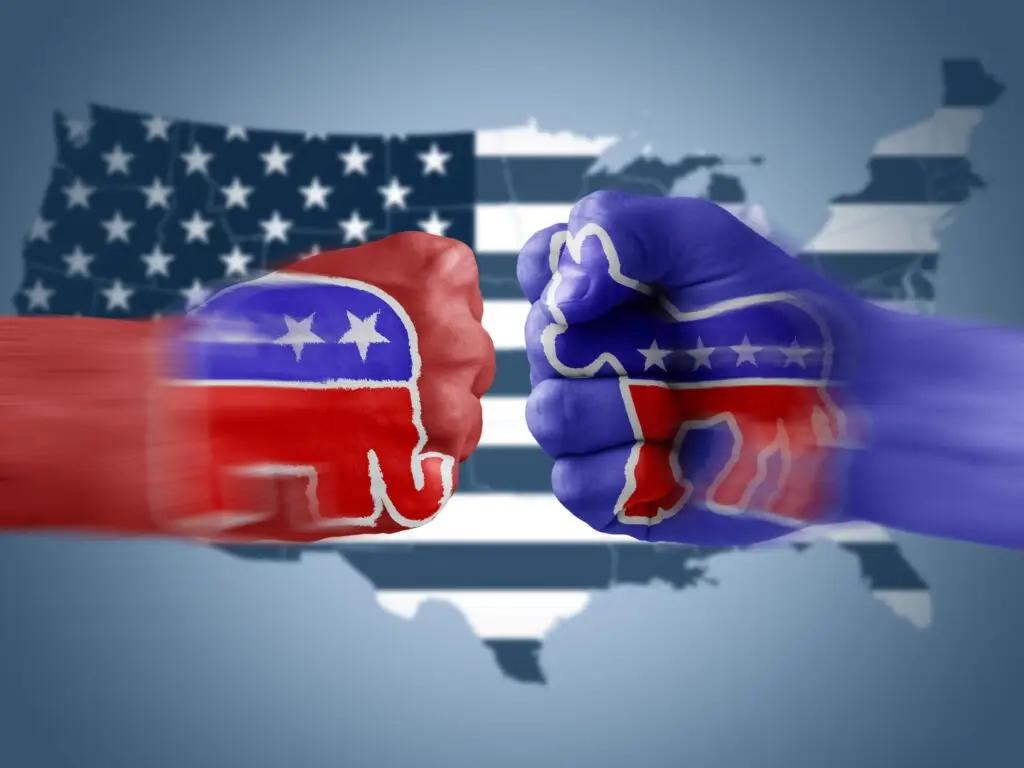
The latest Gallup poll on Americans party identification reveals an interesting split. While the Democrat Party’s favorability has hit a new rock bottom, they have surged ahead of Republicans in party identification.
“Americans’ party affiliation has flipped back toward the Democratic Party after the Republican Party held advantages for most of 2023 and 2024. However, these changes in party preference are occurring at a time when the Democratic Party’s image is at an all-time low and slightly worse than that of the Republican Party,” Gallup reports in a statement releasing the latest poll.
“In the second quarter of 2025, an average of 46% of U.S. adults identified as Democrats or said they are independents who lean toward the Democratic Party, while 43% identified as Republicans or said they lean Republican,” Gallup reports.
“That three-percentage-point Democratic advantage compares with a tie between the two parties in the first quarter of 2025, after a four-point Republican lead in the fourth quarter of 2024. Until now, the Republican Party had led or tied in most quarters since 2023,” Gallup notes.
That would make sense to most people if most viewed Democrats favorably.
But Americans’ views on the Democrat Party have sunk to new lows.
“(T)he Democratic Party’s 34% favorable rating is the lowest Gallup has measured for the group in its trend dating back to 1992. The prior low was 36% in November 2014, after the party lost its majority in the U.S. Senate in that year’s midterm election, which gave the Republican Party control of both houses of Congress at the time,” Gallup notes.
Gallup notes the change follows a historic trend, in which the party out of power sees a rise in party identification, since voters blame the party in power for any dissatisfaction, and notes it also happened under Obama and Clinton.
Gallup writes:
The latest party shifts appear to reflect less of a change in how the parties are viewed overall or perceived in terms of competence, and more of a typical reaction to one party controlling the presidency and both houses of Congress.
Each of the last six new presidents took office with their party also having majorities in both houses of Congress. Those clear lines of political accountability made the ruling party vulnerable in the first midterm election if Americans were unhappy with the president’s performance. All first-term presidents since 1994, with the exception of George W. Bush in 2002 after the 9/11 terrorist attacks, had job approval ratings below 50% at the time of the midterm election. The incumbent presidents subsequently saw their party lose one (2010, 2018 and 2022) or both (1994) houses of Congress in the first midterm election of their presidency.
Those midterm losses were preceded by shifts in party affiliation away from the ruling party during the president’s first year in office. The president’s party saw declines in the percentage identifying with it or leaning toward it in 1993, 2009, 2017 and 2021. The rally in support for Bush and the government after 9/11 helped Republicans make gains in party affiliation in 2001, although that year was also an exception because Republicans had lost their Senate majority in May of that year after Sen. Jim Jeffords changed his party affiliation and caucused with the Democrats.
The opinions expressed in this article are those of the author and do not necessarily reflect the positions of American Liberty News.
READ NEXT: DOE Report Upends Climate Alarmism: CO2 Not The Villain We Were Told
























Democrats and Independents still see the Republican Party as ruled by the RINOs and for good reason.
We need to primary every RINO or force them to retire.
They are “self serving” Globalist Establishment Elites that put America last.
I do not donate to the Republican Party but to individual “America First” candidates.
Polls, polls! Corrupt democrat polls!