

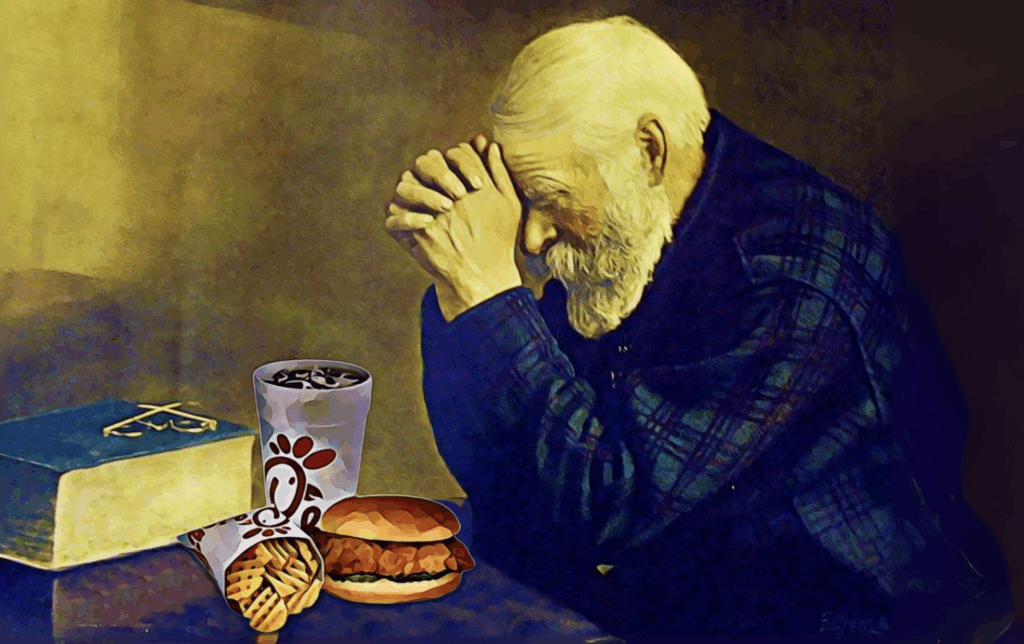
The creation of the Chick-fil-A sandwich was not a corporate brainstorm or the product of market research. It was, fittingly, an accident. More precisely, it was an economic oddity, a surplus of poultry breasts too large to fit into Delta Airlines’ narrow airline trays, and a man named Truett Cathy who saw potential where others saw waste. In that small moment of Southern pragmatism, a revolution was born. Not the bloody kind, but the culinary kind that would ripple outward from a modest diner in Hapeville, Georgia, to alter the course of American fast food.
Let us be clear from the outset: Chick-fil-A did not invent the concept of placing meat between bread. Nor did it invent fried chicken. But to say it merely “made a sandwich” is like saying Edison merely lit a bulb. What Cathy did was to redefine what a fast-food sandwich could be. In the early 1960s, America was a hamburger nation. Chicken, despite its deep Southern roots, was for Sunday dinners and home kitchens. Fried chicken was slow, greasy, and temperamental, hardly the stuff of quick service. Cathy changed all that, not through grand theory, but through trial, error, and a touch of maternal memory.
In 1946, Samuel Truett Cathy and his brother Ben opened the Dwarf Grill, later renamed the Dwarf House, serving up the kind of honest fare you would expect from a post-war Southern diner. For fifteen years, it was largely a steak and burger establishment. Then in 1961, an opportunity presented itself. Goode Brothers Poultry, a local supplier in Atlanta, had a problem. Delta Airlines needed small, boneless chicken breasts for its in-flight meals. The supplier had ended up with an abundance of large breast filets that couldn’t be used. They offered them to Cathy.
He accepted.
What followed was months of tinkering. Cathy drew on his mother’s method of pan-frying chicken under a cast-iron lid to keep the meat moist. But he didn’t have time for cast iron. He had customers. The breakthrough came with a commercial pressure fryer, a device known as the Henny Penny, which allowed him to cook a juicy, golden filet in just four minutes. This was speed on par with the hamburger, but with a very different payoff. Cathy seasoned, breaded, and pressure-fried the oversized breast, then served it on a buttered bun with two dill pickles. It was simple. It was sublime.
The diner regulars loved it. So much so that, after one final test version, a customer declared, “We like it. Don’t change it again.”
He didn’t.
In 1964, the sandwich was officially added to the Dwarf House menu. Cathy trademarked the name “Chick-fil-A,” a stylized play on “chicken filet” with the “A” standing for grade-A quality. He began licensing the sandwich to other establishments, Waffle House among them, before launching the first stand-alone Chick-fil-A restaurant in 1967. To this day, the original sandwich is made the same way: a pressure-fried boneless breast, peanut oil, pickles, and no pretense.
It would be easy to treat this story as corporate mythology, the kind of retroactive heroism companies like to indulge. But the record is clear. Truett Cathy was not looking to become a fast-food pioneer. He was solving a practical problem. The fact that his solution birthed a genre, a category now cluttered with competitors like Popeyes, Wendy’s, and McDonald’s, only underscores the originality of the act.
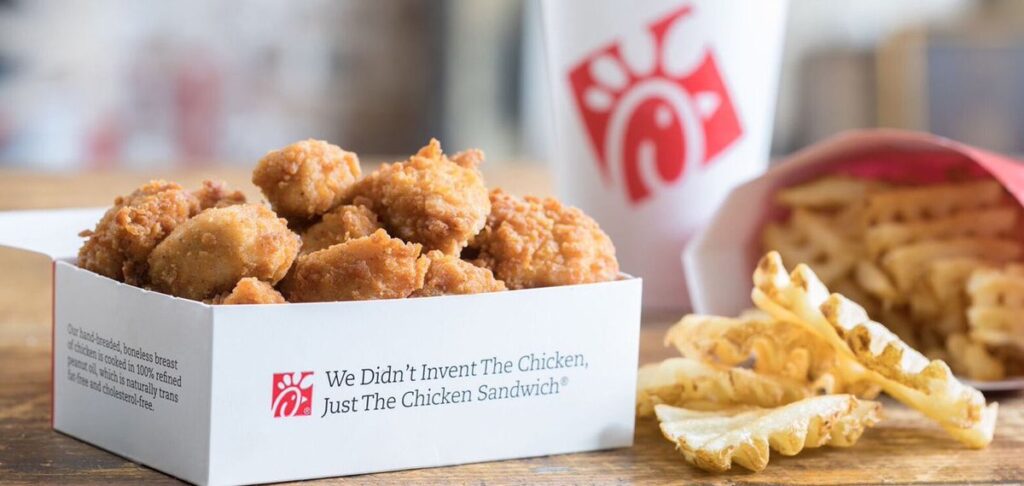
By the 1980s, Cathy had expanded the menu to include bite-sized chicken nuggets, again, not as a boardroom innovation, but in response to customer behavior. Parents were cutting up sandwiches into small chunks for their children. Cathy saw this, and formalized it. The nuggets debuted in 1982 and became an instant hit. They were real chicken, hand-breaded and pressure-cooked, not the processed slurry peddled elsewhere. By the mid-80s, Chick-fil-A nuggets were ubiquitous in Southern mall food courts, their popularity dovetailing with a national surge in nugget consumption led by McDonald’s.
The next menu revolution came in the form of fries. But not just any fries. Waffle Potato Fries, first introduced in 1985, were a deliberate departure from the straight-cut monotony of McDonald’s or Burger King. They were crisp, hearty, and well-suited for dipping. More importantly, they were different. Chick-fil-A has always traded in distinction, not flash, not gimmicks, but substantive difference. The waffle fries, paired with the brand’s now-iconic sauces, became more than a side dish. They became a statement.
What then are we to make of this sandwich? It was born of waste, perfected through ingenuity, and launched a food empire. But its deeper legacy lies in what it displaced. In the mid-20th century, fast food was synonymous with beef. The hamburger was king. Chicken was, at best, a novelty. Cathy’s invention challenged that hegemony. He proved that chicken could be fast, flavorful, and crave-worthy. More than that, he demonstrated that quality and efficiency need not be enemies.
And here, the story acquires a philosophical hue. Efficiency is often cast as the foe of excellence. In government, in education, in cuisine, we are told that speed erodes quality. Truett Cathy’s sandwich is a quiet rebuttal to that dogma. He showed that with the right method, pressure-frying, peanut oil, simplicity, one could achieve both. It was not just a business success. It was a metaphysical point.
Moreover, Chick-fil-A’s sandwich emerged not from the top-down logic of technocracy, but from the bottom-up intuition of experience. Cathy did not study data sets. He studied his customers. He responded to their appetites, their habits, their quirks. It was a form of local knowledge, Burkean in its respect for tradition, Hayekian in its responsiveness to signals. The result was not just a product but a paradigm shift.
Even the company’s slogan, “We Didn’t Invent the Chicken, Just the Chicken Sandwich”, reveals a certain conservative modesty. It is not the boast of a monopolist, but the wink of an innovator who knows that improvement often comes not through invention ex nihilo, but through refinement of what already exists.
Critics have tried to undermine the brand for its traditional values or its founder’s social conservatism. But the product has endured. In fact, it has flourished. In the 2019 so-called “chicken sandwich wars,” competitors unleashed flashy new offerings. Yet, Chick-fil-A, still closed on Sundays, still without gimmicks, maintained dominance. Its strength is not in marketing budget or menu sprawl. Its strength is in the sandwich.
The story of the Chick-fil-A sandwich is not merely about food. It is about how small decisions, grounded in practical reasoning and local knowledge, can reverberate across decades. It is about how restraint, simplicity, and fidelity to quality can triumph over complexity and novelty. And it is about how even in an industry obsessed with speed, it is the patient craftsman, not the frantic imitator, who endures.
If you enjoy my work, please consider subscribing: https://x.com/amuse.
Sponsored by the John Milton Freedom Foundation, a nonprofit dedicated to helping independent journalists overcome formidable challenges in today’s media landscape and bring crucial stories to you.
READ NEXT: Blue City’s New ‘Inclusive’ Scheme — What They’re Not Telling You
Sponsored
Liberals accused an American corporation and Sydney Sweeney of being Facists when they stood up to the woke mob. The left is spiraling out of control. Donate to fight back against the woke cancel culture mob TODAY!
















Enjoyed the history and moral tale on the founder of Chick-A-Fil. I have enjoyed . I also liked the story on how Charlie Kirk got started. Please keep up your good work.
And Chik-fil-A has a corporate culture unlike other fast food outlets. They hire smarter people.