







The war in Ukraine has reached a point where the battlefield no longer promises decisive victory for either side. Russia holds vast swaths of Ukrainian territory in the east and south. Ukraine, though resilient, cannot reclaim all of it without exhausting itself militarily and economically. Western support remains substantial, but not infinite. Recent polling underscores this strategic impasse: Gallup released a survey on August 6, 2025, based on interviews conducted from July 1–14, 2025, showing that only 24% of Ukrainians now support continuing to fight Russia until total victory is achieved, while 69% favor seeking a negotiated settlement as soon as possible. This marks a near-complete reversal from 2022, when 73% favored fighting until victory and just 22% supported negotiations. In this context, President Trump could propose a peace deal that neither Vladimir Putin nor Volodymyr Zelensky would like, but both could ultimately accept. The deal would recognize certain battlefield realities while returning significant territory to Ukraine, providing security guarantees, and restoring political and economic stability to the region.
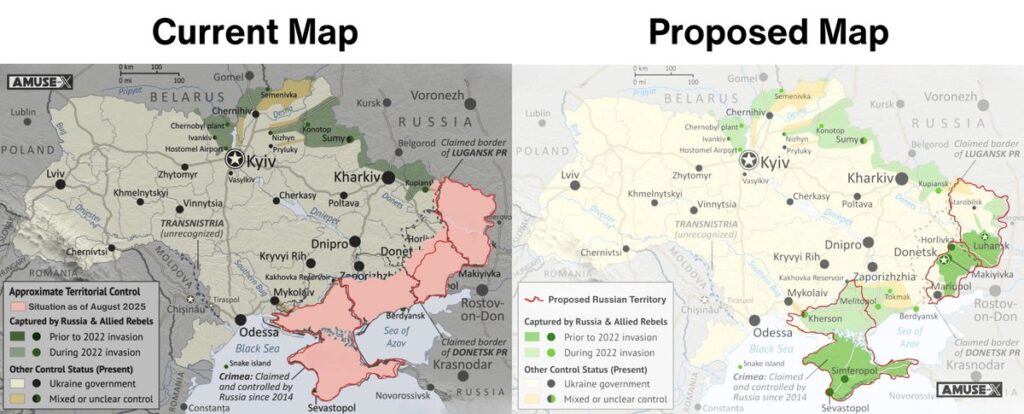
The proposed map would return roughly 25 percent of Donetsk to Ukraine, effectively restoring the pre-2022 lines in that oblast. Russia and its allied rebels controlled much of the region for years prior to the 2022 invasion, but this arrangement would give Ukraine back meaningful land and population. Russia would retain 100 percent of Luhansk, a significant gain compared to its pre-2022 position when it controlled only about 30 percent of the oblast. In Zaporizhzhia, Russia would relinquish all territory, restoring Ukraine’s pre-war control. Crimea would expand north to Kherson and the Kakhovka Reservoir, doubling Russia’s territory there and solidifying its hold on the peninsula.
The logic behind this map is straightforward: return the northern Ukraine-Russia border to pre-2022 lines, restore Ukrainian control where possible, and acknowledge Russia’s control where it is most entrenched. This structure ends the long-disputed conflicts in the Donbas by giving both sides clear, internationally recognized boundaries. The Donetsk and Luhansk disputes have simmered for over a decade, with roots stretching back to regional autonomy debates in the 1990s and intensifying after 2014. By 2010, Ukraine had effectively stopped treating these occupied regions as fully integrated. They participated in the 2010 presidential election, but by 2014, only 20 percent of the disputed territory could vote. In 2019, when Zelensky won the presidency, these areas were entirely excluded from the vote.
Trump’s proposal would differ sharply from Putin’s current offer. Putin has proposed a ceasefire in exchange for sweeping territorial concessions, permanent neutrality for Ukraine, recognition of Russian annexations, lifting of sanctions, security guarantees for Russian-speaking populations, and ideological restrictions such as banning so-called nationalist propaganda. This is a maximalist set of demands. Instead, Trump could counter with a package that includes permanent neutrality, but with Ukraine free to seek EU membership. Borders would be recognized by both sides according to the new map. Sanctions would be lifted, but with firm security guarantees from the EU for Ukraine and protections for both Ukrainian-speaking and Russian-speaking populations. Ukraine would maintain its right to arm itself, particularly with American weapons.
Under this plan, Ukraine would also recognize Russian as an official language but would reject ideological constraints. Russia’s symbolic legislative pledge not to attack Ukraine or Europe could be accepted, but the security weight would come from binding EU guarantees. The suspicion that Putin’s offer is a ploy to pause fighting and sidestep sanctions is well-founded, yet this should not deter a genuine effort to achieve lasting peace.
Reparations would be negotiated, but instead of direct payments to Ukraine, a portion would go to the US and EU to partially repay their wartime support. Those funds could then be reinvested into rebuilding Ukraine’s infrastructure and economy. Ukraine, for its part, would commit to holding elections, restoring opposition parties, ensuring the restoration of churches and release of incarcerated priests, returning free speech and press freedoms, and releasing all political prisoners. Both sides would agree to an immediate exchange of all prisoners of war.
On security, Russia would demilitarize the territories it retains from Ukraine, except for military installations in Crimea. Paramilitary groups in the Donbas would be disbanded, and the area would be fully demilitarized. If conflicts arose, UN peacekeepers could be deployed to maintain order.
For Russia, the deal includes a full lifting of sanctions, restored diplomatic recognition, and the return of seized Russian property, contingent on the release of all US, UK, and EU citizens in Russian prisons.
The legal roadblock for Zelensky is formidable. Article 73 of Ukraine’s Constitution requires that any alteration of territory be decided by a national referendum. This process demands two parliamentary approvals, one by a simple majority, another by a two-thirds supermajority in the next regular session, followed by a Constitutional Court review. In wartime, securing such consensus is politically perilous. Parliamentarians risk their careers by supporting territorial concessions, and the military and nationalist factions would likely resist. Nonetheless, a leader’s role is to navigate the possible, and the proposed deal offers a realistic framework for ending a costly war.
If Trump were to champion such a plan, he could position the US as the broker of a hard but fair peace. This would not be a victory parade for either side, but a structured end to a conflict that has drained lives, resources, and geopolitical stability for too long.
If you enjoy my work, please consider subscribing: https://x.com/amuse.
Sponsored by the John Milton Freedom Foundation, a nonprofit dedicated to helping independent journalists overcome formidable challenges in today’s media landscape and bring crucial stories to you.
READ NEXT: Jets Fired Up Following Daring Strike Alarmingly Close To US Interests




















NO!!! Putin deserves No territory expansion. He’s our current version of Hitler into Czechoslovakia. He deserves to be slapped down. Hard.
I guess justice is not a war aim? The proposed borders are indefensible long-term, just as surrender of the Sudetenland left Czechoslovakia indefensible.