

AD Muse: Life, Ministry, and Legacy of a 20th-Century American Preacher
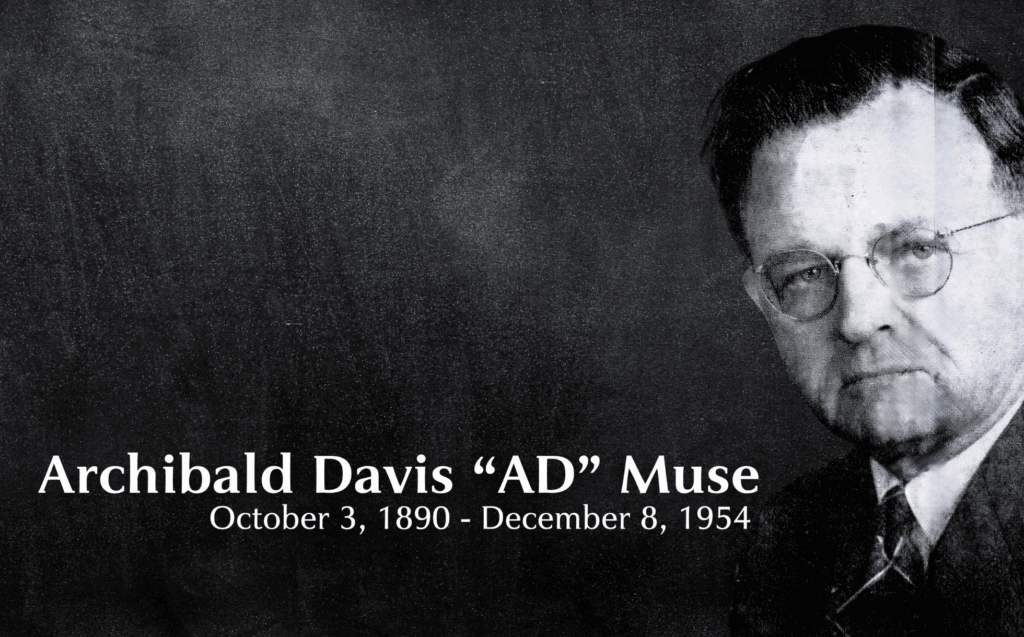
When tracing the lines of one’s own spiritual journey, the path often bends toward ancestry. In reflecting on my own faith, I find myself drawn to the life of my great grandfather, Archibald Davis “AD” Muse, born October 3, 1890, in Simpson County, Mississippi. His story is not just a record of personal devotion but a window into the transformation of American Christianity in the early twentieth century. Muse lived during an era that saw rural revivalism mature into urban radio evangelism, and his ministry embodied that shift. His forty years of preaching illustrate the adaptability of the gospel message across new mediums and changing times.
AD Muse was born into the rural soil of Mississippi, a farm boy who would become a preacher of the Word. By the 1910s he had begun his public ministry, taking to the open road as a revival evangelist across the American South. His sermons were marked by clarity and conviction, traits that soon earned him a reputation as a “noted Bible scholar.” In 1928 he conducted a cooperative tent meeting in Madisonville, Texas, where he preached on the deity of Christ and the second coming. These meetings were not isolated spectacles but intentional collaborations between Baptist and Methodist congregations, demonstrating both his ecumenical reach and his practical bent. Muse was a man who could hold a crowd with doctrine while also bridging divides between communities.
By 1929 Muse had entered the settled life of pastoral ministry. He first pastored the First Baptist Church of Claremore, Oklahoma, and a few years later accepted the call to First Baptist Church of Pauls Valley. His time as a pastor coincided with the Great Depression, and yet he persevered in service. Newspaper records from the era attest to his regular duties, from conducting funerals to organizing local revivals. It is telling that even in these difficult years his reputation expanded beyond his pastorates. By the mid-1930s Muse had moved into an itinerant ministry based in Memphis, Tennessee, where he was often identified simply as “Evangelist AD Muse” or “Dr. AD Muse”. His memorial tribute to T.T. Martin in the Western Recorder in 1939 shows his connection to leading figures in the fundamentalist movement.
The most enduring chapter of his ministry began in Louisville, Kentucky, where he established Hearts Harbor Tabernacle at 11th and Market Streets. For the last twenty years of his life, Louisville became his home base and the stage for his greatest influence. It was here that Muse embraced a new frontier in ministry: radio. Broadcasting daily on station WGRC, he carried his preaching into homes across the Ohio Valley. This daily radio ministry was revolutionary in its time, democratizing access to preaching well before the age of the internet or even television. Through radio, Muse’s sermons reached people who might never step inside a church. His voice was a companion to thousands, a daily reminder of biblical truth in an increasingly fast-paced world.

At Hearts Harbor Tabernacle, Muse hosted Bible conferences that brought together emerging leaders in the Sovereign Grace movement. His November 1954 conference drew younger preachers like Henry Mahan, along with Rolfe Barnard, B.B. Caldwell, George Fletcher, and Clarence Walker, men who would carry forward the doctrinal emphases he had championed. Muse fell ill during that very conference and died shortly thereafter, on December 8, 1954. He was laid to rest in Louisville’s Cave Hill Cemetery, closing a life devoted to proclaiming the sovereignty of God and the sufficiency of Christ.
Muse was more than a preacher of sermons; he was a publisher and writer. Through his periodical The Harvester, he distributed doctrinal articles, sermon booklets, and Bible studies. For an annual subscription of a dollar, readers received teaching that was designed to stir not just emotions but serious study. He also authored or edited books, including a biography of T.T. Martin and a pamphlet defending biblical inerrancy against higher criticism. His printed works reveal a man committed to the intellectual defense of faith, a thinker as much as a preacher.
Theologically, Muse’s ministry charted a trajectory from fundamentalist revivalism to Calvinistic conviction. Early in his career he preached on prophecy and the deity of Christ, wielding painted charts to illustrate the wilderness tabernacle. By the 1940s he had aligned with the resurgence of Reformed theology among Baptists. His role at the 1954 Sovereign Grace Bible Conference in Ashland, Kentucky, alongside Rolfe Barnard and Clarence Walker, placed him at the heart of this doctrinal rediscovery. He was no mere local pastor but a participant in a movement that reshaped mid-century Baptist life.
Muse’s denominational identity was flexible. He pastored Southern Baptist churches in Oklahoma and contributed to Baptist newspapers, but he never confined himself to denominational boundaries. His Louisville tabernacle was independent, and his evangelistic efforts often involved cooperation with Methodists and Baptists alike. This independence gave him freedom to pursue the message he believed most vital, regardless of institutional pressures. It also ensured that his influence crossed denominational lines, touching audiences more concerned with truth than labels.
His legacy is preserved in archives and recordings. The Southern Baptist Theological Seminary holds copies of his publications, including his biography of T.T. Martin. The National Archives and Smithsonian retain recordings of his sermons, allowing future generations to hear his voice. Digital repositories circulate his messages, including his sermon “Stewards of the Grace of God” on 1 Peter 4:10. These enduring artifacts testify to the reach of a man who preached both with his voice and his pen.
To understand A.D. Muse is to understand the American evangelical transition from the brush arbor to the broadcast studio. He exemplified the preacher who could adapt without compromise, who carried the old truths into new formats. His ministry reminds us that faith is not bound by geography or technology but can flourish wherever conviction meets opportunity. In reflecting on my own spiritual path, I see in him a model of seriousness, adaptability, and perseverance. He was a man of his times and yet also a man who looked beyond them, urging his listeners to lift their eyes to eternal things.
If you enjoy my work, please consider subscribing: https://x.com/amuse.
Sponsored by the John Milton Freedom Foundation, a nonprofit dedicated to helping independent journalists overcome formidable challenges in today’s media landscape and bring crucial stories to you.
READ NEXT: Kavanaugh Plot Case: New Court Docs Reveal Stunning Detail



















AMuse, that is amazing and wonderful to read about your Great Grandfather. Thank you for the insight into your Family history